Economic Pulse Net | Sources: World Bank World Development Indicators, Government Sources | 2026
🇮🇳 India 2025 — The Giant’s Quiet Acceleration: How Macro Resilience Meets Micro Realities
Key Takeaways
- India’s economy is expanding at a robust 7.57% rate, significantly outpacing global averages, while keeping inflation remarkably low at approximately 2.4%.
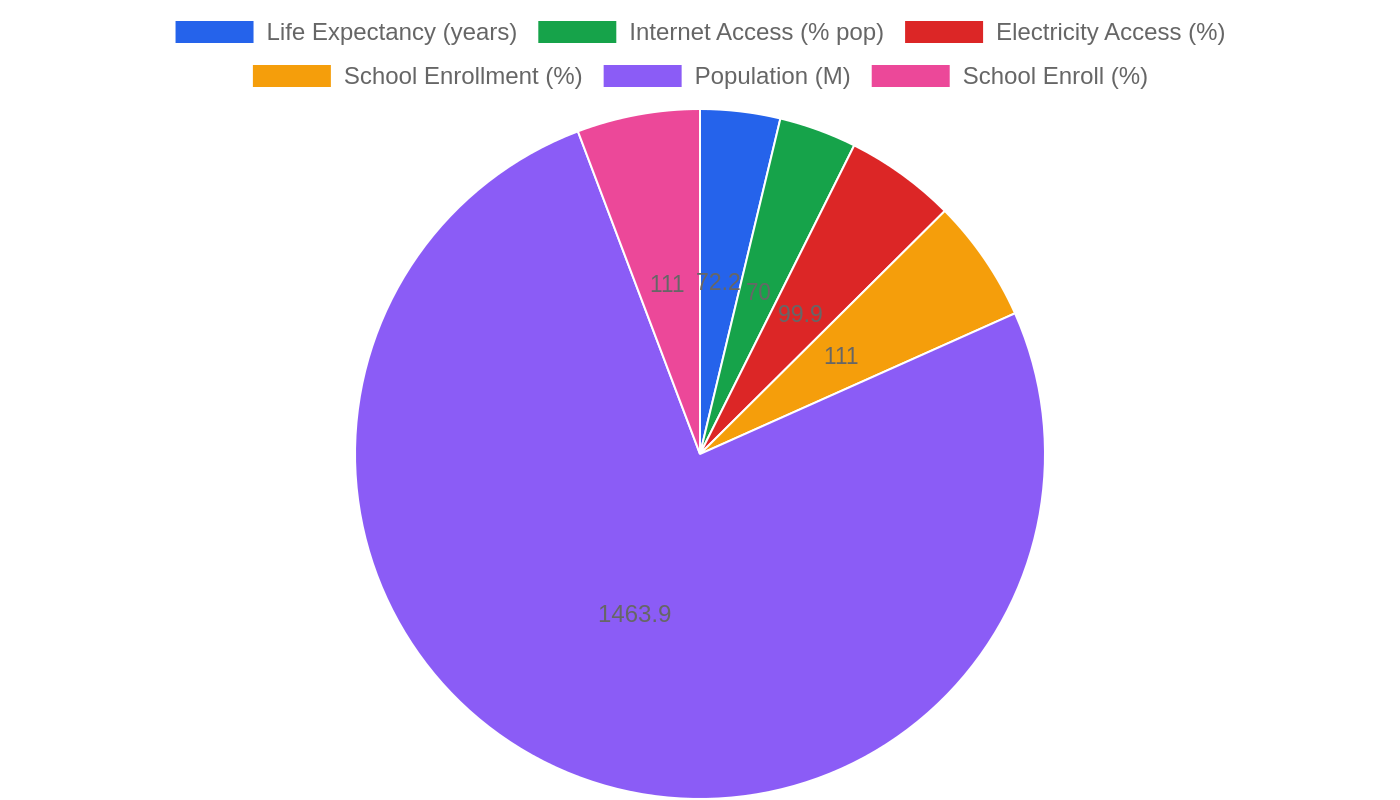
- With a GDP nearing $3.96 trillion and a population of over 1.46 billion, India stands as one of the world’s largest economic engines, though the gap between nominal and purchasing power parity figures highlights significant structural cost differences.
- The business landscape is dominated by a mix of massive conglomerates like the Adani Group and specialized industrial players such as ACC and ABG Shipyard, indicating a diversified industrial base.
- Political stability is maintained through a complex multi-party parliamentary system, with the Bharatiya Janata Party (BJP) and the Indian National Congress serving as the primary ideological anchors in a landscape of over 50 regional parties.
- Current market chatter, as seen in recent financial headlines, points toward a period of regulatory tightening in the food and beverage sector and broader global crypto market corrections affecting local sentiment.
The Engine Room: A Macro Picture of Steady Power
The fundamental health of the Indian economy, as reported by the World Bank, presents a picture of high growth coupled with exceptional price stability.
With a GDP growth rate of 7.56666179284244% for 2025, India is not merely participating in the global economic recovery; it is leading it.
This growth is particularly impressive when viewed alongside an inflation rate (CPI) of just **2.39884954182294%**, a figure that suggests the central bank and government are successfully managing the delicate balance between stimulating activity and preventing currency devaluation.
The total GDP stands at approximately **$3.956 trillion**, a massive figure that cements India’s status as a top-tier global economy.
However, the per capita metrics tell a more nuanced story.
While GDP per capita at purchasing power parity (PPP) is **$11,747.92**, the Gross National Income (GNI) per capita is significantly lower at **$2,760**.
This disparity highlights the purchasing power advantage of the domestic market but also underscores that average incomes remain modest compared to developed nations.
Unemployment sits at a manageable **4.219%**, indicating that the economy is creating jobs, albeit with the caveat that the sheer scale of the **1.46 billion** population means even low unemployment rates translate to millions of individuals in the labor market.
This combination of high growth, low inflation, and moderate unemployment creates a fertile ground for both domestic consumption and foreign investment, positioning India as a key driver of global economic output in the coming years.
The Cost of Living: Navigating the Price Gap
Understanding the cost of living in India requires distinguishing between nominal wealth and actual purchasing power.
With a GNI per capita of $2,760, the average Indian household operates within a budget that is far tighter than what the higher PPP figure of **$11,747.92** might suggest to an outside observer.
This significant gap indicates that while goods and services are cheaper in local currency terms, the standard of living and disposable income for the average citizen are constrained relative to their global peers.
For potential expatriates or investors, this means that daily expenses, housing, and local services are generally affordable when converted from major international currencies, offering a high quality of life for a fraction of the cost found in Western capitals.
However, without specific data on housing rents or detailed cost-of-living indices provided in the current dataset, it is difficult to make precise comparisons to regional averages.
What remains clear is that the economic structure supports a large consumer base where price sensitivity is high, and value-for-money is the primary driver of purchasing decisions.
The affordability of basic necessities allows for a larger share of income to be saved or invested, which fuels the domestic financial markets and real estate sectors, even as the broader economy grows.
Investment Landscape: Conglomerates and Industrial Giants
The Indian business environment is characterized by a powerful mix of diversified conglomerates and specialized industrial firms, creating a resilient investment landscape.
According to recent company listings, major players include the Adani Group, a conglomerate with interests spanning energy, infrastructure, and retail, and **ACC**, a major force in the industrials sector.
The presence of companies like **Aban Offshore** in energy and **ABG Shipyard** in industrials suggests a strong foundation in heavy manufacturing and resource extraction, sectors that are critical for long-term economic development.
In the technology and services space, firms such as **63 Moons Technologies** and **Acko General Insurance** indicate a vibrant fintech and insurance ecosystem that is modernizing the financial services sector.
The **Action Group** and **ABP Group** further illustrate the diversity of the corporate sector, ranging from construction equipment to consumer services.
For investors, this diversity offers multiple entry points into the Indian market, from stable industrial cash flows to high-growth technology and insurance plays.
The business climate appears supportive of large-scale industrial projects, as evidenced by the prominence of major industrial firms in the top companies list, suggesting that government policy continues to prioritize infrastructure and manufacturing as pillars of economic growth.
Political Stability and Social Safety
India operates as a parliamentary republic with a multi-party system, a structure that has historically provided a buffer against political shocks despite the complexity of its coalition dynamics.
The political landscape is dominated by the Indian National Congress, which is often viewed as the ideological center, and the **Bharatiya Janata Party (BJP)**, which occupies the right-wing to far-right spectrum.
With over 50 recognized regional parties in addition to the six national parties, the political scene is highly fragmented, requiring coalition-building and consensus-seeking that can slow legislative processes but also ensures broad-based representation.
While specific crime and safety indices are not currently available in the provided data, the political framework suggests a state apparatus capable of maintaining order across a diverse and populous nation.
The stability of the multi-party system is crucial for investors, as it reduces the risk of sudden policy reversals that can occur in less structured political environments.
The presence of established parties with deep historical roots, such as the Congress, provides a counterweight to the BJP, ensuring that political discourse remains competitive and that policy outcomes are often tempered by the need for national consensus.
This political maturity is a key asset for long-term economic planning and infrastructure development.
Market Pulse: Regulatory Tightening and Global Spillovers
Recent news from financial outlets like Economic Times and **LiveMint** highlights a shifting regulatory environment, particularly in the food and beverage (F&B) sector.
A notable trend is the emphasis on compliance over growth in F&B boardrooms, driven by a crackdown on food safety, which signals that regulators are prioritizing consumer protection and quality standards over rapid expansion.
This shift may impact smaller players who lack the resources to meet stringent safety standards, potentially leading to consolidation in the sector.
Simultaneously, global market forces are influencing local sentiment; recent reports indicate that Bitcoin fell below **$78,000** following comments by Fed Chair Warsh at Jackson Hole, causing a correction in the crypto market.
While India is not the source of this global monetary policy, the volatility in digital assets affects local investors and the broader fintech ecosystem, where companies like **Acko General Insurance** are increasingly active.
The **Economic Times** and **LiveMint** both highlight “Market Snapshot” and “Trending in Markets” features, suggesting that retail and institutional investors are closely monitoring these shifts.
The interplay between domestic regulatory tightening and global financial volatility creates a complex but dynamic environment where companies must navigate both local compliance hurdles and international market swings.
The Bottom Line
India presents a compelling case for long-term engagement, combining high growth, low inflation, and a stable, albeit complex, political framework.
For investors, the key is to balance the opportunity in high-growth sectors like technology and insurance with the stability of industrial giants like ACC and **Aban Offshore**.
The regulatory focus on safety and compliance in sectors like F&B suggests a maturing market that prioritizes quality and sustainability.
While the per capita income remains modest, the sheer scale of the population and the strong GDP growth rate create a vast and expanding consumer market.
Watch closely for how the multi-party political system navigates upcoming policy decisions, as the balance between the BJP and Congress will shape the economic trajectory.
Sources & Methodology
This article is authored by Economic Pulse Net for informational and research purposes.
Economic Pulse Net sources its data from multilateral institutions, national statistics bureaus, and proprietary databases.
All data is believed to be current as of the date of publication. Published: September 04, 2026 |
Category: Research — India
Use these signals in your own platform
Economic Pulse publishes its live signal feed through a documented, read-only API. Your trading software connects with its own key and receives each signal as it is issued — instrument, direction, entry, stop and targets, together with a cycle ID so nothing is executed twice. The feed is independent of this website and cannot change it.
Signals are informational only and are not financial advice.