Economic Pulse Net | Sources: World Bank World Development Indicators, Government Sources | 2026
Key Takeaways
– China’s economy grew at 4.96% in 2025, according to World Bank data, a solid but unspectacular pace that reflects the country’s transition from breakneck expansion to more mature, quality-focused growth.
– Inflation is virtually nonexistent at 0.06%, a striking figure that signals weak consumer demand and potential deflationary pressures beneath the surface of the world’s second-largest economy.
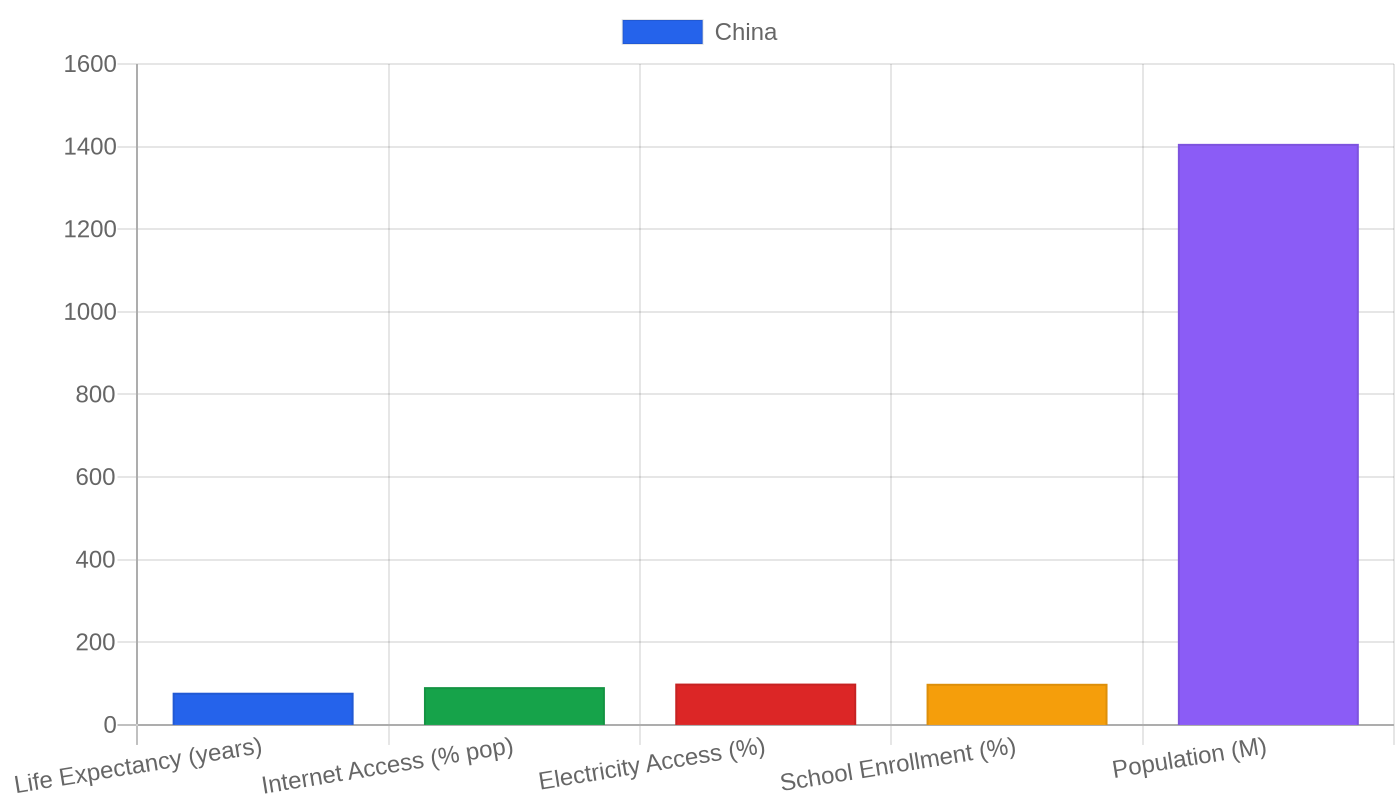
– The country’s GDP now stands at approximately $19.5 trillion, with a population of roughly 1.4 billion people, placing per capita GDP at around $14,230 in nominal terms.
– China’s economic engine remains heavily concentrated in consumer goods, technology, and financial services, with major players like Alibaba Group and the Agricultural Bank of China dominating the corporate landscape.
– Recent market volatility in the technology sector, particularly among chipmakers, highlights the ongoing tensions between domestic innovation drives and external pressures on China’s tech ambitions.
The Growth Paradox: Solid Numbers, Soft Underbelly
The headline figure of 4.96% GDP growth in 2025, as reported by the World Bank, would be the envy of most developed economies. But for China, a country that routinely posted double-digit growth rates in previous decades, this number tells a more nuanced story. The economy is no longer firing on all cylinders; instead, it is running a measured, controlled marathon rather than a sprint.
The most striking data point is inflation. At 0.06%, consumer prices are essentially flat. In economic terms, this is dangerously close to deflation territory. For context, most central banks target inflation rates of around 2% to encourage spending and investment. China’s near-zero inflation suggests that consumers are cautious, saving rather than spending, and that businesses are struggling to pass on costs to wary buyers.
This is not necessarily a crisis — some economists argue that modest inflation gives policymakers room to stimulate — but it does reflect a domestic demand picture that remains subdued.
The GDP per capita figure of approximately $29,333 in purchasing power parity terms, according to World Bank data, places China firmly in the upper-middle-income bracket. Yet the gap between urban coastal prosperity and rural inland poverty remains a defining feature of the Chinese economic landscape. The GNI per capita of $14,230 tells a similar story: China is no longer poor, but it is not yet rich by Western European or North American standards.
What drives this economy? According to the World Bank data provided, the dominant listed companies span consumer goods, financials, technology, industrials, and basic materials. This is a broadly diversified economy, but the consumer goods sector — represented by companies like Anta Sports, 361 Degrees, and Anker — is particularly significant. These firms are betting on the rise of Chinese consumer spending, yet the inflation data suggests that this bet is not yet paying off as handsomely as hoped.
The Cost of Living Conundrum: Stability at a Price
For the average Chinese citizen, the cost of living story is one of remarkable stability mixed with regional disparity. With inflation at just 0.06%, the prices of everyday goods — from food staples to clothing — have remained largely unchanged over the past year. In nominal terms, this is a double-edged sword. On one hand, wage earners are not seeing their purchasing power eroded.
On the other hand, the lack of price growth often correlates with weak wage growth, meaning that the real economic experience for many families is one of stagnation rather than improvement.
Housing remains the single largest expense for most urban Chinese households. While specific rental and purchase price data is not available in the World Bank figures, the broader economic context suggests that property prices in major cities like Beijing, Shanghai, and Shenzhen remain elevated relative to average incomes.
The Chinese government has repeatedly stated its commitment to the principle that “housing is for living, not for speculation,” and recent policy shifts have aimed to cool the property market. However, for young professionals in tier-one cities, homeownership remains a distant dream, pushing many toward the rental market or toward smaller, less central cities where costs are more manageable.
Compared to regional neighbors, China’s cost of living is moderate. It is cheaper than Japan or South Korea, but more expensive than Vietnam or Indonesia. The key differentiator is the vast internal variation: a factory worker in inland Henan province lives on a fraction of what a tech professional in Shenzhen requires. This internal disparity is one of the defining features of the Chinese economic experience.

The Investment Arena: Giants and Disruptors
For investors, China presents a landscape of extraordinary scale and significant complexity. The top companies list reveals the contours of the market: the Agricultural Bank of China represents the financial behemoths that dominate the state-influenced banking sector, while Alibaba Group stands as the private-sector technology champion. Between these poles lie a host of consumer brands — Anta Sports, 361 Degrees, Anker — that are increasingly looking beyond domestic borders for growth.
The technology sector, particularly semiconductors, is the area to watch. The recent news from SCMP about the Star Market 50 index of chipmakers rebounding 9% in August after a 26% slump the previous month underscores the extreme volatility in this space. This is a sector caught between massive government investment and external restrictions on technology transfers and equipment sales. For investors, the potential upside is enormous, but so is the risk.
The business environment in China is characterized by what the political landscape describes as “socialism with Chinese characteristics” — a system that combines market economics with significant state direction. Foreign companies face a complex regulatory environment, and domestic firms often benefit from preferential treatment. Yet the sheer size of the Chinese market — 1.4 billion consumers — makes it impossible for global businesses to ignore.
The Aluminum Corporation of China and AVIC represent the state-owned industrial giants that form the backbone of strategic sectors, while consumer-focused companies like Aigo and Amoi show the entrepreneurial energy that persists despite regulatory headwinds.
Politics, Safety, and the Quality of Life Equation
The political landscape of China is unambiguous: the country operates as a unitary state under the absolute leadership of the Chinese Communist Party. The World Bank data provided describes the system as one where the CCP has, since the 1980s, guided its policies under the banner of “socialism with Chinese characteristics,” an adapted form of Marxism-Leninism that embraces a market economy as the primary stage of socialism.
Academic sources characterize the system as authoritarian, though the government itself describes the state as a “people’s democratic dictatorship.”
What does this mean for the average citizen? In terms of safety, China enjoys low crime rates by global standards. While specific crime index data is not available in the provided figures, the general experience of residents and visitors alike is of a society with strong social order and visible security presence. Violent crime is rare, and street-level safety in major cities is generally excellent.
This contributes to a quality of life that, for many, offsets the political restrictions and lack of democratic representation.
The quality of life equation in China is therefore a trade-off: economic opportunity and personal safety in exchange for political conformity and limited civil liberties. For many Chinese citizens, particularly those who have seen their living standards rise dramatically over the past two decades, this trade-off is acceptable. For others, particularly the educated urban youth who feel the constraints of censorship and surveillance most acutely, it is a source of growing frustration.
The social contract in China is evolving, and how the government manages these tensions will define the country’s trajectory in the coming years.
Current Affairs: Navigating the Chip Wars and Data Dominance
The most immediate story in China right now is the battle over technology supremacy, particularly in semiconductors. According to SCMP, the Star Market 50 index — which tracks the performance of mostly chipmaker companies on Shanghai’s tech-focused board — rebounded 9% in August, recouping some of the 26% slump suffered the previous month.
This volatility reflects the intense pressures on China’s tech sector: external restrictions on advanced chip imports and equipment, combined with a domestic push for self-sufficiency.
The same SCMP report highlights a congressional advisory panel urging Washington to develop a national strategy in response to Beijing’s data push, which is giving Chinese firms an edge in artificial intelligence and robotics. This is a recognition, from China’s competitors, that the country’s approach to data collection and utilization — often controversial in Western democracies — is yielding tangible advantages in the technologies of the future.
The China Daily report, headlined simply “Business+”, suggests that the official narrative remains focused on economic development and corporate growth. The government’s messaging continues to emphasize stability and progress, even as the underlying data shows an economy growing at its slowest pace in decades. The inflation figure of 0.06% is particularly telling: it suggests that despite government efforts to stimulate consumption, Chinese households remain cautious about spending.
This is the paradox of modern China: a country with enormous economic power that is struggling to translate that power into domestic consumer confidence.
The coming months will be critical. Will the government introduce further stimulus measures to boost domestic demand? Can the technology sector stabilize after its recent volatility? And how will external pressures shape China’s economic trajectory? These are the questions that will define the next chapter of the Chinese economic story.
The Bottom Line
China remains the most important emerging market in the world, not because of its growth rate — which is now moderate — but because of its sheer scale and strategic significance. Investors should watch this country for the technology sector’s evolution, particularly the semiconductor industry, where fortunes are being made and lost with alarming speed.
Policymakers and business leaders globally must understand China’s deflationary pressures and the government’s response, as these dynamics will shape global supply chains and trade patterns for years to come. For the casual observer, China is a nation in transition — no longer the unstoppable growth machine of the early 2000s, but still a formidable economic force whose choices will reverberate far beyond its borders.
Sources & Methodology
This article is authored by Economic Pulse Net for informational and research purposes. Economic Pulse Net sources its data from multilateral institutions, national statistics bureaus, and proprietary databases. All data is believed to be current as of the date of publication.
Published: August 19, 2026 | Category: Research — China
Use these signals in your own platform
Economic Pulse publishes its live signal feed through a documented, read-only API. Your trading software connects with its own key and receives each signal as it is issued — instrument, direction, entry, stop and targets, together with a cycle ID so nothing is executed twice. The feed is independent of this website and cannot change it.
Signals are informational only and are not financial advice.