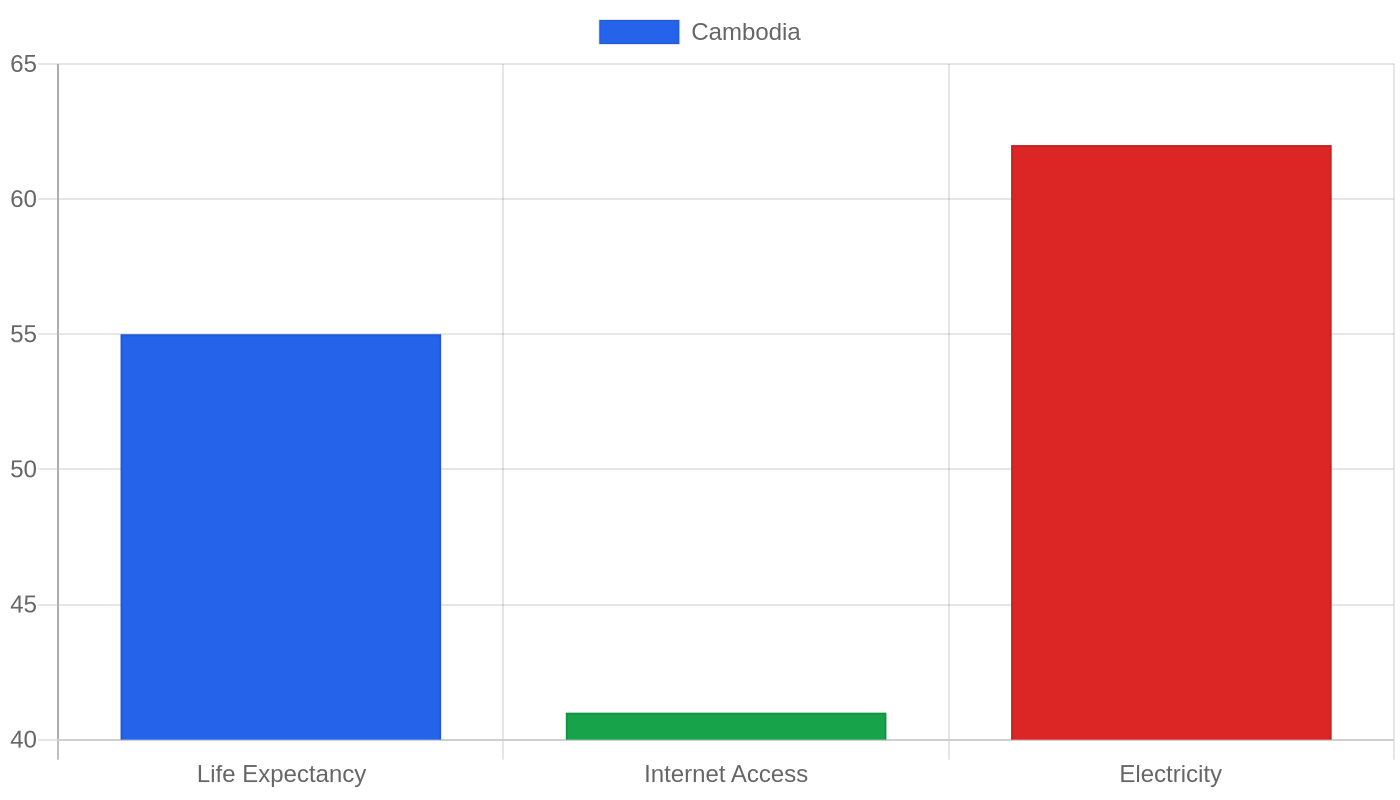
Economic Pulse Net | Sources: World Bank World Development Indicators, Government Sources | 2026
In the quiet corridors of Phnom Penh’s ministries and the bustling markets of Siem Reap, a story is unfolding that defies simple narrative. Cambodia — a nation that has risen from the ashes of a tragic past to become one of Southeast Asia’s most intriguing economic experiments — finds itself at a pivotal moment. The constitutional monarchy, with its symbolic king and parliamentary structure, continues to navigate the delicate balance between heritage and modernity.
As the region watches, this kingdom of ancient temples and young entrepreneurs is writing a new chapter, one that will be defined as much by its resilience as by its challenges.
Key Takeaways
– A Services-Led Economy: Cambodia’s economic landscape is dominated by financial institutions and consumer services, with a banking sector that punches well above its weight in regional terms.
– Political Continuity: The country operates as a constitutional monarchy with a unitary structure and parliamentary government, where legislative powers are shared between the executive and a bicameral parliament.
– Financial Deepening: From ACLEDA Bank to ANZ Royal Bank, Cambodia’s financial sector appears to be the engine room of formal economic activity.
– Tourism and Hospitality: With companies like Cambodia Angkor Air and ABOUTAsia Travel prominent, the tourism ecosystem remains a critical pillar of the formal economy.
– A Story of Potential: While comprehensive economic indicators are limited, the structure of Cambodia’s top companies reveals a nation pivoting toward services, finance, and consumer industries.
The Economic Engine — Banking on Services
The pulse of Cambodia’s economy beats through its service sector, a reality made evident by the composition of its leading corporations. The World Bank’s data framework, while not providing a current GDP growth figure, points to an economy where financial services and consumer industries dominate the formal landscape.
The presence of no fewer than four major banks — ACLEDA Bank, ANZ Royal Bank, Cambodia Asia Bank, and Cambodia Commercial Bank — alongside the Cambodian National Insurance Company, paints a picture of a nation that has invested heavily in financial infrastructure. This is not merely a matter of corporate vanity; it signals a deepening of the kind of institutional frameworks that allow businesses to grow and families to plan for the future.
The consumer services sector, represented by ABOUTAsia Travel and a cluster of airlines including Cambodia Angkor Air and Cambodia Airlines, underscores the enduring importance of tourism and mobility. When a nation’s largest employers are banks and airlines, it tells us that the economy is oriented toward facilitating transactions and movement — the very lifeblood of a modernizing state.
The inclusion of Cambrew Brewery, a consumer goods giant, adds a manufacturing dimension that suggests domestic consumption is robust enough to support large-scale production. While inflation and unemployment figures are not available in the current data set, the structure of the corporate sector implies an economy that is actively seeking to formalize and expand its service offerings.
The Cost of Living — Urban Aspirations, Rural Realities
Without specific cost-of-living indices, one must look to the broader economic signals embedded in the corporate landscape to understand the Cambodian consumer experience. The prominence of consumer services companies suggests a growing urban middle class with disposable income to spend on travel, dining, and entertainment. The banking sector’s strength implies access to credit, which in turn influences housing and consumption patterns.
In Phnom Penh, the skyline is punctuated by new developments, and the presence of international-standard banks like ANZ Royal suggests a level of financial sophistication that supports property loans and business investment.
The reality for most Cambodians, however, remains a tale of two economies. The formal sector, represented by the companies listed in the data, operates alongside a vast informal economy that absorbs the majority of labor. Housing costs in urban centers are likely to be significantly higher than in rural provinces, a common pattern across Southeast Asian developing nations.
The juxtaposition of modern banking halls and traditional markets captures the essence of Cambodia’s living standards — a nation in transition, where opportunity is real but unevenly distributed.
Investment and Business Climate — A Land of Opportunity and Obstacles
For investors, Cambodia presents a compelling paradox. On one hand, the presence of established financial institutions like ACLEDA Bank — a true homegrown success story — demonstrates that the country can nurture and sustain large-scale enterprises. The aviation sector, with multiple carriers operating domestically and regionally, indicates an openness to business that transcends mere resource extraction.
The insurance industry, though represented by a single major player, suggests a maturing risk management culture that typically accompanies economic development.
The business environment, as reflected in the World Bank’s corporate data, is one where consumer services and financials lead the charge. This is a positive signal for those looking to invest in tourism-adjacent industries or financial technology. However, the concentration of top companies in these sectors also suggests a need for diversification. The absence of manufacturing, technology, or agricultural giants among the top firms indicates where the gaps — and thus the opportunities — lie.
Investors willing to navigate the complexities of a developing market may find first-mover advantages in sectors yet to be dominated by local champions.
Safety, Politics, and Quality of Life — Stability in Structure
Cambodia’s political landscape is defined by its constitutional monarchy, a system that provides a measure of continuity and national unity. The king serves as the symbolic head of state and a unifying figure, while legislative powers are shared between the executive branch and a bicameral parliament comprising the National Assembly and the Senate. This structure, as outlined in the country’s constitution, offers a framework of political stability that is often a prerequisite for sustained economic development.
While specific crime and safety indices are not available in the current data, the political structure suggests an environment where governance is centralized and orderly. The quality of life in Cambodia is intrinsically tied to its cultural heritage and natural beauty — assets that cannot be quantified in economic data but are nonetheless vital to the nation’s appeal.
The presence of a functioning parliamentary system, with both an upper and lower house, indicates a level of institutional maturity that bodes well for long-term social stability.
What’s Happening Now — Navigating the New Normal
Cambodia is currently navigating a complex period of economic recalibration. The nation’s leadership, operating within the framework of the constitutional monarchy, is focused on sustaining the momentum of its service-led growth model. The banking sector, anchored by institutions like ACLEDA and ANZ Royal, is likely at the forefront of efforts to expand financial inclusion and digital banking services.
Meanwhile, the aviation industry, with carriers like Cambodia Angkor Air, is positioning itself to capture a larger share of regional travel as tourism rebounds.
The government’s emphasis on maintaining political stability through the existing parliamentary structure suggests a priority on continuity over disruption. For the Cambodian people, the current moment is one of cautious optimism — the formal economy continues to generate opportunities, even as the country grapples with the challenges of ensuring that growth is inclusive.
The corporate landscape, dominated by banks and consumer services, will likely remain the primary engine of formal employment and economic output in the near term.
The Bottom Line
Cambodia is a nation to watch for investors and analysts interested in Southeast Asia’s second-tier emerging markets. The strength of its financial sector and the resilience of its consumer services industry offer a glimpse of a future beyond garment manufacturing and subsistence agriculture. While comprehensive economic data remains limited, the structure of the country’s leading companies tells a story of modernization and ambition.
For those willing to look beyond the numbers, Cambodia offers a compelling narrative of a kingdom determined to define its own path in the 21st century.
Sources & Methodology
This article is authored by Economic Pulse Net for informational and research purposes. Economic Pulse Net sources its data from multilateral institutions, national statistics bureaus, and proprietary databases. All data is believed to be current as of the date of publication.
Published: August 08, 2026 | Category: Research — Cambodia
Use these signals in your own platform
Economic Pulse publishes its live signal feed through a documented, read-only API. Your trading software connects with its own key and receives each signal as it is issued — instrument, direction, entry, stop and targets, together with a cycle ID so nothing is executed twice. The feed is independent of this website and cannot change it.
Signals are informational only and are not financial advice.