Economic Pulse Net | Sources: World Bank World Development Indicators, Government Sources | 2026
Key Takeaways
* State-Directed Stability: Brunei’s economy remains anchored by the Malay Islamic Monarchy (MIB) framework, where political stability is maintained through appointed governance rather than electoral competition.
Energy Dominance: The nation’s industrial backbone is heavily concentrated in oil, gas, and petrochemicals, with major entities like Brunei Shell Petroleum and Brunei LNG driving national output.
Financial Centrality: A robust financial sector led by institutions such as the Brunei Darussalam Central Bank and Baiduri Bank supports local commerce, while the Brunei Investment Agency manages sovereign wealth.
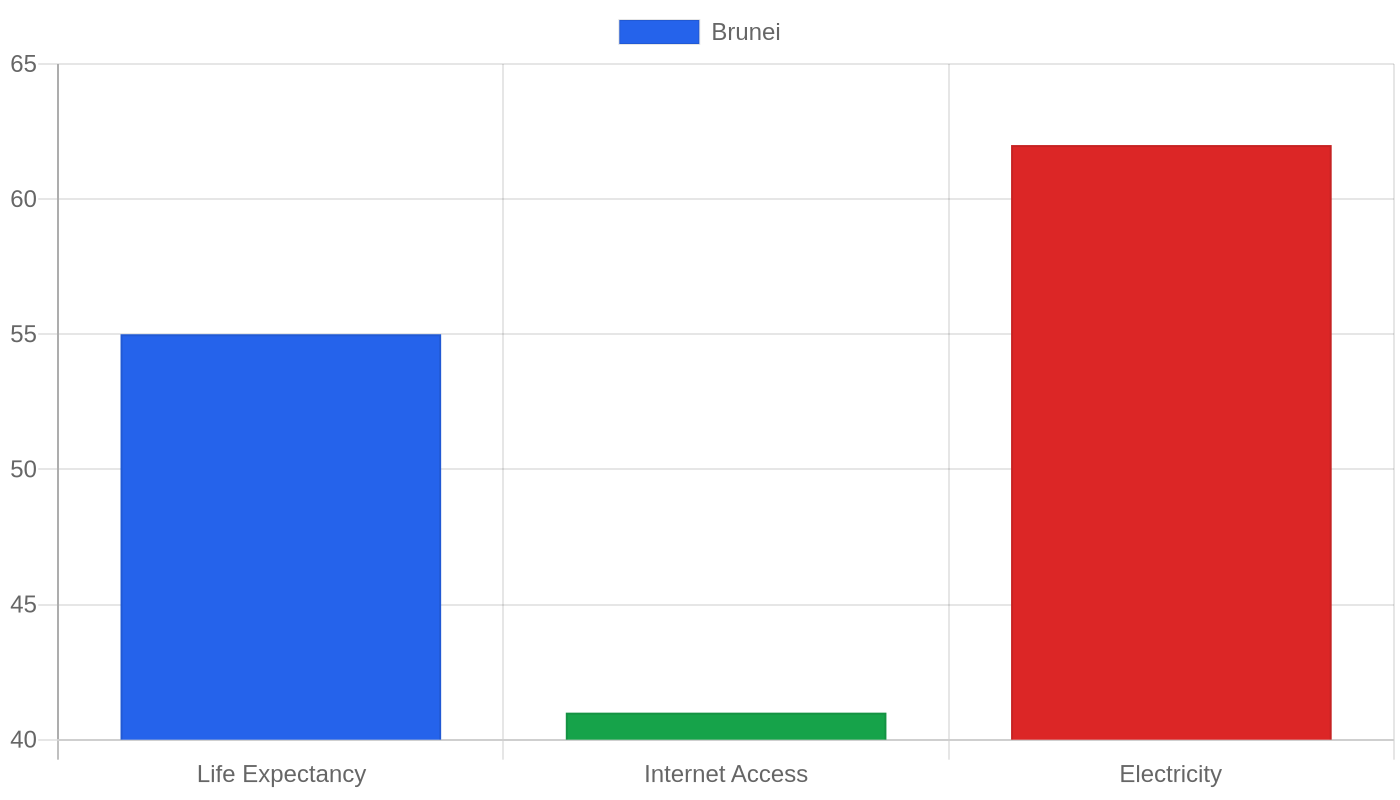
Limited Economic Transparency: Official metrics for GDP growth, inflation, and unemployment are currently unavailable, suggesting an economy that operates with significant opacity regarding public statistical reporting.
The Anchor of Energy and Sovereignty
Brunei’s economic narrative is defined less by volatile market fluctuations and more by the steady pulse of its hydrocarbon reserves. While specific figures for GDP growth, inflation, or unemployment rates are not currently available from the World Bank, the structural composition of the economy reveals a clear dependency on energy.
The country’s main industries are dominated by upstream and downstream petroleum activities, creating a revenue stream that is both substantial and vulnerable to global price shifts. This reliance shapes every aspect of national policy, from infrastructure development to social welfare programs.
Without concrete data on per capita income or population size, it is difficult to gauge the precise distribution of wealth, but the presence of major players like Brunei Fertilizer Industries and Brunei Methanol Company indicates a sophisticated value-chain approach beyond simple extraction.
The absence of standard macroeconomic indicators does not imply stagnation; rather, it points to a state-managed model where traditional Western-style economic transparency takes a backseat to sovereign control and long-term strategic planning via the Brunei Investment Agency.
Cost of Living and Daily Realities
For residents and expatriates alike, the cost of living in Brunei is shaped by a mix of subsidized essentials and premium imported goods. While exact CPI figures are missing, the retail landscape offers clues about consumer dynamics. Hua Ho Department Store stands out as a key player in the consumer services sector, providing a window into how households access everyday necessities.
In a nation where housing policies often favor citizens and rent markets can be tightly regulated, the ability to buy versus rent is heavily influenced by one’s status within the MIB framework. Daily expenses likely reflect a high baseline due to import dependencies, yet the government’s role in stabilizing prices through entities like Brunei Energy Services and Trading helps mitigate shocks.
Unlike regional neighbors with hyper-transparent real estate markets, Brunei’s housing costs remain somewhat opaque to outside observers, requiring a nuanced understanding of local subsidies and land ownership laws that privilege nationals over foreigners.
Investment Landscape and Corporate Power
The business environment in Brunei is characterized by a close alignment between state interests and private enterprise, creating a unique investment climate. Major corporations operate under the shadow of the monarchy, ensuring that commercial success aligns with national objectives. In the financial sector, Baiduri Bank and Bank Islam Brunei Darussalam provide essential banking services, catering to both conventional and Islamic finance needs, which is critical in this Muslim-majority nation.
The Brunei Darussalam Central Bank plays a pivotal role in maintaining monetary stability, acting as the guardian of the ringgit. For foreign investors, the presence of Brunei Shell Petroleum and Brunei LNG signals continued international engagement, particularly in technology transfer and joint ventures. However, the lack of recent election data and the appointed nature of the parliament mean that regulatory changes may occur without extensive public debate.
Investors must navigate a system where relationships and compliance with MIB principles are just as important as capital efficiency.
Safety, Politics, and Social Fabric
Brunei offers a high degree of personal safety, though comprehensive crime indices are not publicly disclosed. The general atmosphere is one of order and tranquility, deeply rooted in the cultural and religious values of the Malay Islamic Monarchy. Politically, the country operates under a constitution that integrates Islamic law (sharia) with English common law, creating a dual legal system where sharia supersedes in specific cases.
There are no elections; instead, members of the parliament are appointed by the sultan, ensuring that governance remains centralized and consistent with royal decrees. This political structure minimizes the risk of civil unrest or populist policy swings, offering a predictable environment for long-term planning.
However, the lack of democratic accountability means that citizen feedback mechanisms are limited, and social cohesion is maintained through top-down cultural enforcement rather than grassroots political participation.
Current Affairs and Governance Trends
Right now, Brunei continues to reinforce its identity as a stable, conservative monarchy amidst a rapidly changing Southeast Asia. The latest political developments emphasize the enduring relevance of the M ideology, which covers Malay culture, Islamic religion, and the political framework under the monarchy. With no recent elections to track, the focus remains on administrative continuity and the management of sovereign assets through the Brunei Investment Agency.
Business leaders are closely watching how the government balances traditional energy exports with potential diversification efforts, although specific reform timelines remain unclear. The legal system’s reliance on English common law alongside sharia provides a hybrid framework that appeals to certain international partners while maintaining local religious integrity.
As global energy markets shift, Brunei’s internal policy discussions likely center on sustaining prosperity without compromising its cultural sovereignty. The absence of new legislative milestones suggests a period of consolidation rather than radical transformation.
The Bottom Line
Brunei is a country best understood through its institutional stability rather than its statistical volatility. It is a destination for those who prioritize safety, political predictability, and deep ties to the energy sector over high-growth entrepreneurial opportunities. Investors and analysts should watch for subtle shifts in the Brunei Investment Agency’s portfolio and any adjustments to the integration of sharia law in commercial disputes.
For now, the Sultanate remains a quiet fortress of wealth and tradition, resistant to the rapid democratization seen elsewhere in the region.
Sources & Methodology
This article is authored by Economic Pulse Net for informational and research purposes. Economic Pulse Net sources its data from multilateral institutions, national statistics bureaus, and proprietary databases. All data is believed to be current as of the date of publication.
Published: September 28, 2026 | Category: Research — Brunei
Use these signals in your own platform
Economic Pulse publishes its live signal feed through a documented, read-only API. Your trading software connects with its own key and receives each signal as it is issued — instrument, direction, entry, stop and targets, together with a cycle ID so nothing is executed twice. The feed is independent of this website and cannot change it.
Signals are informational only and are not financial advice.