Economic Pulse Net | Sources: World Bank World Development Indicators, Government Sources | 2026
Key Takeaways
– A Two-Party Dominance: Since independence, the Awami League (AL) and Bangladesh Nationalist Party (BNP) have remained the country’s two most powerful political forces, shaping every major economic and policy decision.
– A Conglomerate Economy: Bangladesh’s private sector is driven by massive family-owned conglomerates like A K Khan & Company, Abul Khair Group, and Akij, which dominate everything from consumer goods to industrials.
– Manufacturing Backbone: From jute to advanced chemicals, Bangladesh’s industrial base is diverse but faces the challenge of modernizing in a competitive global market.
– A Constitutional Democracy: By constitution, Bangladesh is a unitary state and de jure representative democracy with a Westminster-style parliamentary system, universal suffrage, and a formal separation of powers.
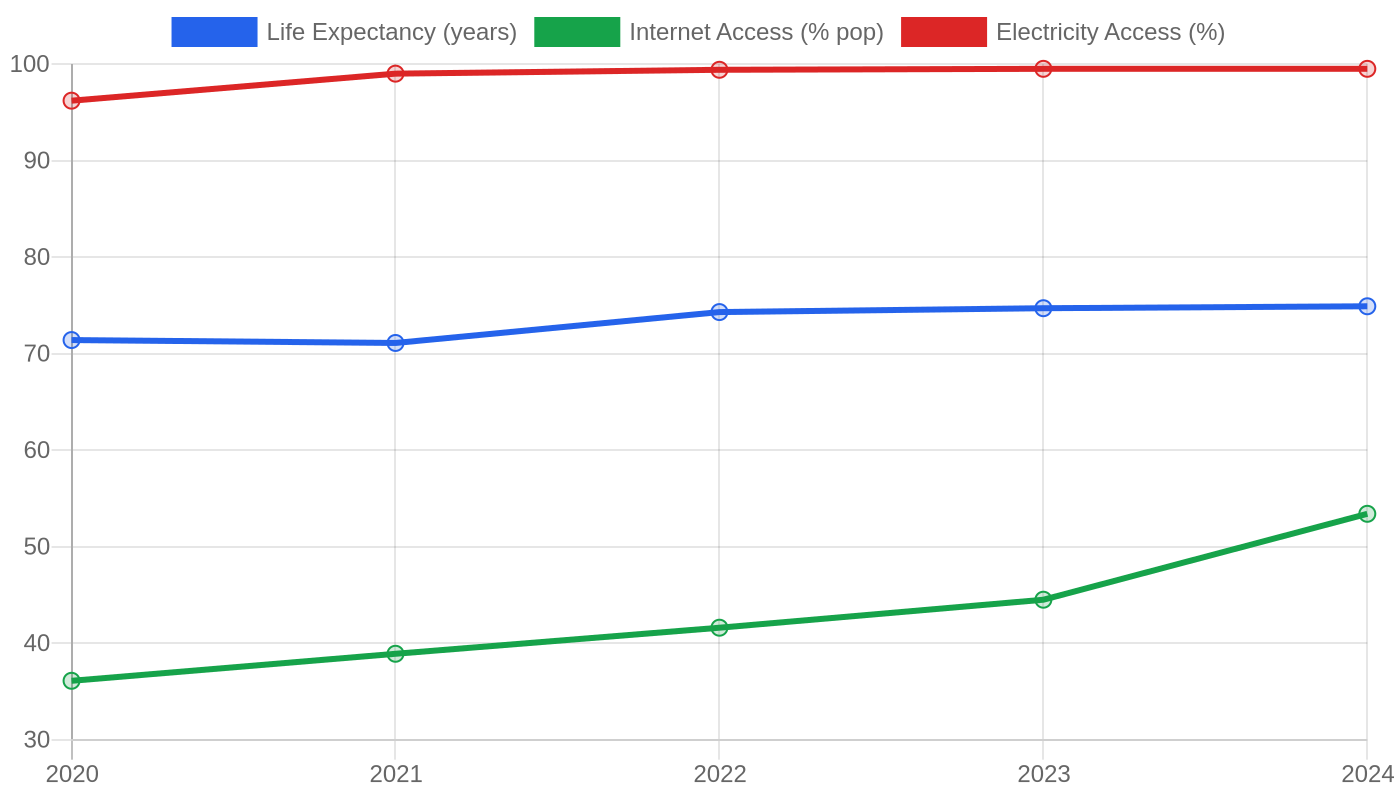
– Data Transparency Gaps: The most recent World Bank figures for GDP growth, inflation, and unemployment are not available, making real-time economic assessment difficult but not impossible.
The Economic Engine: Growth, Inflation, and the Industrial Fabric
The most recent World Bank data for Bangladesh’s GDP growth, inflation, and unemployment are not currently available, leaving economists to piece together the country’s trajectory from its industrial composition and historical patterns. What is clear is that Bangladesh has long operated as a manufacturing-driven economy, with jute historically serving as the country’s economic lifeblood.
The presence of Adamjee Jute Mills among the nation’s top companies is a reminder of this legacy, even as the sector has faced global competition and shifting demand. The country has attempted to diversify, with Advanced Chemical Industries (ACI) representing a push into higher-value manufacturing and pharmaceuticals. This industrial mix matters because it tells a story of a nation trying to transition from low-cost commodity production toward more sophisticated outputs.
The reliance on conglomerates like Abul Khair Group and Akij suggests a concentration of economic power that can both drive rapid development and create barriers to entry for smaller firms. These conglomerates span multiple sectors, from consumer goods to industrials, giving them outsized influence over pricing, employment, and investment decisions.
The World Bank’s lack of updated growth figures is itself a point of concern; without reliable macroeconomic data, both domestic policymakers and international investors are navigating a fog. Inflation, if it has followed regional trends, would be a significant pressure point, eroding the purchasing power of urban workers. The absence of unemployment data is equally troubling, as Bangladesh’s young population needs formal job creation at scale.
The country’s economic narrative is one of potential — but potential that requires better data, structural reforms, and a clear-eyed assessment of where the next wave of growth will come from.
The Cost of Living: Urban Pressures and Everyday Economics
Without current World Bank data on household incomes or consumer prices, the cost of living in Bangladesh must be understood through the lens of its industrial structure and corporate landscape. The dominance of consumer goods companies like Aarong suggests a significant domestic market for retail and lifestyle products, particularly among the urban middle class in Dhaka and Chattogram.
Aarong, known for its handicrafts and fashion retail, indicates that there is disposable income being spent beyond basic necessities. However, the concentration of conglomerates in consumer goods also means that pricing power is held by a few large players, which can keep costs higher than they might be in a more competitive retail environment.
Housing costs in Bangladesh’s major cities have historically been a challenge, driven by rapid urbanization and limited formal housing supply. The presence of major financial institutions like Agrani Bank among the top companies suggests a banking sector that is deeply intertwined with real estate and construction financing. For the average worker, the gap between wages and housing costs is likely widening, particularly as conglomerates expand their commercial footprints.
The cost of living in Dhaka is generally considered high relative to regional peers when measured against average incomes, even though absolute prices remain lower than in more developed Asian economies. Without precise inflation data, it is difficult to quantify the exact burden, but the structural factors — concentrated retail, urban migration, and limited affordable housing — point to a challenging environment for low- and middle-income families.
Investment and Business Climate: The Power of Conglomerates
Bangladesh’s business environment is defined by the outsized role of its top companies, which span nearly every sector of the economy. A K Khan & Company, one of the oldest conglomerates, has interests that touch everything from trading to manufacturing, making it a bellwether for the broader economy.
The telecommunications sector, represented by Airtel Bangladesh, shows that foreign investment and joint ventures have found a foothold, though the market remains competitive and regulatory oversight is a key concern. Agrani Bank, as a state-owned financial institution, highlights the continued government presence in the banking sector, which can be both a stabilizer and a drag on efficiency.
For investors, the key question is whether the conglomerate-dominated landscape offers opportunities or obstacles. On one hand, these large firms have the capital, distribution networks, and political connections to navigate complex regulatory environments. On the other hand, their dominance can crowd out smaller competitors and limit the dynamism that comes from new entrants.
The industrials sector, represented by Alim Industries Limited, suggests there is room for growth in manufacturing, particularly if Bangladesh can position itself as an alternative production hub. The business climate is also shaped by the political landscape, with the Awami League and BNP’s rivalry creating periods of uncertainty around elections and policy shifts.
For now, the conglomerates remain the safest bet for investors, but the long-term health of the economy will depend on whether smaller firms can gain traction.
Safety, Politics, and Quality of Life: A Democracy in Practice
Crime and safety indices for Bangladesh are not currently available from the World Bank, but the country’s political structure offers some insight into its social stability. By constitution, Bangladesh is a unitary state and a de jure representative democracy with a Westminster-style parliamentary system. This means there is universal suffrage, and the government is formally divided into three pillars: the executive, the legislative, and the judiciary.
These structures are designed to ensure accountability, transparency, and checks and balances. In practice, however, the dominance of the Awami League and the BNP has meant that political life is often polarized, with periods of strikes, protests, and political violence around election cycles.
Quality of life in Bangladesh is a mixed picture. The presence of major retail and consumer goods companies suggests a vibrant urban culture, particularly in Dhaka, where shopping, dining, and entertainment options have expanded. However, the lack of reliable crime data makes it difficult to assess personal safety, and the political rivalry between AL and BNP can occasionally spill over into public disruption.
The judiciary, as one of the three pillars, is meant to provide a check on executive power, but its effectiveness has been questioned during times of political crisis. For the average citizen, the quality of life is likely shaped more by economic opportunity than by political institutions. The country’s democratic framework provides the formal structures for civic participation, but the real test is whether those structures deliver tangible improvements in daily life.
What’s Happening Now: The Political and Economic Pulse
As of the latest reporting, Bangladesh is in a period of heightened political activity, with the Awami League and the Bangladesh Nationalist Party continuing to dominate the national stage. The World Bank has not released updated figures for GDP growth, inflation, or unemployment, which is itself a notable data gap that complicates policy-making.
The political landscape remains tense, as the two major parties prepare for future electoral contests, and the government’s commitment to checks and balances is being tested. The conglomerates that drive the economy are watching closely, as any shift in political power could bring changes to regulatory policy, taxation, and trade agreements.
The telecommunications sector, including Airtel Bangladesh, is navigating a competitive market with evolving consumer demands. The financial sector, anchored by Agrani Bank, is under pressure to modernize and expand access to credit, particularly for small and medium-sized enterprises. The industrial sector, from jute to advanced chemicals, is looking for new export markets and ways to increase productivity.
The absence of fresh economic data means that these developments are being assessed anecdotally rather than through hard numbers. That is a precarious position for a country with as much potential as Bangladesh. The coming months will be critical in determining whether the country can address its data gaps, maintain political stability, and chart a course toward sustainable growth.
The Bottom Line
Bangladesh is a country of significant economic potential, driven by powerful conglomerates and a young, ambitious workforce. However, the lack of updated World Bank data on key indicators like GDP growth, inflation, and unemployment makes it difficult to assess the country’s current trajectory with precision. Investors and policymakers should watch Bangladesh closely, particularly the interplay between the Awami League and the BNP, as political stability will be the key determinant of economic performance.
For those willing to navigate the data gaps and political complexities, Bangladesh offers a compelling story of a nation on the rise — but one that still has significant hurdles to overcome.
Sources & Methodology
This article is authored by Economic Pulse Net for informational and research purposes. Economic Pulse Net sources its data from multilateral institutions, national statistics bureaus, and proprietary databases. All data is believed to be current as of the date of publication.
Published: August 09, 2026 | Category: Research — Bangladesh
Use these signals in your own platform
Economic Pulse publishes its live signal feed through a documented, read-only API. Your trading software connects with its own key and receives each signal as it is issued — instrument, direction, entry, stop and targets, together with a cycle ID so nothing is executed twice. The feed is independent of this website and cannot change it.
Signals are informational only and are not financial advice.