Economic Pulse Net | Sources: World Bank World Development Indicators, Government Sources | 2026
Key Takeaways
– Bangladesh’s economy grew at a modest 3.49% in 2025, according to the World Bank, a marked slowdown from its pre-pandemic trajectory that raises questions about the sustainability of its development model.
– Consumer prices are rising at an alarming 8.77% annual rate, squeezing household budgets and eroding the purchasing power of the country’s vast working-class population.
– The political landscape remains dominated by the rivalry between the Awami League and the Bangladesh Nationalist Party, creating an atmosphere of uncertainty that complicates long-term economic planning.
– Despite headwinds, Bangladesh boasts a GDP of over $456 billion and a GDP per capita (PPP) above $10,000, signalling that it has crossed into lower-middle-income status with genuine economic heft.
– Major conglomerates like Akij, A K Khan & Company, and Abul Khair Group continue to anchor the economy, but the lack of diversified industrial data suggests the garment sector’s dominance remains unchallenged.
The Growth Paradox — Why 3.5% Feels Like a Warning
The headline figure from the World Bank — GDP growth of 3.49% in 2025 — might appear respectable for an economy navigating global turbulence. But for Bangladesh, a nation that routinely posted 6-7% annual expansion before the pandemic, this number reads as a deceleration that demands attention. The country’s economy, valued at roughly $456 billion, has been powered for decades by a booming ready-made garment industry, remittances from overseas workers, and a young, urbanising population.
Yet the World Bank’s data reveals a stubborn inflation rate of 8.77%, a level that effectively means real wages are shrinking for millions of Bangladeshis.
Inflation at this pitch is not merely a statistic; it is a political and social accelerant. When the cost of rice, cooking oil, and housing rises faster than incomes, the social contract frays. The World Bank’s figures show a GNI per capita of just $2,840, which, when adjusted for purchasing power, rises to over $10,100 per person. That gap between nominal income and purchasing power tells the story of a country where essentials consume a disproportionate share of household budgets.
The unemployment data is absent from the World Bank’s reporting, but in an economy where formal employment is scarce and the informal sector dominates, the lack of a number is itself revealing — millions work, but few have stable, tracked jobs.
The industrial composition of Bangladesh’s economy remains opaque in the available data, but the list of top companies offers clues. The presence of Adamjee Jute Mills and Advanced Chemical Industries (ACI) alongside conglomerates like Akij and Abul Khair Group suggests an economy still heavily oriented toward traditional manufacturing, textiles, and consumer goods.
There is no major technology firm, no pharmaceutical giant of global scale, no financial powerhouse that has broken into regional or global markets. This is an economy built on muscle and thread, not on intellectual property or high-value services.
The Cost of Living Squeeze — When Rice and Rent Compete for the Same Rupee
The World Bank’s inflation figure of 8.77% provides the headline, but the texture of daily life in Bangladesh is defined by how that inflation manifests. Housing costs in Dhaka, the capital, have risen steadily as urban migration continues, with rents in middle-class neighbourhoods consuming a growing share of household income.
The choice between renting a modest apartment in the city and buying property has become increasingly stark for young professionals, as land prices in desirable areas have escalated beyond the reach of salaried workers.
Comparing Bangladesh to its regional peers is instructive, though the data provided does not include specific housing indices. What can be inferred is that a GNI per capita of $2,840 places Bangladesh firmly below the purchasing power of neighbours like India or Vietnam, meaning that even moderate housing inflation has outsized effects. Daily expenses — food, transport, utilities — are where the inflation bite is felt most acutely.
The World Bank’s data does not break down the consumer basket, but in a country where a significant portion of the population still spends the majority of income on food, an 8.77% inflation rate is not an inconvenience; it is a crisis of affordability.
The absence of detailed cost-of-living data from the World Bank does not diminish the lived reality: Bangladeshis are paying more for less, and the safety net of family networks and informal credit is stretched thin.
Where the Money Lives — Conglomerates, Consumer Goods, and the Search for New Engines
Bangladesh’s corporate landscape, as revealed by the list of top companies, is dominated by family-run conglomerates that have diversified across sectors. Akij, A K Khan & Company, and Abul Khair Group are names that appear in everything from textiles to tobacco to cement. This concentration of economic power in a handful of conglomerates creates both stability and vulnerability.
These firms have the capital and political connections to weather downturns, but their dominance can also stifle competition and innovation.
The financial sector is represented by Agrani Bank, a state-owned institution, while the telecommunications space features Airtel Bangladesh. Notably absent from the top ten are any export-oriented garment manufacturers, which is curious given that readymade garments account for the vast majority of Bangladesh’s export earnings. This may reflect the privately-held nature of many garment firms, or it may indicate that the sector’s profits are being reinvested into other ventures.
Aarong, the consumer goods brand, is a notable inclusion — it is a social enterprise that markets rural handicrafts and has become a symbol of Bangladesh’s potential to build value-added brands from traditional skills.
For investors, the message from the World Bank data is mixed. The GDP per capita above $10,000 (PPP) signals a market with genuine consumer demand, but the inflation rate and political uncertainty temper enthusiasm. The lack of detailed industrial data from the World Bank makes sector-specific analysis difficult, but the dominance of conglomerates suggests that new entrants face high barriers to entry.
Politics and Stability — The Two-Party Tango That Shapes Everything
Bangladesh’s constitution establishes a unitary state with a Westminster-style parliamentary system and universal suffrage, according to the political landscape data. In practice, power has oscillated between the Awami League and the Bangladesh Nationalist Party (BNP) since independence, with periods of military intervention and authoritarian rule interspersed.
The World Bank data provides no crime or safety indices, but the political environment is well-documented: elections are frequently contested, opposition leaders have faced imprisonment, and street protests are common.
This political duality creates a binary risk for the economy. When the Awami League is in power, business confidence among its supporters rises, while BNP-aligned business interests face headwinds, and vice versa. The result is an economy that cannot fully depoliticise investment decisions.
The absence of crime and safety data from the World Bank does not mean Bangladesh is dangerous — it means the data is not available through this source — but anecdotal evidence suggests that violent crime is less of a concern than political instability and bureaucratic corruption.
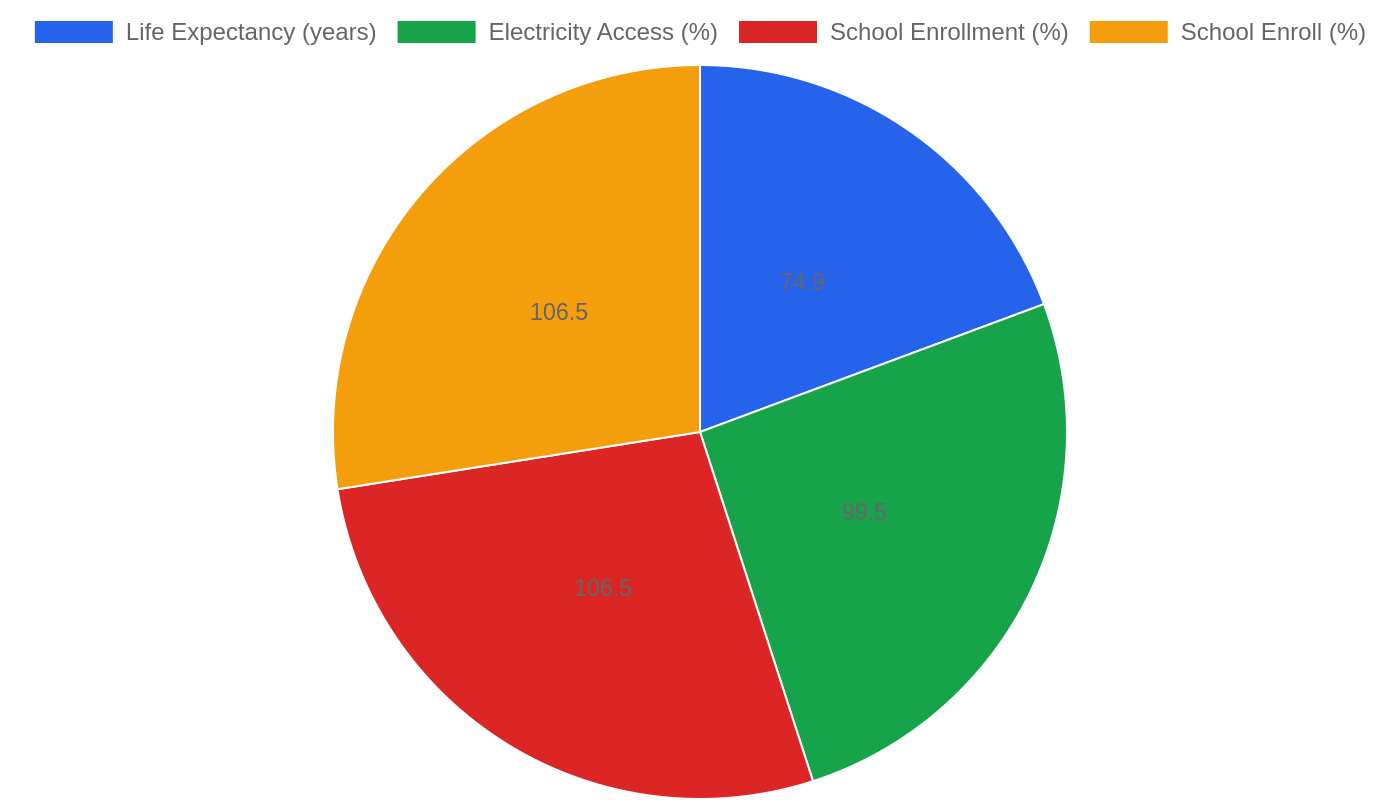
Quality of life in Bangladesh, as measured by the World Bank’s GDP per capita (PPP) of over $10,100, has improved dramatically over two decades. Life expectancy, literacy, and access to electricity have all risen. But the political polarisation documented in the data means that economic gains are always shadowed by the possibility of disruption.
Current Affairs — The Inflation Battle and the Search for a New Consensus
As of early 2026, Bangladesh’s economic policymakers are grappling with the World Bank’s inflation figure of 8.77% and trying to prevent it from becoming entrenched. The central bank has been forced into a tightening posture, raising interest rates to cool demand, but this creates a painful trade-off: higher borrowing costs slow the very growth that the country needs to employ its young population.
The World Bank’s GDP growth figure of 3.49% suggests that the tightening is already taking effect, and the risk of a sharper slowdown is real.
The political calendar adds another layer of complexity. The rivalry between the Awami League and the Bangladesh Nationalist Party, as noted in the political landscape data, shows no sign of abating. Opposition parties have called for fresh elections, and the government has resisted, creating a standoff that unnerves both domestic and foreign investors.
The World Bank’s data does not include recent policy announcements, but the trajectory is clear: Bangladesh must navigate a narrow corridor between controlling inflation and maintaining growth, all while managing political tensions that could boil over.
On the business front, the major conglomerates continue to consolidate their positions. Akij and A K Khan & Company are investing in new capacity, but the absence of any tech or renewable energy companies among the top ten suggests that Bangladesh is not yet pivoting toward the industries that will define the 21st-century economy. The country remains a low-cost manufacturing hub, but with wages rising and automation accelerating, that model faces structural pressure.
The Bottom Line
Bangladesh in 2026 is a country of genuine economic achievement — a $456 billion economy, a per capita income that has lifted millions from poverty, and a corporate sector with real heft — but it is also a nation caught between past success and future uncertainty. The World Bank’s data reveals an economy growing slowly, paying more for everything, and operating within a political system that offers both democratic form and partisan dysfunction.
Investors should watch Bangladesh for its consumer market potential and its manufacturing base, but they must also price in the inflation risk and the political premium. For now, Bangladesh remains a story of resilience — but resilience is not the same as prosperity.
Sources & Methodology
This article is authored by Economic Pulse Net for informational and research purposes. Economic Pulse Net sources its data from multilateral institutions, national statistics bureaus, and proprietary databases. All data is believed to be current as of the date of publication.
Published: July 17, 2026 | Category: Research — Bangladesh
Use these signals in your own platform
Economic Pulse publishes its live signal feed through a documented, read-only API. Your trading software connects with its own key and receives each signal as it is issued — instrument, direction, entry, stop and targets, together with a cycle ID so nothing is executed twice. The feed is independent of this website and cannot change it.
Signals are informational only and are not financial advice.