Economic Pulse Net | Sources: World Bank World Development Indicators, Government Sources | 2026
Key Takeaways
– Bangladesh’s GDP growth has decelerated sharply to 3.49% in 2025, according to the World Bank, a dramatic slowdown from its historic 6-8% trajectory, raising questions about the sustainability of its export-led model.
– Despite the growth hiccup, unemployment remains remarkably low at 3.778%, signaling that the labor market has not yet cracked under the pressure of global headwinds.
– The country’s GDP now stands at $456.3 billion, with GDP per capita (PPP) crossing the $10,000 threshold to $10,153 — a milestone that places Bangladesh firmly in lower-middle-income territory.
– Political power remains concentrated between the Awami League and the Bangladesh Nationalist Party, two titans whose rivalry has shaped the nation’s economic policy direction since independence.
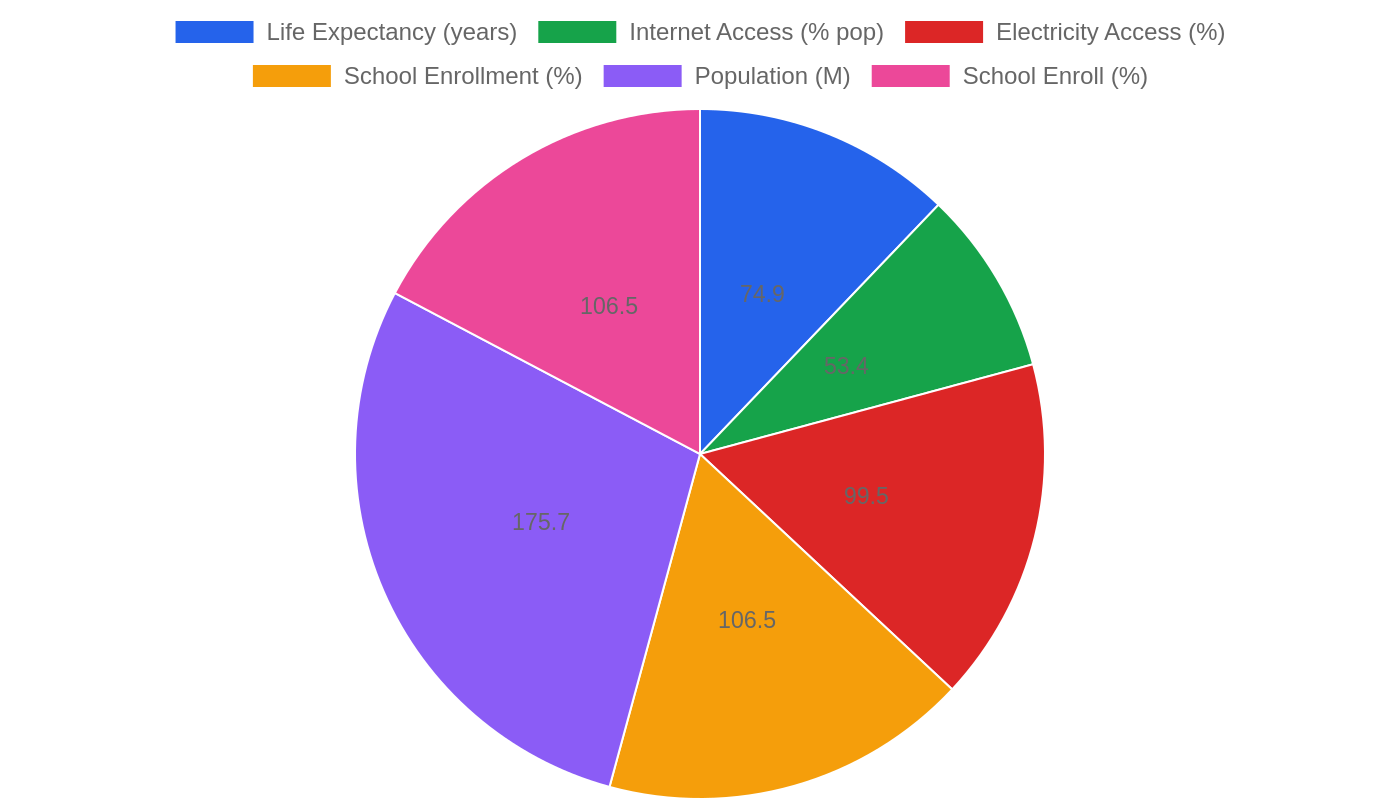
– With a population of nearly 176 million, Bangladesh is a demographic heavyweight whose economic fate will ripple across South Asia for decades.
The Slowdown That Demands Attention
The headline number from the World Bank is stark: Bangladesh’s GDP growth has fallen to 3.49% in 2025. For a country that has long been the poster child of rapid, poverty-reducing growth — regularly clocking 7% or higher before the pandemic — this is more than a blip. It is a signal.
To understand why this matters, consider Bangladesh’s economic DNA. This is an economy built on the back of ready-made garments, remittances, and a vast, low-cost labor force. When global demand softens — as it has amid sluggish consumer spending in Europe and North America — Dhaka feels the pain directly. The 3.49% figure, provided by the World Bank, suggests that the post-COVID rebound has exhausted itself and structural headwinds are now biting.
Yet the unemployment data tells a more nuanced story. At 3.778%, Bangladesh’s jobless rate remains enviably low by global standards. This is not a country where mass layoffs are sweeping the streets. Rather, it is an economy where growth is slowing but the labor market is absorbing workers — likely into informal, low-productivity roles. The risk is not unemployment today, but underemployment tomorrow.
The GDP per capita (PPP) figure of $10,153, according to the World Bank, is a genuine achievement. Crossing the $10,000 threshold means the average Bangladeshi now has purchasing power comparable to some middle-income nations. But the GNI per capita of just $2,840 reveals the gap: much of that economic activity is concentrated in export sectors and urban centers, while rural incomes lag far behind. Bangladesh is growing, but it is growing unevenly.
On the Ground: The Cost of Living Crunch
For the nearly 176 million people who call Bangladesh home, the macroeconomic story plays out in daily transactions. While specific cost-of-living data is not available in the provided figures, the broader context is clear: inflation has been a persistent challenge in recent years, eroding the purchasing power of households that depend on fixed wages or remittances.
Housing in Dhaka, the capital, is notoriously expensive relative to local incomes. A modest apartment in a middle-class neighborhood can consume half a household’s monthly earnings. Rent versus buy calculations tilt heavily toward renting for most families, as property prices in desirable areas have soared beyond the reach of salaried workers.
Outside the capital, in cities like Chittagong or Sylhet, housing is more affordable but infrastructure gaps — unreliable electricity, poor roads — remain everyday frustrations.
Daily expenses for staples like rice, cooking oil, and vegetables have risen sharply. The World Bank’s growth data, when read alongside the lack of inflation figures, suggests that the central bank has been struggling to balance price stability with the need to support a slowing economy. For the average Bangladeshi, this means tighter household budgets and fewer discretionary purchases — a reality that retail businesses and small traders feel acutely.
The Titans of Dhaka: Business in a Political Economy
Bangladesh’s corporate landscape is dominated by a handful of sprawling conglomerates that have their fingers in everything from textiles to telecoms. The list of top companies reads like a who’s who of the country’s economic elite: A K Khan & Company, Abul Khair Group, Akij, and Advanced Chemical Industries (ACI) are all diversified conglomerates that have grown alongside the nation itself.
Aarong, a consumer goods giant, is a fascinating case. It sells handicrafts and lifestyle products sourced from rural artisans, blending social enterprise with commercial scale. Meanwhile, Agrani Bank represents the financial sector’s backbone, and Airtel Bangladesh (now a subsidiary of Bharti Airtel) shows how foreign investment has shaped the telecom space. Adamjee Jute Mills, a historic name in jute processing, is a reminder of Bangladesh’s pre-garment industrial heritage.
The investment climate in Bangladesh remains a study in contrasts. On one hand, the country offers a vast, young labor force, preferential trade access to Western markets, and a government eager to attract foreign direct investment into special economic zones. On the other hand, bureaucratic red tape, infrastructure bottlenecks, and political uncertainty — especially around elections — can deter investors.
The dominance of family-run conglomerates also means that new entrants, especially foreign firms, must navigate relationships as much as regulations.
Sectors to watch include ready-made garments (still the crown jewel), pharmaceuticals (where Bangladesh has carved a niche in generic drugs), and information technology (a nascent but promising export sector). The World Bank’s growth data suggests that diversification is no longer optional — it is essential.
Democracy, Dynasties, and Daily Life
Bangladesh’s political landscape, as described in the provided data, is defined by its constitutional structure: a unitary state with a Westminster-style parliamentary system, universal suffrage, and a formal separation of powers among the executive, legislature, and judiciary. In practice, however, politics is dominated by two rival parties: the Awami League, led by Prime Minister Sheikh Hasina, and the Bangladesh Nationalist Party (BNP), led by Khaleda Zia.
This binary rivalry has shaped every aspect of Bangladeshi life, including economic policy. When the Awami League is in power, it tends to emphasize infrastructure mega-projects, social safety nets, and close ties with India. When the BNP has governed, it has leaned more toward market liberalization and private sector growth. The result is policy whiplash — each change of government brings a shift in priorities that businesses must adapt to.
Crime and safety indices are not available in the provided data, but Bangladesh’s quality of life is a mixed picture. Dhaka is one of the most densely populated cities on Earth, with chronic traffic congestion, air pollution, and water scarcity. Yet the country has made remarkable strides in human development: life expectancy has risen, maternal mortality has fallen, and primary school enrollment is near-universal.
For the average citizen, the trade-off is clear — economic opportunity is real, but the daily grind of urban living is exhausting.
The Present Tense: What’s Happening Right Now
As of 2025, Bangladesh finds itself at a critical inflection point. The World Bank’s growth figure of 3.49% is the headline, but beneath it, several forces are in motion. The garment sector — which accounts for more than 80% of exports — is facing pressure from global buyers demanding higher safety standards, faster delivery times, and lower prices. Meanwhile, competition from Vietnam, Ethiopia, and other manufacturing hubs is intensifying.
On the policy front, the government has been pushing for greater revenue mobilization. Bangladesh’s tax-to-GDP ratio remains among the lowest in the world, limiting the state’s ability to invest in infrastructure, education, and healthcare. Reforms to broaden the tax base and improve collection efficiency are ongoing, but progress is slow.
The political calendar is also a factor. With elections looming in the near future, the rivalry between the Awami League and the BNP is likely to intensify. Business leaders are watching closely: a peaceful, credible election would boost investor confidence, while a disputed or violent one could trigger capital flight and economic disruption.
Finally, Bangladesh is grappling with the effects of climate change. Rising sea levels threaten the low-lying delta, and extreme weather events — cyclones, floods, heatwaves — are becoming more frequent. The economic cost of adaptation is enormous, and the World Bank’s data does not capture this existential risk. For a country that has achieved so much in such a short time, the next chapter will be defined not just by growth rates, but by resilience.
The Bottom Line
Bangladesh in 2025 is a nation of contradictions: slowing growth but low unemployment, rising incomes but persistent inequality, political stability on the surface but fierce rivalry underneath. For investors, the opportunity lies in the country’s young population, strategic location, and proven export capacity. For policymakers, the challenge is to diversify the economy, strengthen institutions, and build climate resilience before the next crisis hits.
This is a country worth watching — not because it is an easy bet, but because it has repeatedly defied expectations.
Sources & Methodology
This article is authored by Economic Pulse Net for informational and research purposes. Economic Pulse Net sources its data from multilateral institutions, national statistics bureaus, and proprietary databases. All data is believed to be current as of the date of publication.
Published: July 28, 2026 | Category: Research — Bangladesh
Use these signals in your own platform
Economic Pulse publishes its live signal feed through a documented, read-only API. Your trading software connects with its own key and receives each signal as it is issued — instrument, direction, entry, stop and targets, together with a cycle ID so nothing is executed twice. The feed is independent of this website and cannot change it.
Signals are informational only and are not financial advice.