Economic Pulse Net | Sources: World Bank World Development Indicators, Government Sources | 2026
Key Takeaways
* Economic Scale: With a GDP of approximately $456.3 billion, Bangladesh represents a significant emerging market economy in South Asia, supported by a population base that drives domestic consumption.
Inflationary Headwinds: The consumer price index (CPI) has settled at roughly 8.77%, indicating persistent cost-of-living pressures that impact household purchasing power and business margins.
Labor Market Resilience: Unemployment remains relatively low at 3.78%, suggesting a tight labor market where demand for workers outpaces supply, potentially driving wage growth.
Corporate Landscape: The business environment is dominated by large conglomerates such as Akij, A K Khan & Company, and Advanced Chemical Industries, which span diverse sectors from textiles to chemicals.
Political Framework: The nation operates under a Westminster-style parliamentary democracy, with the Awami League and Bangladesh Nationalist Party (BNP) historically serving as the two primary political forces shaping policy and stability.
Economic Engine: Growth and Inflation Dynamics
Bangladesh’s economic profile presents a complex picture of robust aggregate output struggling against moderate inflationary trends. According to World Bank data, the country’s Gross Domestic Product stands at an impressive $456.3 billion, reflecting its status as one of the larger economies in the region. However, this scale is tempered by a CPI inflation rate of 8.77%, a figure that suggests prices for goods and services are rising at a pace that challenges both consumers and corporate planners.
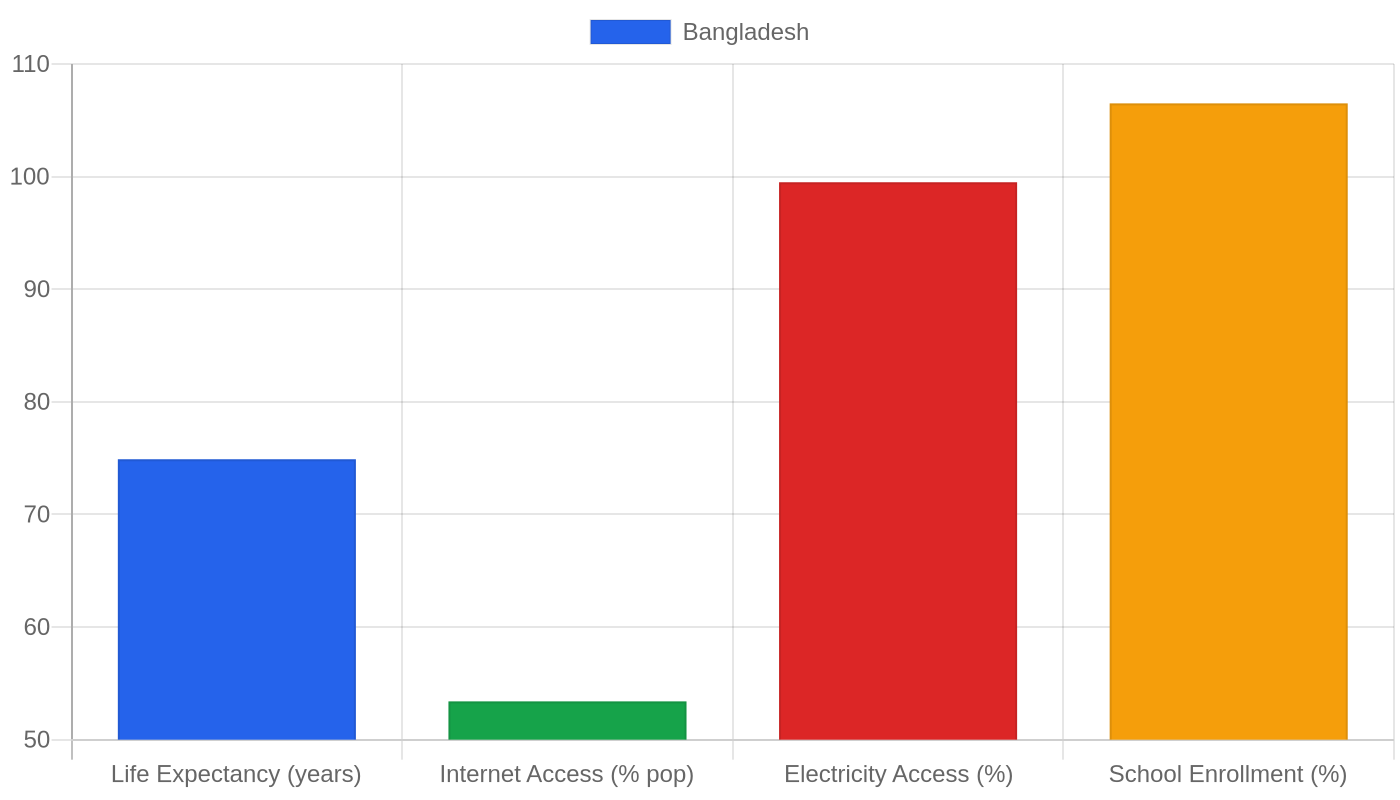
While specific GDP growth percentages for the latest period are not available, the underlying strength of the economy is evident in the GDP per capita (PPP) of $10,153, which indicates a growing middle class with increasing purchasing power relative to regional peers. Employment metrics offer a silver lining; with unemployment recorded at just 3.78%, the labor market is exceptionally tight.
This low unemployment rate implies that businesses face difficulty finding talent, which could lead to upward pressure on wages and operational costs. For investors, these numbers signal a market with strong domestic demand but limited slack, requiring careful navigation of cost structures. The interplay between high GDP volume and sticky inflation creates an environment where efficiency and supply chain management are critical competitive advantages.
Cost of Living: Navigating Daily Expenses
The daily economic reality for residents in Bangladesh is shaped significantly by the current inflationary environment. With CPI hovering near 8.8%, households are likely experiencing noticeable increases in the cost of basic necessities, from food staples to utility bills. Although specific housing rent indices are not provided in the dataset, the general rise in consumer prices typically correlates with increased living costs across all major urban centers.
The GDP per capita of over $10,000 (PPP) suggests that while expenses are rising, the average citizen’s standard of living is higher than many neighboring developing nations, allowing for some discretionary spending despite inflation. Businesses operating in the consumer goods sector must therefore balance price sensitivity with brand loyalty, as customers may trade down to cheaper alternatives if prices exceed their threshold.
Furthermore, the low unemployment rate of 3.78% means that workers have bargaining power, potentially leading to higher wage demands that further contribute to service-sector inflation. Understanding these dynamics is crucial for anyone planning to relocate or invest in retail infrastructure, as the margin for error in pricing strategies is slim.
Investment & Business Climate: Conglomerates and Sectors
The corporate landscape in Bangladesh is characterized by the dominance of large, diversified conglomerates that drive much of the industrial activity. Major players such as Akij, A K Khan & Company, and Abul Khair Group operate across multiple sectors, providing stability and scale to the local economy.
In the consumer goods space, companies like Aarong and Adamjee Jute Mills leverage local resources and cultural heritage to capture market share, while Advanced Chemical Industries (ACI) underscores the importance of industrial inputs in the manufacturing value chain. The financial sector is anchored by institutions like Agrani Bank, which facilitates the flow of capital necessary for business expansion.
Meanwhile, the telecommunications sector, represented by Airtel Bangladesh, continues to be a vital conduit for digital connectivity and modern business operations. For foreign investors, the presence of these established entities offers potential partnership opportunities, though it also signals a competitive environment where market entry requires strategic alliances.
The industrial sector, including firms like Alim Industries Limited, provides a foundation for export-oriented growth, particularly in textiles and light manufacturing. Monitoring the performance of these key companies offers a reliable barometer for the overall health of the Bangladeshi business climate.
Safety, Politics & Quality of Life: Governance and Stability
Political stability in Bangladesh is rooted in its constitutional framework as a unitary state and a representative democracy. The Westminster-style parliamentary system ensures checks and balances among the executive, legislative, and judiciary branches, promoting accountability and transparency in governance.
Historically, the political arena has been defined by the rivalry between the Awami League (AL) and the Bangladesh Nationalist Party (BNP), two powerful parties that shape national policy through universal suffrage. While specific crime and safety indices are not currently available, the structured nature of the government suggests a predictable regulatory environment for long-term planning. The absence of detailed safety data does not detract from the clear institutional architecture that supports civic order.
For expatriates and international businesses, understanding the political dynamics between the AL and BNP is essential, as shifts in power can influence policy direction and investment incentives. Despite the lack of granular crime statistics, the formal democratic processes provide a stable backdrop for social and economic interactions. Quality of life indicators are indirectly supported by the growing GDP per capita, which reflects improved access to goods and services over time.
What’s Happening Now: Policy and Market Trends
The current economic narrative in Bangladesh is being driven by the need to manage inflation while sustaining growth momentum. With CPI at 8.77%, policymakers are likely focusing on monetary tools to stabilize prices without stifling the robust labor market evidenced by the 3.78% unemployment rate. The continued operation of major conglomerates like Akij and A K Khan & Company indicates that private sector confidence remains intact despite macroeconomic headwinds.
Investors are closely watching how the government balances fiscal discipline with social welfare, given the political prominence of the AL and BNP. Any shifts in trade policy or industrial regulation will directly impact sectors like jute, textiles, and chemicals, where local firms hold significant market position. The resilience of the banking sector, led by institutions like Agrani Bank, will be crucial in supporting credit flow to small and medium enterprises.
As global supply chains evolve, Bangladesh’s role as a manufacturing hub depends on maintaining competitive costs and operational efficiency. Recent trends suggest a focus on internal market development, leveraging the growing PPP-adjusted income levels to boost domestic consumption.
The Bottom Line
Bangladesh offers a compelling case for investors seeking exposure to a large, young, and growing economy with strong industrial foundations. The combination of a $456 billion GDP and low unemployment highlights a dynamic market with significant domestic potential. However, the 8.77% inflation rate serves as a reminder that operational risks related to cost management remain relevant. Companies that can navigate the political landscape and partner with established local conglomerates are best positioned to succeed.
For those willing to engage with the complexities of the region, Bangladesh presents a high-reward opportunity within South Asia.
Sources & Methodology
This article is authored by Economic Pulse Net for informational and research purposes. Economic Pulse Net sources its data from multilateral institutions, national statistics bureaus, and proprietary databases. All data is believed to be current as of the date of publication.
Published: October 12, 2026 | Category: Research — Bangladesh
Use these signals in your own platform
Economic Pulse publishes its live signal feed through a documented, read-only API. Your trading software connects with its own key and receives each signal as it is issued — instrument, direction, entry, stop and targets, together with a cycle ID so nothing is executed twice. The feed is independent of this website and cannot change it.
Signals are informational only and are not financial advice.