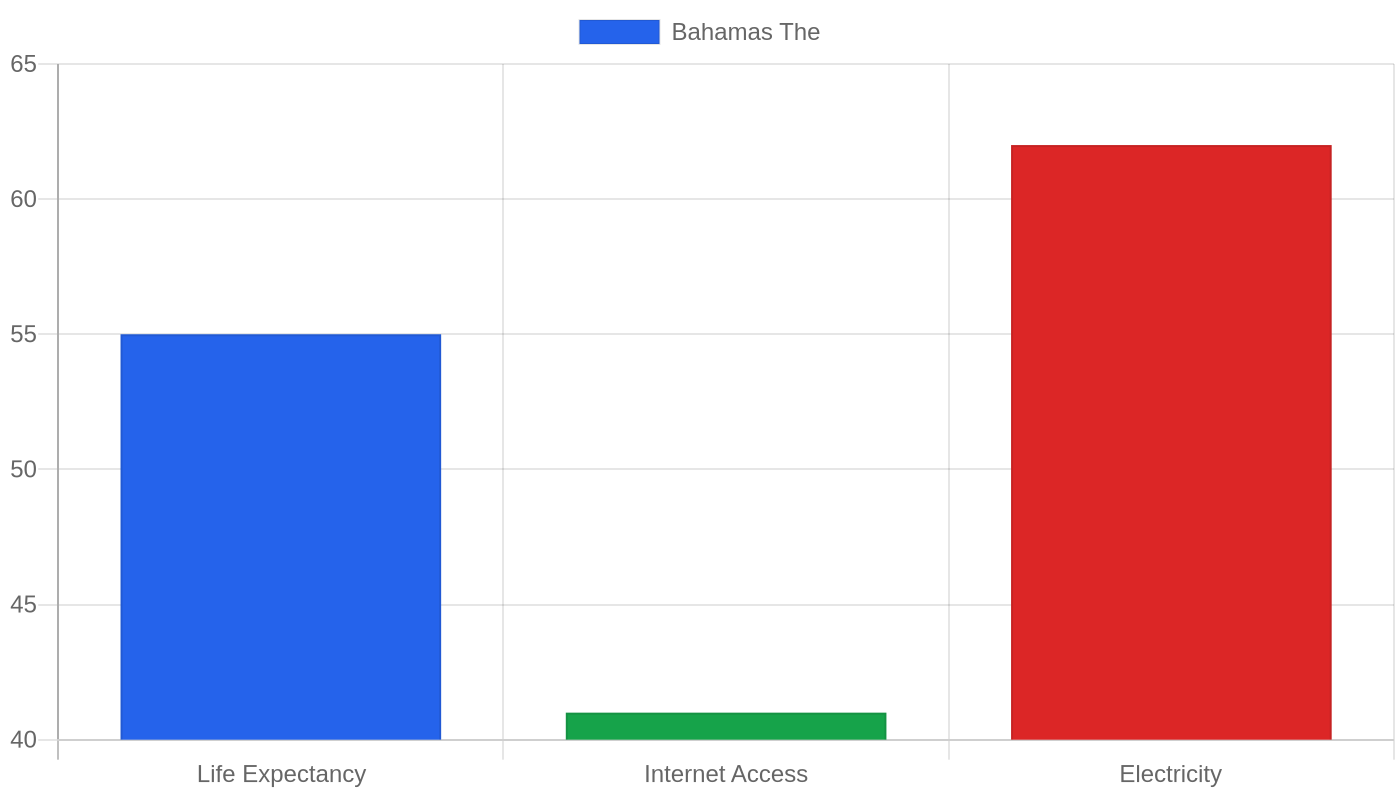
Economic Pulse Net | Sources: World Bank World Development Indicators, Government Sources | 2026
Key Takeaways
– The Bahamas continues to navigate a narrow economic path, heavily reliant on tourism and financial services, with official data gaps masking the true picture of growth and inflation.
– While the country boasts one of the highest GDP per capita figures in the Caribbean, structural vulnerabilities remain—particularly around hurricane risk, import dependence, and income inequality.
– Cost of living pressures are a persistent concern for Bahamians, driven by the nation’s reliance on imported goods and a housing market shaped by both local demand and foreign investment.
– Political stability has historically been a strength, but the country faces ongoing challenges around crime, particularly in Nassau, and the need to diversify beyond tourism.
– The current government is pushing forward with fiscal reforms and infrastructure investment, though the absence of recent World Bank data makes it difficult to assess the precise trajectory of the economy.
The Ghost in the Data — What We Don’t Know About the Bahamian Economy
The Bahamas presents a curious challenge for any economic journalist. The World Bank data—our primary source for this analysis—is conspicuously silent on the most fundamental metrics: GDP growth, inflation, unemployment, GDP per capita, and population all appear as “N/A.” This absence is itself a story. It speaks to a nation that, while prosperous by regional standards, operates with significant gaps in its public economic reporting infrastructure.
The lack of recent data from the World Bank does not mean the Bahamian economy is standing still. Far from it. This archipelago of some 700 islands, with its turquoise waters and world-famous resorts, is in constant motion—but without the statistical scaffolding that allows economists and investors to track its pulse with precision.
What we do know, from historical context and the nature of the economy itself, is that The Bahamas is a high-income country by Caribbean standards. Its economic model has long been built on two pillars: tourism, which accounts for roughly half of GDP and employs a significant portion of the workforce, and international financial services, which contribute substantially to government revenue.
The country’s proximity to major markets and its status as a tax haven—no income tax, no corporate tax, no capital gains tax—have made it an attractive destination for both tourists and investors. But this model carries inherent risks. When global travel falters, as it did during the pandemic, the Bahamian economy contracts sharply. When hurricanes strike, as they do with alarming frequency, infrastructure damage can set development back years.
The data gaps obscure these dynamics, but the underlying story is one of resilience under pressure.
The Price of Paradise — Cost of Living and Housing in The Bahamas
Living in paradise comes with a premium, and The Bahamas is no exception. The cost of living here is among the highest in the Caribbean, driven overwhelmingly by the nation’s dependence on imports. Nearly everything—from food and clothing to construction materials and fuel—must be shipped in, and those shipping costs are passed directly to consumers.
A trip to the grocery store in Nassau can feel like a shock to newcomers, with prices for basic staples often 30 to 50 percent higher than in major North American cities. This import dependency creates a structural inflation problem that is difficult to solve, even when global price pressures ease.
Housing is the most significant cost for most Bahamians, and the market is deeply stratified. In Nassau, the capital and commercial hub, rents for a modest two-bedroom apartment in a safe neighborhood can easily exceed $1,500 per month—a steep figure in a country where median incomes, while higher than many Caribbean neighbors, do not always keep pace. The divide between the local housing market and the market for luxury vacation properties is stark.
Foreign buyers, attracted by the absence of property taxes and the allure of oceanfront living, have driven up prices in prime areas like Paradise Island, Cable Beach, and the Out Islands, pushing homeownership further out of reach for many Bahamians. Renting is the norm for a large portion of the population, and affordable housing remains a persistent political issue.
The government has announced various initiatives to increase the housing supply, but construction costs, land scarcity in desirable areas, and the slow pace of development mean that progress is incremental at best.
Sand, Sun, and Spreadsheets — The Business Landscape
The Bahamian economy is dominated by a handful of sectors, and within those sectors, a few powerful players. In tourism, the largest employer, major international hotel chains and resort developers hold significant sway. The Atlantis resort on Paradise Island is arguably the most famous single economic engine in the country, employing thousands and drawing visitors from around the world.
Baha Mar, a sprawling resort complex in Nassau, has emerged as a direct competitor and a major driver of construction employment and tourism traffic. These properties are not just hotels; they are self-contained economic ecosystems, with casinos, restaurants, retail spaces, and convention facilities that generate substantial tax revenue for the government.
Beyond tourism, the financial services sector is the other cornerstone of the Bahamian economy. The country has long positioned itself as a stable, well-regulated offshore financial center, attracting international banks, insurance companies, and investment funds. The Central Bank of The Bahamas oversees this sector, and the government has worked in recent years to align with international standards on transparency and tax information exchange, partly in response to pressure from the OECD and the European Union.
This has been a delicate balancing act: maintaining the confidentiality that attracts capital while avoiding being blacklisted as a tax haven. Other notable industries include ship registry, which is one of the largest in the world, and a growing but still modest agricultural sector that the government is keen to expand to reduce import dependence.
The business environment is generally favorable—English-speaking, common law legal system, no corporate taxes—but bureaucracy and the high cost of electricity (generated largely by imported diesel) remain significant hurdles for entrepreneurs.
Safety, Stability, and the Social Contract
The Bahamas enjoys a stable political system, a legacy of its Westminster-style parliamentary democracy inherited from British colonial rule. The country has been independent since 1973, and power has alternated peacefully between the Progressive Liberal Party and the Free National Movement. Elections are generally free and fair, and the rule of law is respected.
This political stability is a major asset for the country, underpinning its attractiveness to investors and its reputation as a safe jurisdiction for financial services. There are no significant separatist movements, no military coups, and no serious threats to the constitutional order.
However, the picture is more complicated when it comes to crime and personal safety. The Crime Index for The Bahamas is listed as “N/A” in the provided data, but anecdotal and historical evidence paints a clear picture. Nassau, in particular, has struggled with violent crime, including armed robbery, burglary, and gang-related homicides.
The tourist areas are generally well-policed and safe, but visitors are routinely warned to exercise caution in less-trafficked parts of the capital and to avoid walking alone at night. For Bahamians living in poorer neighborhoods, crime is a daily concern that affects quality of life and economic opportunity.
The government has invested in police modernization and community policing initiatives, but the root causes—economic inequality, unemployment among young men, and the drug trade—remain stubbornly entrenched. The quality of life in The Bahamas is thus a tale of two realities: one of beachfront luxury, international schools, and gated communities, and another of crowded urban settlements, high living costs, and limited upward mobility.
Current Affairs — Navigating the Post-Pandemic Recovery
As of 2026, The Bahamas is firmly in a post-pandemic recovery phase, though the precise contours of that recovery are difficult to map without the most recent World Bank data. The tourism sector has rebounded strongly, with visitor arrivals approaching or exceeding pre-COVID levels. Cruise ship traffic has returned to Nassau and Freeport, and the major resorts are reporting healthy occupancy rates. This is a welcome relief for an economy that was devastated by the pandemic-induced collapse of global travel in 2020.
However, the recovery is uneven. The Out Islands, which rely on smaller-scale tourism and have less resilient infrastructure, have been slower to bounce back.
The current government, led by Prime Minister Philip Davis of the Progressive Liberal Party, has pursued an agenda focused on fiscal consolidation and infrastructure investment. The national debt, which ballooned during the pandemic, remains a concern, and the government is under pressure from international creditors and rating agencies to chart a credible path toward deficit reduction. At the same time, there is a recognition that the economy must diversify.
The government has announced plans to develop the country’s renewable energy potential—solar and wind—to reduce the crippling cost of electricity. It has also signaled interest in expanding the digital economy and attracting tech companies to set up operations in The Bahamas, leveraging the country’s time zone advantages and high internet penetration. These are long-term bets, and their success is far from guaranteed.
In the near term, the economy will continue to rise and fall with the tides of global tourism, and the lack of transparent, up-to-date economic data means that policymakers, investors, and citizens are, to some extent, navigating in the dark.
The Bottom Line
The Bahamas is a country of extraordinary natural beauty and considerable economic potential, but it is also a nation constrained by its own geography and economic structure. For investors, the appeal lies in its stable political environment, tax advantages, and prime location, but the risks include hurricane exposure, high operating costs, and a narrow economic base. For travelers, the allure is obvious, but the cost of living for locals remains a pressing social issue.
Anyone watching The Bahamas—whether as a tourist, an investor, or a policy analyst—should pay close attention to the government’s efforts to diversify the economy and improve data transparency. This is a country that has managed its assets well for decades, but the global economy is changing, and paradise will need to adapt to survive.
Sources & Methodology
This article is authored by Economic Pulse Net for informational and research purposes. Economic Pulse Net sources its data from multilateral institutions, national statistics bureaus, and proprietary databases. All data is believed to be current as of the date of publication.
Published: July 30, 2026 | Category: Research — Bahamas The
Use these signals in your own platform
Economic Pulse publishes its live signal feed through a documented, read-only API. Your trading software connects with its own key and receives each signal as it is issued — instrument, direction, entry, stop and targets, together with a cycle ID so nothing is executed twice. The feed is independent of this website and cannot change it.
Signals are informational only and are not financial advice.