Economic Pulse Net | Sources: World Bank World Development Indicators, Government Sources | 2026
Key Takeaways
– The Bahamas, a high-income archipelagic nation, continues to navigate a complex economic landscape shaped by its heavy reliance on tourism and offshore financial services.
– While the World Bank’s latest data shows gaps in headline indicators like GDP growth and inflation, the country’s fundamental economic structure remains anchored in services, which account for the vast majority of economic activity.
– The nation’s cost of living profile reflects its status as a premium Caribbean destination, with significant import dependence driving consumer prices.
– The Bahamas’ political stability, rooted in a Westminster-style parliamentary democracy, provides a foundation for long-term investment planning despite periodic electoral transitions.
– As a regional financial hub, the country’s business climate is defined by its sophisticated banking sector and ongoing efforts to align with international regulatory standards.
The Economic Engine: Services, Sunshine, and Sophisticated Finance
The Bahamian economy is a study in concentrated economic specialization. According to the World Bank, the country’s primary industries revolve around tourism and offshore financial services — two sectors that have historically provided the twin pillars of national prosperity. This is not a diversified manufacturing economy; rather, it is a services-driven nation that has successfully leveraged its geographic position and natural endowments to create wealth.
The tourism sector, which draws millions of visitors annually to the islands’ famed beaches and resorts, generates substantial foreign exchange earnings and supports a vast ecosystem of hospitality, retail, and transportation businesses. The financial services industry, meanwhile, has positioned the country as a significant player in the Caribbean’s offshore banking landscape, attracting international capital and sophisticated financial intermediaries.
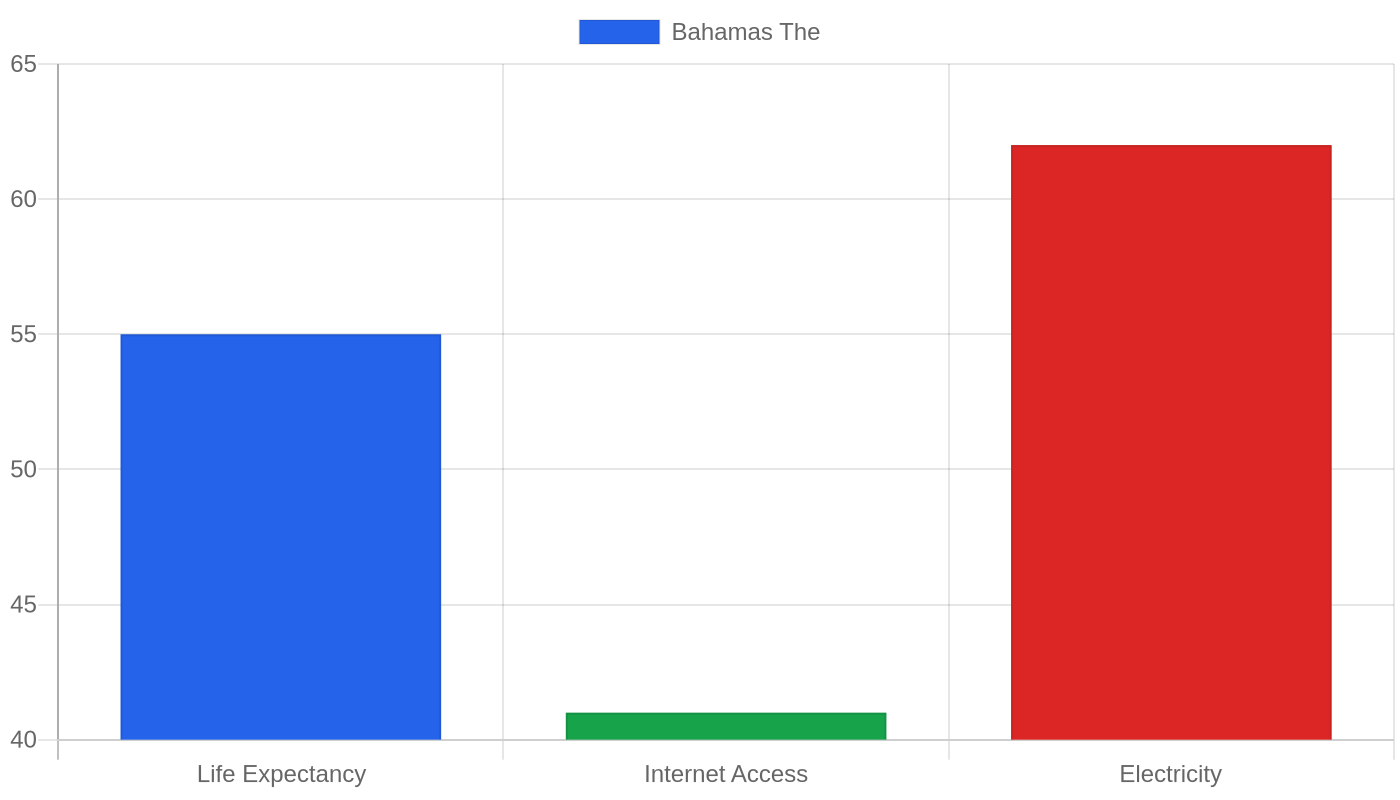
The World Bank data presents a challenging picture for analysts, as key metrics such as GDP growth, inflation, and unemployment are currently listed as unavailable. This data gap itself tells a story — it reflects the practical difficulties of economic measurement in small island states, where statistical capacity is often stretched and data collection can lag behind real-world developments. Nevertheless, the underlying economic model remains intact.
The Bahamas generates significant per-capita wealth through its service industries, though this wealth is distributed unevenly across the archipelago. The economy’s performance is closely tied to external factors — particularly the health of global travel markets and the regulatory environment for international finance. When global tourism thrives, the Bahamas prospers; when travel demand falters, the islands feel the pinch acutely.
The absence of current inflation data from the World Bank does not diminish the reality that price pressures, particularly in food and energy categories, remain a persistent concern for Bahamian households. As an import-dependent economy, the country is inherently exposed to global commodity price fluctuations, and local consumers have historically faced higher prices than their mainland counterparts for basic goods.
The unemployment picture, while not captured in the latest data, is seasonally influenced by tourism cycles, with employment typically surging during peak travel seasons and contracting during off-peak periods. This structural seasonality is a defining characteristic of the Bahamian labor market, and it shapes everything from household financial planning to government fiscal policy.
The Price of Paradise: Navigating a High-Cost Reality
Living in the Bahamas comes at a premium, and the cost of living profile reflects the country’s status as a high-end Caribbean destination. The World Bank’s classification of the Bahamas as a high-income nation is consistent with the price levels observed across the archipelago.
Housing, in particular, represents a significant household expense, with property prices in desirable areas — particularly in Nassau and on the Family Islands — reflecting strong demand from both locals and international buyers. The rental market is similarly robust, with quality accommodation commanding substantial monthly rents that would be considered elevated by regional standards.
For Bahamians, the decision to rent versus buy is often dictated by access to financing, as mortgage rates and down payment requirements can be prohibitive for first-time buyers.
Daily expenses in the Bahamas are shaped by the country’s import dependence. The World Bank’s data on the country’s economic structure implies a heavy reliance on imported food, fuel, and manufactured goods, all of which arrive with shipping costs and import duties that are passed on to consumers. Grocery bills in the Bahamas are notably higher than in larger, more diversified economies, and this price differential is a constant source of household budget pressure.
Utilities, particularly electricity, also represent a significant monthly outlay, as the country’s energy infrastructure has historically relied on imported fossil fuels. The cost of transportation, healthcare, and education round out the household budget, and all carry premium pricing relative to regional comparators.
While salaries in the financial services and tourism management sectors can be competitive, the overall cost structure means that disposable income can be quickly absorbed by essential expenditures.
The Business Climate: Where Capital Meets Caribbean Opportunity
The Bahamian business environment is defined by its dual focus on tourism infrastructure and financial services. The country’s top companies are predominantly concentrated in these sectors, ranging from hotel and resort operators to international banks and trust companies.
The presence of these established players creates a business ecosystem that is sophisticated by regional standards, with a professional services sector — legal, accounting, and consulting firms — that supports the needs of international clients. The government has, in recent years, signaled interest in diversifying the economic base, with attention paid to sectors such as technology-enabled services and renewable energy.
However, the pace of diversification has been gradual, and the economy remains substantially reliant on its traditional strengths.
For investors, the Bahamas offers a stable regulatory environment within a well-established legal framework. The country’s political stability and English-speaking workforce are significant advantages, as is its geographic proximity to major markets. The business registration process is generally straightforward, though navigating local permitting and licensing requirements can require local knowledge and partnerships.
The financial services sector, in particular, operates under a regulatory regime that has evolved to meet international standards, and this has helped maintain the country’s reputation as a credible offshore jurisdiction. The World Bank’s country classification underscores the sophistication of the market, and for businesses seeking a Caribbean base with a high level of professional service, the Bahamas remains an attractive option.
Sectors to watch include luxury tourism, where the country continues to attract high-end resort development, and the broader financial services industry, which is adapting to a changing global regulatory environment.
Stability and Society: The Social Contract in the Islands
The political landscape of the Bahamas is characterized by democratic governance and orderly transitions of power. The country operates as a parliamentary democracy within the Commonwealth, and its political institutions have demonstrated resilience over decades of independence. Elections are held regularly, and power has alternated between the two major political parties, a sign of a healthy, functioning democratic system.
The World Bank data does not provide specific crime or safety indices for the country, but the broader context suggests that while the Bahamas faces typical Caribbean challenges related to crime, the overall political and social environment remains stable. The rule of law is generally respected, and the judicial system operates independently, providing a reliable mechanism for dispute resolution.
Quality of life in the Bahamas is a mixed picture. The natural beauty of the islands offers an unparalleled lifestyle backdrop, and many residents enjoy a high standard of living. However, the cost of living pressures, income inequality, and the vulnerability to hurricanes and other climate-related events are persistent concerns.
The social safety net is less comprehensive than in many developed nations, and economic opportunities can be unevenly distributed across the islands, with New Providence and Grand Bahama attracting the bulk of investment and employment. The country’s cultural richness, from Junkanoo to its vibrant music and arts scene, contributes significantly to the quality of life, as does the strong sense of community that characterizes Bahamian society.
For expatriates and international residents, the Bahamas offers an attractive lifestyle, but it is one that comes with a price tag that reflects the premium nature of the destination.
Current Affairs: Adapting to a Post-Pandemic World
The Bahamas is currently navigating a period of adaptation and renewal. The global pandemic delivered a severe shock to the tourism-dependent economy, and the recovery has been a central focus of government policy. The country has been working to rebuild its visitor numbers, while simultaneously pursuing economic reforms aimed at strengthening resilience. The government has engaged with international financial institutions and partners to address debt sustainability and to fund infrastructure improvements.
There is a palpable sense that the country is at a crossroads, with decisions being made about the future direction of the economy — whether to double down on traditional strengths or to pursue a more diversified approach.
According to the World Bank, the data environment remains challenging, but the broader narrative is one of cautious optimism. The tourism sector is showing signs of recovery, and the financial services industry continues to adapt to evolving international regulations. The government has announced initiatives related to improving the ease of doing business and has signaled interest in sectors such as digital finance and sustainable energy.
These are early-stage developments, but they indicate a willingness to evolve. The country is also engaged in ongoing discussions about climate resilience, recognizing that the long-term sustainability of the economy depends on protecting the natural assets that underpin its tourism industry. The Bahamas is not standing still; it is actively seeking to redefine its economic model for a new era.
The Bottom Line
The Bahamas presents a compelling, if nuanced, investment and economic story. For investors seeking exposure to the Caribbean’s premium tourism and financial services sectors, the country offers a stable, well-regulated environment with significant upside potential. For businesses and individuals considering relocation, the high cost of living is offset by a high quality of life and a sophisticated service economy.
The data gaps in the World Bank’s latest report are a reminder of the challenges of economic measurement in small island states, but they do not diminish the fundamental strengths of the Bahamian economy. This is a country with established institutions, a strategic location, and a clear sense of its economic identity. The coming years will be defined by how successfully it navigates the twin imperatives of economic diversification and climate resilience.
For those who understand the unique dynamics of island economies, the Bahamas remains a nation worth watching.
Sources & Methodology
This article is authored by Economic Pulse Net for informational and research purposes. Economic Pulse Net sources its data from multilateral institutions, national statistics bureaus, and proprietary databases. All data is believed to be current as of the date of publication.
Published: August 01, 2026 | Category: Research — Bahamas The
Use these signals in your own platform
Economic Pulse publishes its live signal feed through a documented, read-only API. Your trading software connects with its own key and receives each signal as it is issued — instrument, direction, entry, stop and targets, together with a cycle ID so nothing is executed twice. The feed is independent of this website and cannot change it.
Signals are informational only and are not financial advice.