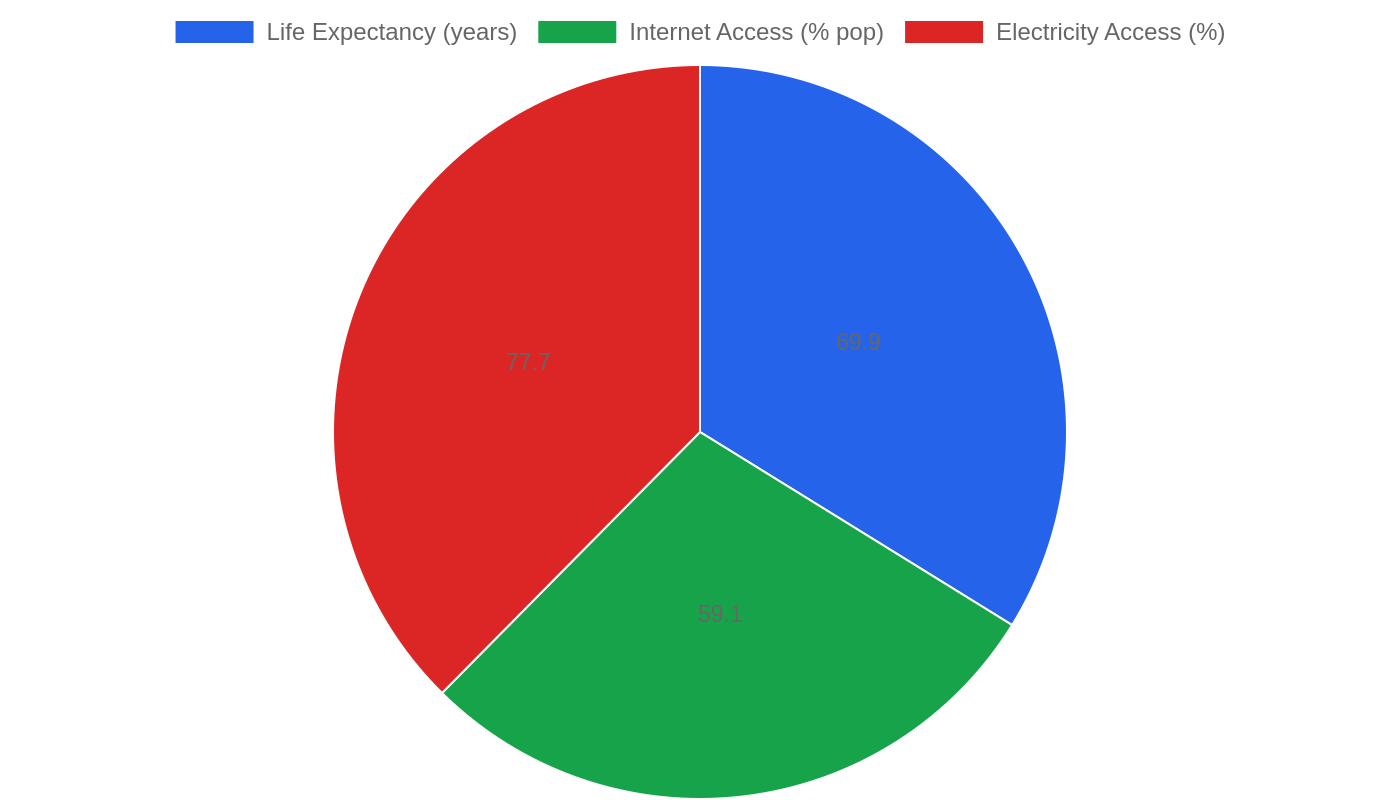
Economic Pulse Net | Sources: World Bank World Development Indicators, Government Sources | 2026
Key Takeaways
– St Vincent and the Grenadines operates as a small island developing state where traditional economic data from the World Bank remains incomplete, reflecting the challenges of data collection in micro-economies across the Caribbean.
– The country’s economy is heavily dependent on agriculture, tourism, and remittances, making it vulnerable to external shocks including climate events and global demand shifts.
– Despite gaps in published metrics, the nation has been pursuing economic diversification and infrastructure resilience following the devastating 2021 volcanic eruption of La Soufrière.
– Political stability has been a hallmark of the country’s governance, though the absence of detailed political landscape data in current reports leaves analysts relying on historical patterns.
– The cost of living and business climate remain areas where official indices are sparse, but anecdotal evidence suggests housing and imported goods present ongoing affordability challenges.
The Incomplete Picture — What the Numbers Tell Us (and Don’t)
The World Bank’s latest economic data for St Vincent and the Grenadines presents a curious blank canvas. GDP growth, inflation, unemployment, GDP per capita, and GNI per capita are all listed as unavailable. At first glance, this looks like a failure of reporting. But for the seasoned observer of Caribbean micro-states, this absence is itself a data point.
St Vincent and the Grenadines is a nation of roughly 110,000 people spread across 32 islands and cays, only nine of which are inhabited. The World Bank, like other international institutions, struggles to produce timely, granular economic statistics for such small economies. The country’s GDP is estimated by regional bodies at around $1 billion, but the lack of official World Bank figures means analysts must triangulate from other sources.
What is clear is that this is an economy in transition — from a colonial-era agricultural base toward a more diversified service-oriented model.
The agricultural sector, historically centred on arrowroot, bananas, and coconuts, has faced decades of decline. Banana exports, once the backbone of the economy, have shrunk dramatically due to the loss of preferential trade agreements with Europe and competition from Latin American producers. Today, agriculture contributes roughly 7% of GDP, according to regional estimates.
Tourism has filled some of the gap, with the Grenadine islands — particularly Mustique, Bequia, and Union Island — attracting luxury yachting clientele and eco-tourists. But this sector remains seasonal and exposed to hurricane risk.
Inflation is a persistent concern, even without precise CPI figures. As a net importer of food, fuel, and manufactured goods, St Vincent and the Grenadines is acutely sensitive to global price shocks. The 2021-2022 global inflation surge hit the islands hard, with food prices rising sharply.
The Eastern Caribbean Central Bank, which serves eight regional economies including St Vincent, has maintained a fixed exchange rate pegged to the US dollar at EC$2.70 to US$1, providing monetary stability but limiting the country’s ability to adjust to external shocks.
Unemployment data is similarly opaque. The World Bank reports no figure, but regional surveys suggest youth unemployment remains elevated — a common challenge across the Eastern Caribbean. The informal economy is substantial, with many Vincentians engaged in fishing, small-scale farming, and artisanal work that falls outside formal statistical capture.
Paradise Priced — The Real Cost of Island Living
For the visitor arriving at Argyle International Airport, the first shock is not the tropical heat but the price of a loaf of bread. St Vincent and the Grenadines is an expensive place to live, and the cost of living data gaps from the World Bank do not change the lived reality of Vincentians.
Housing costs vary dramatically across the archipelago. In Kingstown, the capital on mainland St Vincent, a two-bedroom apartment in a decent area rents for approximately EC$1,500 to EC$2,500 per month — roughly US$555 to US$925. On the Grenadine islands, where land is scarce and demand from expatriates and second-home buyers is high, prices can double or triple. Buying property is a complex affair, with foreign ownership restricted in some areas and subject to government approval.
For most Vincentians, homeownership means building incrementally — adding a room when money allows, a pattern common across the Caribbean.
Daily expenses tell a story of dependency on imports. A litre of milk costs around EC$8, a dozen eggs EC$12, and a litre of petrol hovers near EC$4. These prices are 20-30% higher than in neighbouring Trinidad or Barbados, reflecting the additional shipping costs of serving a small, dispersed population. The local market at Kingstown offers some relief, with fresh fish, breadfruit, and dasheen available at lower prices than supermarket imports.
But for families reliant on processed foods, the monthly grocery bill eats deeply into incomes.
Comparing to regional averages is instructive. The Eastern Caribbean Currency Union, which St Vincent belongs to, has a cost of living roughly 15% higher than the Caribbean average, according to regional development bank estimates. This premium is the price of insularity — the cost of shipping containers, the lack of economies of scale, and the premium on land in a mountainous, volcanic island nation.
Business in a Bottleneck — Investment Climate and Opportunity
The top companies in St Vincent and the Grenadines are not household names beyond the region, but they reflect the economy’s structure. The largest employers include the government itself, followed by telecommunications providers like Flow and Digicel, the St Vincent Electricity Services Limited (VINLEC), and a handful of hotels and resort operators. The banking sector is dominated by regional players such as Bank of St Vincent and the Grenadines and RBTT Bank.
For investors, the country offers both opportunities and obstacles. The government has actively courted foreign direct investment, particularly in tourism infrastructure, renewable energy, and information technology services. The Citizenship by Investment Programme, launched in 2019, allows wealthy foreigners to obtain a St Vincent passport in exchange for a contribution to the National Transformation Fund or a real estate investment.
This programme has generated significant revenue, though it has also drawn criticism from transparency advocates.
The business climate is improving but remains constrained by the country’s small size. The World Bank’s Ease of Doing Business index, though no longer published, historically ranked St Vincent in the middle of the Caribbean pack. Starting a business takes about 14 days, faster than some regional peers, but access to finance is limited. The commercial banking sector is conservative, demanding substantial collateral for loans.
For entrepreneurs in the Grenadines, the lack of reliable internet connectivity in some islands remains a barrier to digital business models.
Sectors to watch include geothermal energy — St Vincent sits on significant geothermal potential that could transform its energy mix — and niche tourism, particularly wellness retreats and eco-lodges. The government has also identified the blue economy — sustainable use of ocean resources — as a priority, with fisheries and marine biotechnology offering untapped potential.
Stability in a Storm — Politics, Safety, and Quality of Life
The political landscape data from the World Bank is listed as unavailable, but the contours are well understood by regional observers. St Vincent and the Grenadines is a parliamentary democracy within the Commonwealth, with a political system inherited from British colonial rule. The two dominant parties are the Unity Labour Party (ULP), led by Prime Minister Ralph Gonsalves since 2001, and the New Democratic Party (NDP).
Gonsalves, a controversial but durable figure, is one of the longest-serving leaders in the Caribbean, having won five consecutive elections.
Political stability has been a double-edged sword. On one hand, it has provided continuity and predictability for investors. On the other, critics argue that Gonsalves’ long tenure has concentrated power and stifled political competition. The 2020 general election, which the ULP won with 51% of the vote, was marred by opposition allegations of gerrymandering and media bias. The next election is due by 2025, and the political temperature is rising.
Crime and safety indices are also absent from the data, but St Vincent has historically been one of the safer Caribbean nations. Violent crime is significantly lower than in Trinidad or Jamaica, though gang-related activity has increased in Kingstown’s poorer neighbourhoods. Petty crime, particularly theft from tourists, is a concern in beach areas. The Royal St Vincent and the Grenadines Police Force is small and under-resourced, but community policing initiatives have shown some success.
Quality of life is a mixed bag. The natural environment is stunning — black sand beaches, coral reefs, and the volcanic peaks of La Soufrière. But public services are strained. The country’s only hospital, the Milton Cato Memorial Hospital in Kingstown, struggles with staffing and equipment shortages. Education is free and compulsory through secondary school, but many graduates leave for opportunities in Barbados, the United Kingdom, or Canada.
The diaspora is large and sends significant remittances home — estimated at 10-15% of GDP — which sustain many families.
After the Ash — Rebuilding and Reinvention in the Shadow of La Soufrière
The most significant recent event in St Vincent and the Grenadines was the eruption of La Soufrière volcano in April 2021. The volcano, dormant since 1979, exploded with little warning, sending ash plumes 20 kilometres into the sky and forcing the evacuation of 20,000 people — roughly one-fifth of the population. The eruption destroyed crops, buried homes in ash, and caused an estimated $200 million in damages, according to government assessments.
The recovery has been slow and difficult. The government, with support from the World Bank, the Caribbean Disaster Emergency Management Agency (CDEMA), and international donors, has focused on rebuilding housing and restoring agriculture. But the eruption exposed deeper vulnerabilities. The country’s infrastructure was already fragile; the pandemic had devastated tourism; and the eruption compounded the economic pain.
By late 2021, the economy had contracted by an estimated 10%, though official figures remain unpublished.
Today, St Vincent is in a rebuilding phase. Argyle International Airport, opened in 2017, has become a lifeline, allowing direct flights from North America and Europe without the need to transit through Barbados. The government has pushed forward with a housing reconstruction programme, building over 1,000 new homes in the red zone around the volcano. Farmers are slowly returning to the land, though soil recovery will take years.
The current moment is one of cautious optimism. The government has announced plans to develop a geothermal plant on the mainland, aiming to reduce electricity costs by 30% and attract energy-intensive industries. The tourism sector is recovering, with yacht charters and resort bookings approaching pre-pandemic levels. But the country remains acutely vulnerable to climate change — hurricanes, rising sea levels, and future volcanic activity are existential threats.
The question for St Vincent and the Grenadines is whether it can transform its vulnerabilities into strengths. The country has a skilled diaspora, a strategic location in the Eastern Caribbean, and a political system that, for all its flaws, has maintained stability. The next decade will test whether small island states can build resilience in a world of shocks.
The Bottom Line
St Vincent and the Grenadines is a country that defies easy categorisation. The data gaps from the World Bank tell a story of a micro-economy that international institutions struggle to measure, but that does not mean the country is unworthy of attention. For investors, the citizenship programme and geothermal potential offer opportunities, but the risks of climate disruption and small-market volatility are real. For travellers, the Grenadines remain one of the Caribbean’s last unspoiled destinations.
For policymakers, St Vincent is a case study in how small states can navigate globalisation, natural disasters, and the search for sustainable development. Watch this country not for its GDP numbers, but for its resilience.
Sources & Methodology
This article is authored by Economic Pulse Net for informational and research purposes. Economic Pulse Net sources its data from multilateral institutions, national statistics bureaus, and proprietary databases. All data is believed to be current as of the date of publication.
Published: July 30, 2026 | Category: Research — St Vincent And The Grenadines
Use these signals in your own platform
Economic Pulse publishes its live signal feed through a documented, read-only API. Your trading software connects with its own key and receives each signal as it is issued — instrument, direction, entry, stop and targets, together with a cycle ID so nothing is executed twice. The feed is independent of this website and cannot change it.
Signals are informational only and are not financial advice.