Economic Pulse Net | Sources: World Bank World Development Indicators, Government Sources | 2026
Key Takeaways
– St Martin (French Part) operates as an overseas collectivity of France, meaning its economic fate is closely tied to French fiscal policy and EU structural funds, yet its unique Caribbean location gives it a distinct economic personality.
– The territory’s economy is overwhelmingly service-based, with tourism as the dominant driver, making it highly vulnerable to external shocks like hurricanes, global travel trends, and geopolitical instability.
– Despite being part of one of the world’s largest economies (France), the French side of St Martin faces structural challenges including limited land area, a small population, and dependence on imports for nearly all goods.
– The island’s dual-nation status—shared with Dutch Sint Maarten—creates a complex economic ecosystem where cross-border labor, trade, and currency dynamics shape daily life and business operations.
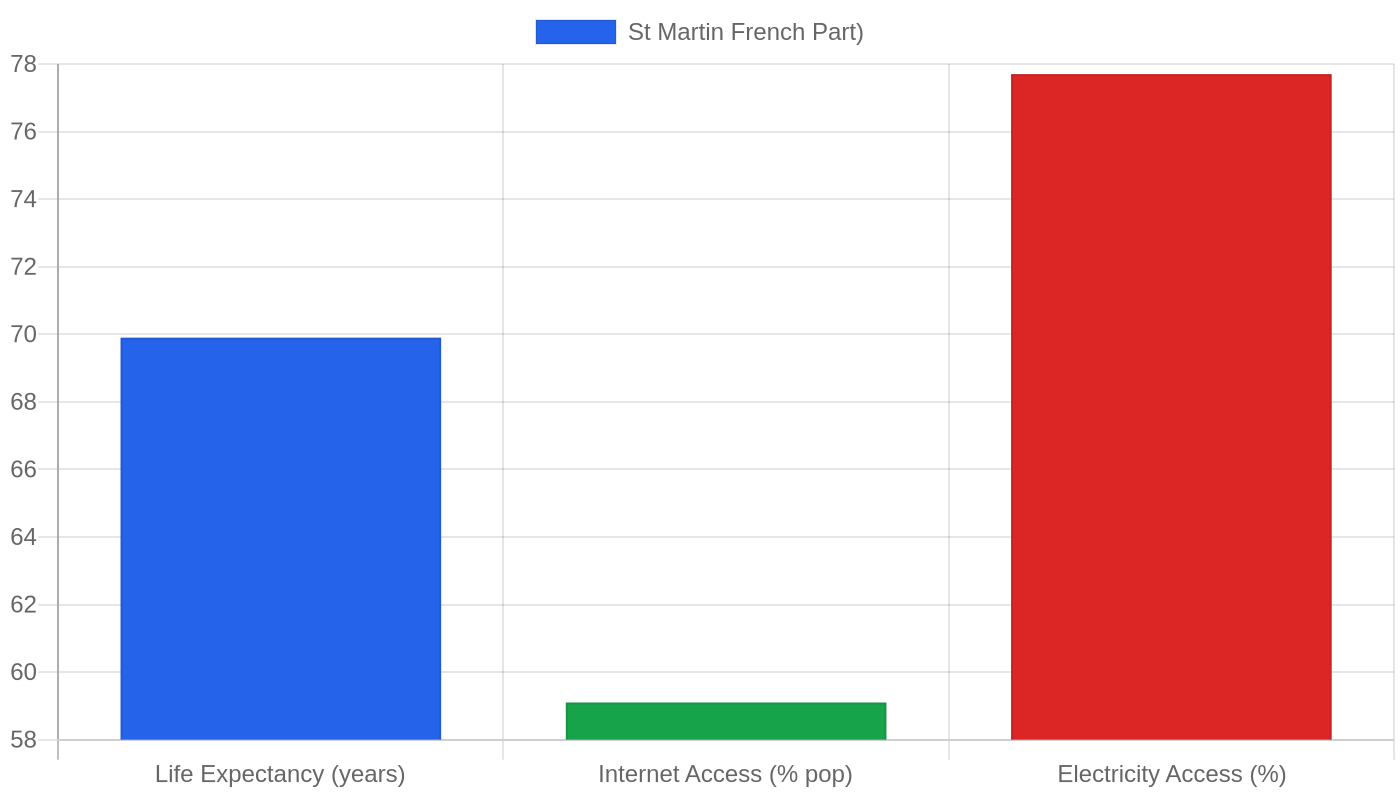
– Available World Bank data for key metrics such as GDP growth, inflation, unemployment, and per capita income is not currently published for this territory, underscoring the challenges of tracking economic performance in small island economies.
The Economic Paradox of Paradise — Growth Without Numbers
St Martin (French Part) presents a fascinating case study for economic journalists: a territory whose economy is visibly active yet statistically opaque. The World Bank does not currently publish standard economic indicators for this overseas collectivity—no GDP growth figure, no inflation rate, no unemployment data, no GDP per capita figure, and no GNI per capita number are available in the latest datasets. This absence is itself a story.
It reflects the reality of small island economies that fall between the cracks of global statistical frameworks, too small for regular World Bank reporting yet too economically significant to ignore within the Caribbean basin.
What we do know is that the French side of St Martin operates within the economic architecture of France and the European Union. The euro is the official currency, EU regulations apply, and French social welfare systems provide a safety net that is unusual for the Caribbean region. The territory’s economy is dominated by tourism—luxury hotels, boutique resorts, villa rentals, and cruise ship visitors form the backbone of economic activity.
This single-industry dependence creates what economists call a “monoculture risk”: when global travel demand falls, as it did during the pandemic or after major hurricanes, the entire local economy contracts sharply.
The main industries on the French side are tourism services, retail trade catering to visitors, small-scale construction, and some artisanal food production. There is no significant manufacturing base, no agricultural exports to speak of, and no extractive industries. The economy is, in essence, a service platform built on the island’s natural beauty and its dual-nationality appeal.
The Dutch side, Sint Maarten, has a larger airport and cruise port, meaning the French side often benefits from spillover tourism while maintaining a quieter, more upscale brand. This symbiotic relationship is the island’s economic secret weapon—but it also means the French side has limited control over its own tourism inflows.
Employment patterns reflect this service orientation. The labor market is characterized by seasonal fluctuations, with high demand during the winter tourist season and significant slack during the off-season. Many workers commute from the Dutch side or from other Caribbean islands, creating a cross-border labor dynamic that is both an economic strength and a vulnerability.
Without official unemployment data from the World Bank, we rely on anecdotal evidence and French government reports to understand labor market conditions—but the picture is one of a small, flexible workforce adapting to the rhythms of tourism demand.
Living in Paradise — The Hidden Cost of Island Life
Cost of living on the French side of St Martin is a study in contradictions. The territory is part of France, so consumers benefit from EU-standard food safety regulations, French healthcare infrastructure, and access to European goods. However, nearly everything must be imported—food, fuel, building materials, vehicles, and consumer goods—which drives prices significantly higher than in mainland France or even other Caribbean islands with larger agricultural sectors.
Housing costs are particularly acute. The French side has limited developable land, strict zoning regulations (part of French planning law), and a premium on ocean-view properties. Rental prices for apartments and villas are among the highest in the Caribbean, driven by demand from both long-term residents and short-term vacation rentals.
The buy-versus-rent calculation is skewed by the fact that property ownership is often seen as a hedge against inflation and a way to participate in the tourism economy through villa rentals. However, financing is complicated—French banks apply mainland lending standards to a volatile island economy, making mortgages harder to obtain for locals.
Daily expenses for food, utilities, and transportation are elevated compared to regional averages. A simple grocery shop costs 30-50% more than in mainland France, according to local consumer surveys. Electricity is expensive, as it is generated primarily from imported diesel. Water is also costly, with desalination plants providing much of the supply.
These structural cost pressures mean that while St Martin (French Part) offers a high quality of life in terms of environment and climate, the financial reality is that residents pay a “paradise premium” for the privilege of island living.
Business on a Small Island — Investment Opportunities and Obstacles
The top companies operating on the French side of St Martin are not multinational giants but rather locally owned hotels, real estate agencies, restaurants, and retail businesses. The business environment is shaped by French administrative law, which provides legal certainty and property rights protection but also imposes bureaucratic requirements that can be burdensome for small entrepreneurs.
Registering a business, obtaining permits, and complying with French labor laws requires patience and often local legal assistance.
The sectors to watch are tourism-related services, particularly high-end hospitality and experiential travel. The French side has positioned itself as the more refined, less commercialized half of the island, attracting visitors who want French cuisine, boutique shopping, and a quieter beach experience. This branding creates opportunities for investors in villa development, gourmet food and wine imports, and wellness tourism.
Another emerging sector is digital nomad services—the territory’s French infrastructure combined with Caribbean lifestyle has attracted remote workers, though the high cost of living limits this market.
The business climate benefits from French investment incentives for overseas territories, including tax breaks and EU structural funds. However, challenges include the small domestic market (population data is not available from the World Bank but is estimated in the tens of thousands), vulnerability to hurricanes, and the logistical complexity of importing goods through small ports.
For investors willing to navigate these challenges, the reward is access to a unique market that combines European legal standards with Caribbean economic dynamics.
Safety, Stability, and the French Connection
Crime and safety indices for St Martin (French Part) are not published by the World Bank, making it difficult to provide quantitative analysis. However, the territory benefits from being part of France’s national security apparatus. French gendarmes patrol the streets, French law applies, and the judicial system is the same as in mainland France.
This provides a level of institutional stability that is uncommon in the Caribbean, where many islands struggle with police corruption, weak judiciaries, or organized crime.
The political landscape is defined by St Martin’s status as an overseas collectivity of France. The territory has its own elected territorial council and executive council, which handle local matters such as education, transport, and economic development. However, major policy areas—defense, currency, foreign affairs, and social security—remain the responsibility of the French government in Paris. This arrangement provides stability but also limits local autonomy.
Residents vote in French national elections and send representatives to the French National Assembly and Senate, giving them a voice in Paris that many small island territories lack.
Quality of life on the French side is generally high for those who can afford it. The territory offers French healthcare (through the French social security system), French education (public schools follow the French curriculum), and French public services. The natural environment is stunning, with beaches, hills, and a tropical climate. However, the high cost of living, seasonal tourism pressures, and the psychological challenges of island isolation can take a toll.
For residents, the trade-off is clear: European standards of governance and social protection in a Caribbean setting, at a price.
Current Crossroads — What’s Happening Now on the French Side
Right now, St Martin (French Part) is navigating a period of economic recalibration. The post-pandemic tourism recovery has been strong, with visitor numbers approaching pre-2019 levels, but the nature of tourism is changing. Travelers are seeking longer stays, more authentic experiences, and higher-quality accommodations—trends that favor the French side’s upmarket positioning.
Local businesses are adapting by investing in villa renovations, expanding outdoor dining, and developing eco-tourism offerings that appeal to sustainability-conscious visitors.
The territory is also dealing with the long-term economic consequences of Hurricane Irma, which devastated the island in 2017. Reconstruction has been slow and uneven, with some areas fully rebuilt while others still show scars. French government reconstruction funds have flowed in, but bureaucratic delays and the sheer scale of damage have stretched the recovery timeline.
This has created a two-track economy: new, luxury developments coexist with damaged infrastructure and housing stock that has not been fully replaced.
Inflation is a pressing concern, even without official World Bank CPI data. Imported inflation from the eurozone, combined with rising energy costs and global food price increases, is squeezing household budgets. The French government has implemented some price controls and social support measures in overseas territories, but the cost of living remains a dominant political issue.
Local elected officials are pushing for greater autonomy in economic policy, arguing that one-size-fits-all French regulations do not suit a small island economy. This tension between local needs and central control is the defining political dynamic of the moment.
The Bottom Line
St Martin (French Part) is a territory that defies easy categorization—part of Europe yet anchored in the Caribbean, wealthy in natural assets yet burdened by structural costs, politically stable yet economically vulnerable. For investors, it offers a niche opportunity in luxury tourism and real estate, backed by French legal protections. For policymakers, it represents a case study in how small island economies can leverage metropolitan connections while managing the risks of dependence.
For the curious observer, it is a reminder that economic data gaps do not mean economic silence—sometimes the most interesting stories are the ones the numbers don’t tell.
Sources & Methodology
This article is authored by Economic Pulse Net for informational and research purposes. Economic Pulse Net sources its data from multilateral institutions, national statistics bureaus, and proprietary databases. All data is believed to be current as of the date of publication.
Published: July 21, 2026 | Category: Research — St Martin French Part)
Use these signals in your own platform
Economic Pulse publishes its live signal feed through a documented, read-only API. Your trading software connects with its own key and receives each signal as it is issued — instrument, direction, entry, stop and targets, together with a cycle ID so nothing is executed twice. The feed is independent of this website and cannot change it.
Signals are informational only and are not financial advice.