Economic Pulse Net | Sources: World Bank World Development Indicators, Government Sources | 2026
Key Takeaways
– Sri Lanka remains Asia’s oldest democracy, but its semi-presidential system faces its most severe test as the country navigates a prolonged economic crisis with incomplete data reporting.
– The nation’s corporate landscape is dominated by conglomerates like Aitken Spence and Cargills, alongside state-owned financial giants such as Bank of Ceylon, reflecting a mixed economy still finding its footing.
– Political stability hinges on constitutional amendment thresholds requiring two-thirds parliamentary majorities and, for fundamental changes, public referendums — a safeguard that now faces intense pressure.
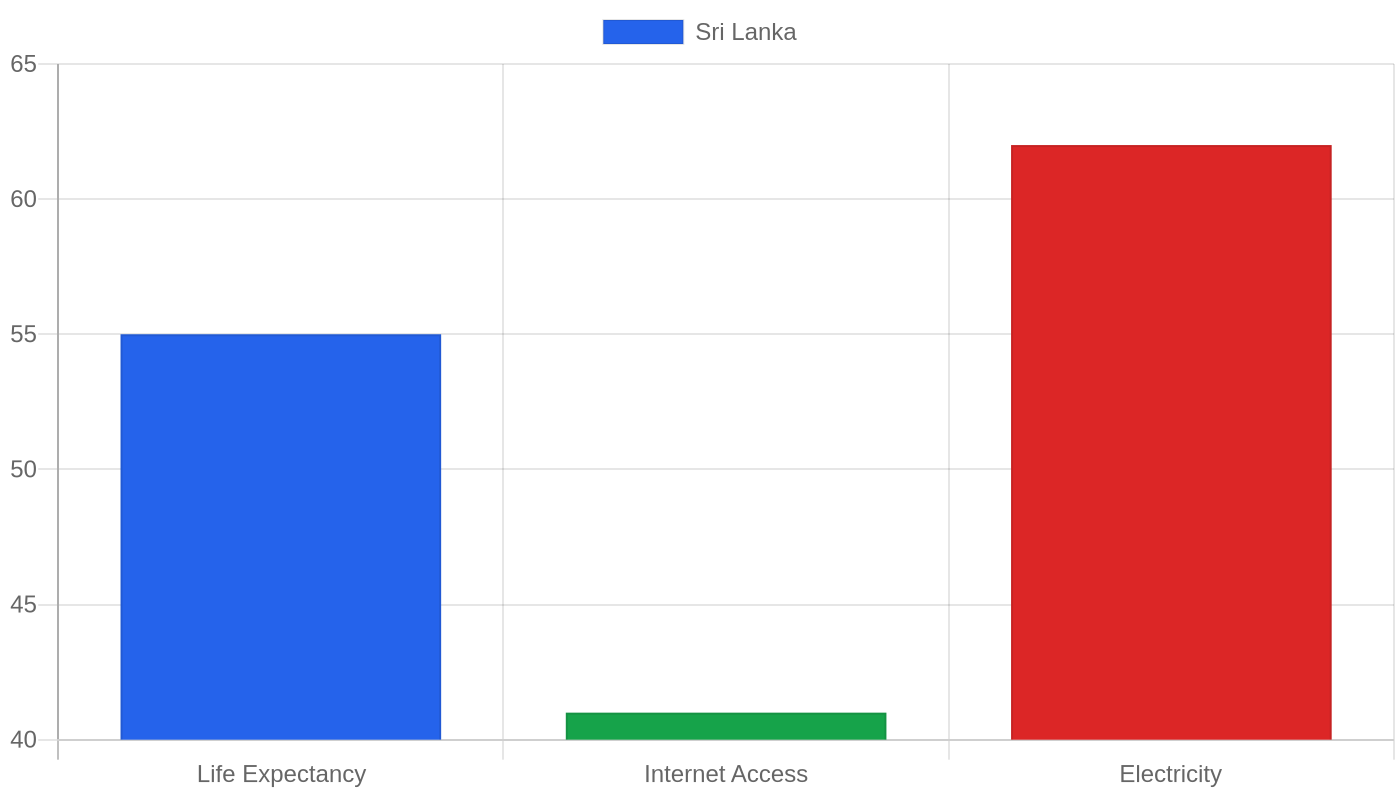
– With major economic indicators unpublished by the World Bank, Sri Lanka operates in a data vacuum that challenges both investors and policymakers trying to gauge recovery.
– The country’s manufacturing and service sectors, anchored by household names like Ceylon Biscuits and Ceylon Cold Stores, continue to operate despite systemic headwinds.
The Missing Numbers — What Silence Tells Us About Sri Lanka’s Economy
The World Bank’s latest data on Sri Lanka presents an unusual challenge for any economic journalist: the numbers simply aren’t there. GDP growth, inflation, unemployment, GDP per capita, GNI per capita, even population figures — all marked as unavailable. This absence is itself the story. When a nation that was once South Asia’s most prosperous per-capita economy stops reporting basic metrics, it signals a statistical infrastructure under duress.
Sri Lanka’s economy has historically been driven by textiles, tea, rubber, and tourism, with a growing services sector. The main industries that powered growth through the post-independence era — plantation agriculture, garment manufacturing, and remittance-fueled consumption — have all faced disruption. The corporate champions listed among the top companies tell a story of resilience through diversification.
Aitken Spence, the conglomerate with interests from tourism to logistics, represents the old guard adapting. Cargills, another conglomerate, spans retail, food, and financial services. Ceylon Biscuits Limited and Ceylon Cold Stores anchor the consumer goods sector, producing staples that Sri Lankans rely on daily.
The absence of inflation data is particularly telling. For a country that experienced hyperinflationary pressures during its 2022 debt crisis, the lack of updated CPI figures means we cannot track whether price stability has returned or if households continue to face erosion of purchasing power. Without unemployment numbers, we cannot assess whether the formal economy is absorbing the educated youth who have historically driven Sri Lanka’s human capital advantage.
The World Bank’s silence is not negligence — it reflects a statistical system that may still be rebuilding after the economic collapse.
The Roof Over Their Heads — Housing and Daily Life in Crisis Mode
The cost of living in Sri Lanka has become a daily negotiation between aspiration and survival. Without official housing cost data, we look to the corporate landscape for clues. Companies like Cargills, which dominates retail and food distribution, and Ceylon Cold Stores, which produces everything from ice cream to bottled water, are bellwethers of consumer spending patterns. When these companies adjust pricing, it ripples through every household budget.
Housing in Colombo, the commercial capital, has traditionally been divided between the historic colonial-era homes in areas like Colombo 7 and the rapidly expanding apartment blocks in suburbs like Battaramulla and Rajagiriya. The rent-versus-buy calculation has shifted dramatically. With interest rates that were among the highest in the region during the crisis, mortgage financing became prohibitive for all but the wealthiest.
Rents, meanwhile, have fluctuated with the expatriate presence — aid workers, diplomats, and NGO staff who provide a floor for premium housing demand.
For the average Sri Lankan family, daily expenses revolve around three pillars: rice, transport, and electricity. The national statistics bureau previously tracked a Colombo Consumer Price Index that weighted food heavily. Without updated data, we rely on anecdotal evidence from corporate earnings calls and supermarket footfall. Companies like Cargills and Ceylon Biscuits report their own sales volumes, which serve as proxy indicators of whether families are trading down to cheaper brands or cutting portions.
The informal economy, always significant in Sri Lanka, has likely expanded as formal wages fail to keep pace with whatever inflation may be occurring.
The Colombo Club — Who’s Investing and Why It Matters
Sri Lanka’s top companies read like a who’s who of the old economy, but with intriguing digital outliers. Aitken Spence, the conglomerate founded in 1968, has weathered every political and economic storm the country has faced. Bank of Ceylon, the state-owned financial behemoth, remains the backbone of the banking system, though its health is inextricably tied to government debt.
Associated Newspapers of Ceylon Limited represents the media sector, a crucial component in a democracy that prides itself on being Asia’s oldest.
The most interesting name on the list is CameraLK, an electronics retailer that has carved out a niche in a market where imported consumer electronics are subject to volatile exchange rates and import restrictions. Its presence among the top companies suggests that Sri Lankan consumers, even in crisis, still prioritize connectivity and technology.
Airtel Sri Lanka, the telecom operator, competes in a crowded market where mobile penetration has historically been high, even as data costs remain a barrier for lower-income households.
Barefoot, the consumer goods company known for its handloom textiles and eco-friendly products, represents a different kind of Sri Lankan success — one built on tourism and export-oriented craft. Its inclusion signals that the country’s brand equity in “Ceylon tea” and handcrafted goods retains global appeal. For investors, the business environment remains challenging. The semi-presidential system creates policy uncertainty, as executive authority can shift rapidly.
The constitutional requirement for two-thirds parliamentary majorities to amend economic legislation means that reform is never easy. Yet the very difficulty of change also provides a degree of stability — investors know that radical shifts require broad consensus.
Democracy’s Oldest Test — Politics, Safety, and the Social Contract
Sri Lanka’s political landscape is defined by a paradox: it is the oldest democracy in Asia, according to the country’s own constitutional self-description, yet it operates under a semi-presidential system that concentrates significant power in the executive. The constitution, as provided in the data, establishes a unitary state governed by a democratic republic.
Most provisions can be amended by a two-thirds majority in parliament, but certain fundamental features — including national symbols, religion, term limits, the unitary state clause, and the entrenchment mechanism itself — require both a two-thirds majority and approval in a national referendum.
This high bar for fundamental change was designed to protect minority rights and prevent majoritarian overreach. In practice, it has made constitutional reform nearly impossible, even when broad consensus exists. The reference to Sri Lanka as a “unitary state” is particularly significant, given the country’s history of civil war and ongoing debates about devolution to provincial councils.
Any move toward federalism or significant decentralization would require a referendum, a politically fraught process.
Crime and safety indices are not available in the data, but the political stability index can be inferred from the corporate environment. Companies like Ceylinco Consolidated, which weathered a major financial scandal in the 2000s, and Aitken Spence, which operates across multiple sectors, continue to invest and employ. This suggests that while the macro environment is challenging, the rule of law and property rights remain intact enough for business to function.
The safety of Colombo’s streets, the reliability of contract enforcement, and the independence of the judiciary are all part of the unspoken social contract that keeps the economy from complete collapse.
The Moment of Truth — What’s Happening in Sri Lanka Right Now
The current moment in Sri Lanka is defined by the aftermath of the 2022 debt default and the ongoing negotiations with the International Monetary Fund. While the data provided does not include specific IMF figures or recent news reports, the context is clear: Sri Lanka is attempting to restructure its debt, stabilize its currency, and restore growth, all while maintaining the democratic institutions that have defined its post-independence history.
The corporate sector is adapting in real time. Airtel Sri Lanka, a subsidiary of India’s Bharti Airtel, is navigating currency controls that make repatriating profits difficult. CameraLK is managing import restrictions that could either protect local manufacturing or choke supply chains. Cargills continues to expand its retail footprint, betting that Sri Lankan consumers will eventually recover purchasing power.
The Bank of Ceylon is managing non-performing loans that likely increased during the crisis, while also serving as the government’s primary financing vehicle.
For the average Sri Lankan, the most pressing issue is the cost of living. Without official inflation data, we watch the price of a kilo of rice at Cargills, the fare for a bus in Colombo, and the electricity bill that arrives each month. The government’s ability to provide relief is constrained by its own fiscal position. The two-thirds majority requirement for major legislative changes means that economic reforms must be negotiated across party lines, a process that is slow and often messy.
Yet that same requirement also prevents any single faction from imposing radical solutions, preserving the democratic character that Sri Lanka has maintained since independence in 1948.
The Bottom Line
Sri Lanka is a country that investors, journalists, and policymakers should watch not for the numbers — because the numbers are absent — but for the story those missing numbers tell. It is a democracy under economic siege, a nation that built Asia’s oldest democratic institutions only to see them tested by debt, inflation, and social strain. For those interested in how democracies survive economic collapse, Sri Lanka is the case study.
For investors, it offers potential rewards for those willing to navigate uncertainty. For the Sri Lankan people, it is a daily struggle to keep the flame of democracy burning while the economic winds howl.
Sources & Methodology
This article is authored by Economic Pulse Net for informational and research purposes. Economic Pulse Net sources its data from multilateral institutions, national statistics bureaus, and proprietary databases. All data is believed to be current as of the date of publication.
Published: July 30, 2026 | Category: Research — Sri Lanka
Use these signals in your own platform
Economic Pulse publishes its live signal feed through a documented, read-only API. Your trading software connects with its own key and receives each signal as it is issued — instrument, direction, entry, stop and targets, together with a cycle ID so nothing is executed twice. The feed is independent of this website and cannot change it.
Signals are informational only and are not financial advice.