Economic Pulse Net | Sources: World Bank World Development Indicators, Government Sources | 2026
Key Takeaways
– Solomon Islands operates as a constitutional monarchy under King Charles III, with a parliamentary system that has shown signs of political volatility through frequent no-confidence votes and early dissolutions.
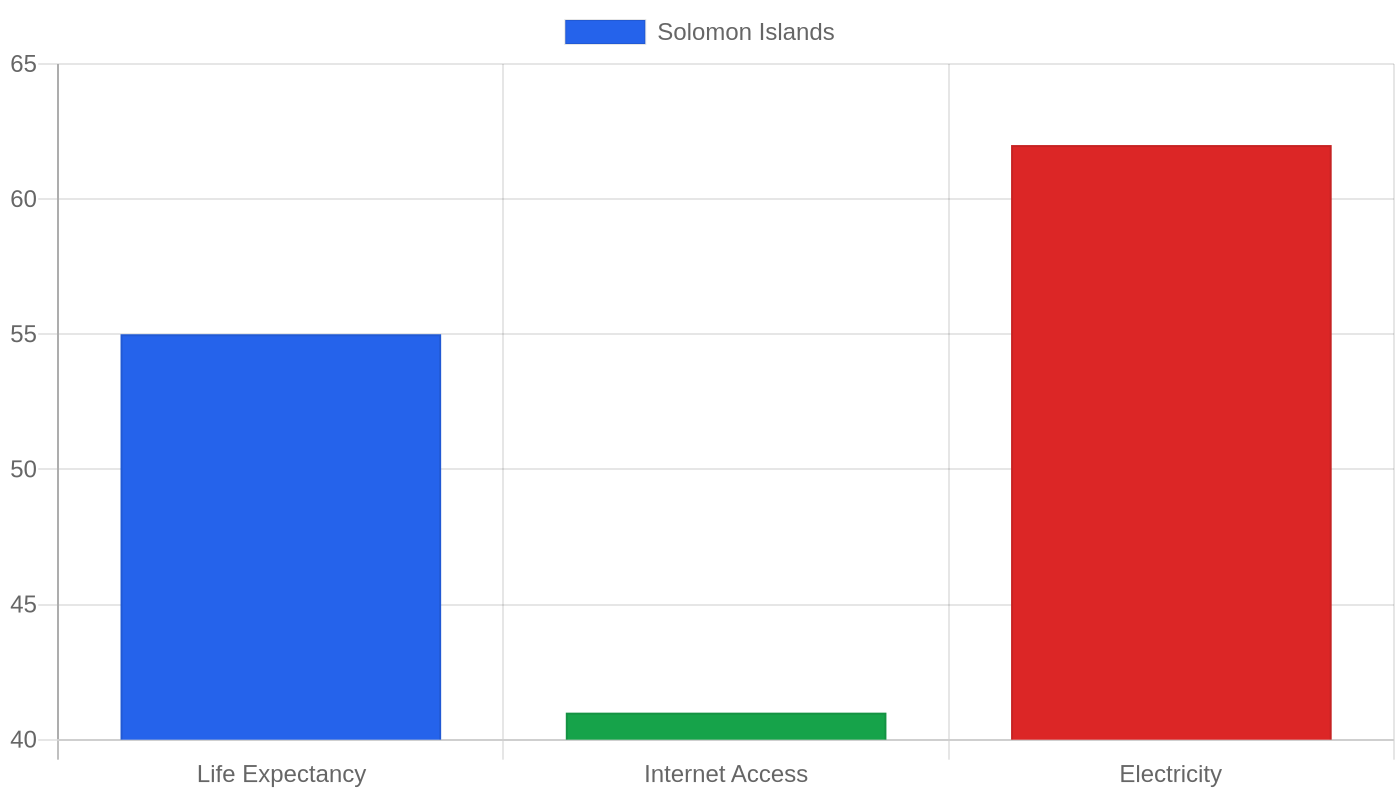
– The country’s economy remains heavily dependent on logging, fisheries, and agriculture, though data gaps from the World Bank make precise GDP, inflation, and employment figures impossible to verify at this time.
– Geopolitical tensions between traditional Western partners and China have reshaped the investment landscape, with infrastructure deals and security pacts drawing global attention to this small Pacific nation.
– Cost of living pressures, particularly in the capital Honiara, are widely reported by regional observers, driven by import dependence and logistical challenges across the archipelago.
– Crime and safety indices are unavailable from standard international databases, but local reporting suggests urban crime and land disputes remain persistent quality-of-life concerns.
The Numbers We Don’t Have — And What They Tell Us
The World Bank provides no GDP growth figure for Solomon Islands, no inflation rate, no unemployment statistic, no GDP in dollar terms, no GDP per capita based on purchasing power parity, and no GNI per capita. The population is unlisted. The main industries are unrecorded. The cost of living data is absent. The top companies are unnamed. The crime index and safety index are both marked “N/A.”
This absence of data is itself a story. It speaks to a nation that, despite its strategic importance in the Pacific, remains statistically invisible to many of the international institutions that track economic performance. Solomon Islands is not a country that generates regular, reliable macroeconomic statistics — and that fact matters for investors, aid donors, and policymakers trying to understand the archipelago’s trajectory.
What can be said is that Solomon Islands’ economy is traditionally built on three pillars: logging, which has long been the dominant export sector but faces sustainability concerns; fisheries, particularly tuna, which provides both domestic employment and export revenue; and subsistence agriculture, which supports the majority of the population across hundreds of islands.
Remittances from Solomon Islanders working abroad, particularly in seasonal labor programs in Australia and New Zealand, also contribute meaningfully to household incomes.
Without hard data, analysts rely on qualitative assessments from regional development banks and diplomatic reports. The picture that emerges is of a small, vulnerable economy — highly exposed to commodity price fluctuations, natural disasters, and the logistical costs of operating across a scattered archipelago. Inflation has been a persistent headache in recent years, driven by global fuel and food price shocks that hit import-dependent Pacific nations particularly hard.
Housing and Daily Life in an Island Economy
The cost of living in Solomon Islands is notoriously high by regional standards, a paradox for a country with low average incomes. Honiara, the capital and only significant urban center, sees rental prices that would surprise visitors expecting cheap Pacific living. A basic two-bedroom house in a reasonable area of Honiara can cost several thousand Solomon Islands dollars per month — a significant sum when formal sector wages are modest.
The explanation lies in geography and infrastructure. Almost everything consumed in Solomon Islands — from food to building materials to fuel — must be imported, shipped across long distances, and distributed across islands with limited roads, ports, and storage facilities. This supply chain premium inflates prices for everything. Local markets offer fresh fish, root crops, and tropical fruits at more affordable prices, but processed goods, household items, and imported foods carry heavy markups.
Land ownership adds another layer of complexity. Around 87% of land in Solomon Islands is held under customary tenure — meaning it belongs to clans or tribes, not individuals, and cannot be bought or sold in the conventional sense. This system protects indigenous rights but also makes housing development,抵押贷款, and urban planning extraordinarily difficult. In Honiara, land disputes are common, sometimes violent, and often drag through customary courts for years.
For most Solomon Islanders, daily expenses center on food, transport by boat or minibus, and school fees. Mobile phone and internet costs are high relative to incomes, though competition has brought prices down somewhat.
The absence of reliable cost-of-living indices from international databases means these observations come from anecdotal reporting and regional development agency assessments — but the consensus is clear: life in Solomon Islands is expensive, especially for those without access to customary land and subsistence resources.
Business and Investment — A High-Risk, High-Stakes Arena
The lack of a documented list of top companies from the World Bank data does not mean Solomon Islands lacks commercial activity. The economy is dominated by small-to-medium enterprises, state-owned utilities, and a handful of foreign-owned resource extraction firms. Logging companies, mostly Malaysian-owned, have been the largest private sector players for decades, though concerns about illegal logging and deforestation have led to regulatory crackdowns and export restrictions.
Fisheries represent the other major commercial opportunity. Solomon Islands has one of the richest tuna fisheries in the Pacific, and the government has pursued policies to increase domestic processing and value addition rather than simply selling fishing licenses to foreign fleets. The Noro tuna cannery in Western Province is a rare example of industrial-scale manufacturing in the country.
The investment climate is challenging. The World Bank’s own Doing Business surveys, before they were discontinued, consistently ranked Solomon Islands near the bottom globally for ease of doing business. Registering a business, obtaining construction permits, enforcing contracts, and getting credit are all slow, expensive, and bureaucratic processes. Corruption is a recognized problem, though data on its precise extent is unavailable from the provided sources.
The geopolitical dimension has transformed the investment landscape. Since switching diplomatic recognition from Taiwan to China in 2019, Solomon Islands has received significant Chinese infrastructure financing and development assistance. A new sports stadium, roads, and telecommunications upgrades have been funded through Chinese loans and grants.
The security pact signed with Beijing in 2022 — which allows Chinese police and military to deploy to Solomon Islands — has alarmed Australia, New Zealand, and the United States, triggering a new wave of Western aid and investment pledges to counter Chinese influence.
For investors willing to navigate the bureaucracy and political risks, the opportunities lie in fisheries, tourism (still underdeveloped despite spectacular diving and cultural assets), renewable energy, and agriculture. But the rule of law is weak, contract enforcement is unreliable, and political instability remains a constant risk.
Safety, Politics, and the Fragile Social Contract
The crime and safety indices are unavailable from the provided data, but local reporting and diplomatic security assessments paint a nuanced picture. Honiara experiences significant property crime, including break-ins and theft, and alcohol-fueled violence is a concern in urban settlements. Rural areas are generally safer, though land disputes can escalate into armed confrontations between clan groups.
The political landscape, as described in the data, is a constitutional monarchy with King Charles III as head of state, represented by a Governor-General chosen by Parliament for a five-year term. The unicameral Parliament has 50 members elected for four-year terms. Crucially, the data notes that “Parliament may be dissolved by the majority vote of its members before the completion of its term” — and this has happened repeatedly.
Solomon Islands has a history of unstable coalition governments, frequent no-confidence votes, and early elections. Since independence in 1978, no government has served a full five-year term.
This political instability has real economic consequences. Policy uncertainty deters long-term investment, budget cycles are disrupted, and civil service capacity is eroded by frequent changes in ministerial leadership. The 2021 riots in Honiara, triggered by frustration over the government’s handling of the economy and its China policy, demonstrated how quickly political tensions can spill into violence.
Quality of life is shaped by community and customary obligations as much as by material wealth. The wantok system — a Melanesian tradition of reciprocal obligation within language groups and extended families — provides a social safety net but also creates expectations that can strain formal employment and savings. Access to healthcare and education is limited outside Honiara, and infrastructure gaps mean many rural communities remain isolated for much of the year.
What’s Happening Now — The Geopolitical Storm Gathers
The most significant current development in Solomon Islands is the ongoing recalibration of its international relationships. The 2022 security pact with China remains the dominant story, fundamentally altering the strategic balance in the Southwest Pacific. Australia responded by negotiating its own bilateral security treaty with Solomon Islands in 2023, and has significantly increased development assistance, including funding for policing, infrastructure, and health programs.
Domestically, the government of Prime Minister Manasseh Sogavare — a veteran politician who has served multiple terms — faces mounting pressure over economic management. The cost of living crisis, while not captured in official statistics from the World Bank, is the dominant political issue. Food and fuel prices have risen sharply, and public sector wages have not kept pace.
The government has imposed price controls on some essential goods and increased subsidies for rice and fuel, but these measures strain an already tight fiscal position.
The logging sector, long the backbone of export earnings, is in decline. The Ministry of Forestry has acknowledged that at current harvest rates, commercially viable timber will be exhausted within a decade. This creates an urgent need for economic diversification — but with limited manufacturing capacity, a small domestic market, and high transport costs, alternatives are not obvious.
On the positive side, tourism is showing signs of recovery after the COVID-19 pandemic devastated the sector. Direct flights from Australia have resumed, and the government has simplified visa requirements for several key markets. The World Heritage-listed East Rennell, the spectacular Marovo Lagoon, and world-class dive sites offer genuine competitive advantages.
But infrastructure remains a bottleneck — hotels are limited, inter-island transport is unreliable, and the international airport in Honiara cannot accommodate large aircraft.
The 2024 national elections, which returned Sogavare to power but with a reduced majority, have not resolved the underlying political instability. Coalition negotiations were protracted, and the current government’s survival is far from guaranteed. The opposition has signaled its intention to challenge the government on the China security pact and economic management, setting the stage for another potential no-confidence vote before the next scheduled election in 2028.
The Bottom Line
Solomon Islands is a country of extraordinary natural beauty and cultural richness that sits at the intersection of great power competition and profound development challenges. For geopolitical analysts and strategic investors, it represents a high-stakes test case of whether small Pacific nations can navigate between China and the West without losing their sovereignty.
For development practitioners, it offers a sobering lesson in the limits of data-driven policymaking — when the statistics don’t exist, decisions must be made on the ground, with all the messiness that entails. Anyone watching the future of the Indo-Pacific should keep their eyes on this archipelago of 900 islands, because the story unfolding there will echo across the region for decades to come.
Sources & Methodology
This article is authored by Economic Pulse Net for informational and research purposes. Economic Pulse Net sources its data from multilateral institutions, national statistics bureaus, and proprietary databases. All data is believed to be current as of the date of publication.
Published: July 30, 2026 | Category: Research — Solomon Islands
Use these signals in your own platform
Economic Pulse publishes its live signal feed through a documented, read-only API. Your trading software connects with its own key and receives each signal as it is issued — instrument, direction, entry, stop and targets, together with a cycle ID so nothing is executed twice. The feed is independent of this website and cannot change it.
Signals are informational only and are not financial advice.