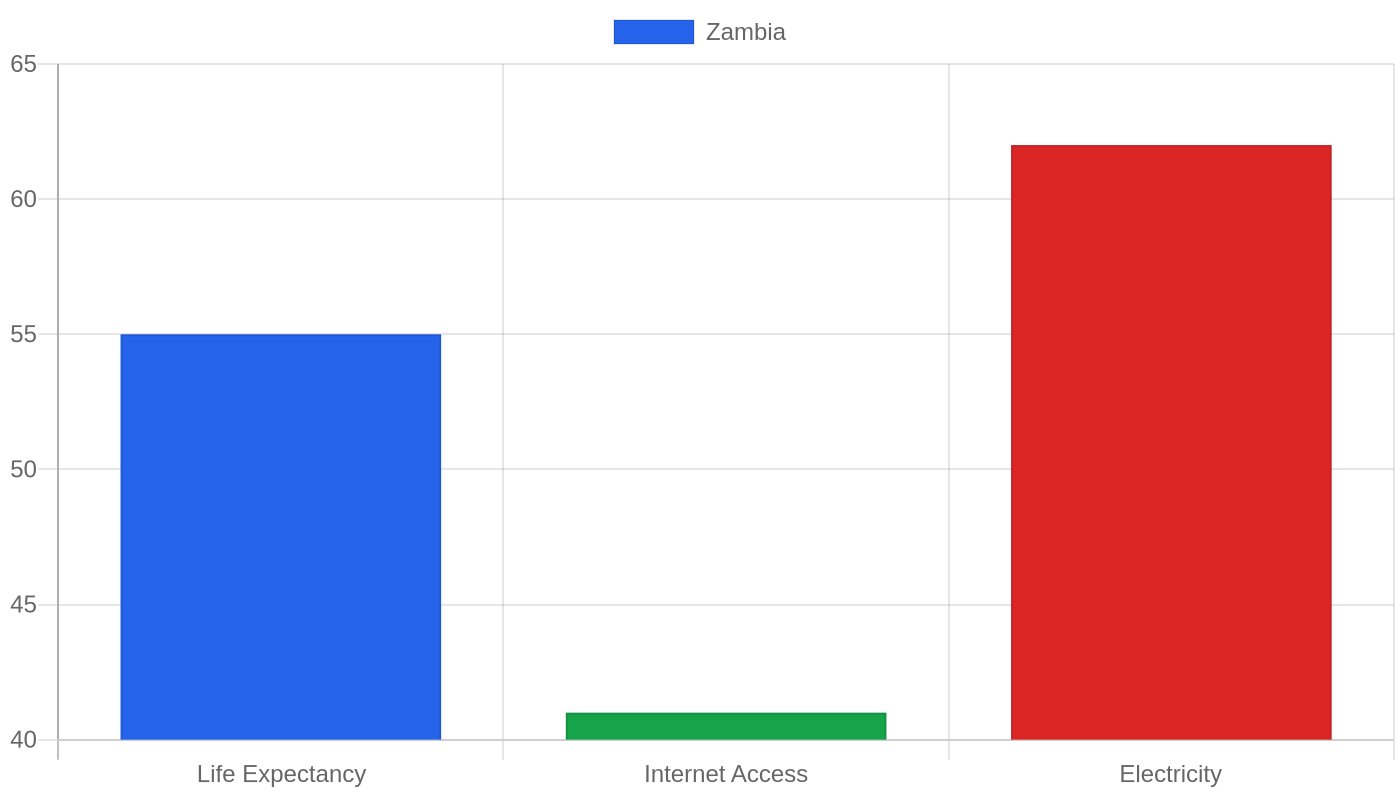
Economic Pulse Net | Sources: World Bank World Development Indicators, Government Sources | 2026
Key Takeaways
– Zambia’s economy remains heavily dependent on its copper mining sector, with major players like FQM Trident Limited and Copperbelt Energy Corporation anchoring industrial activity and export revenues.
– The political landscape operates as a presidential representative democratic republic, where executive and legislative power dynamics shape economic policy and investor confidence.
– A diverse mix of financial institutions—Access Bank Zambia, Atlas Mara Bank, and First Alliance Bank—points to a growing but still developing banking sector seeking to deepen financial inclusion.
– Energy infrastructure is a critical focal point, with companies like Bangweulu Power Company Limited driving renewable energy development amid persistent power supply challenges.
– The country faces structural economic pressures—including inflation, unemployment, and cost-of-living strains—though specific data gaps make precise assessment difficult without official World Bank figures.
The Copper Conundrum — What Drives Zambia’s Economy
Zambia’s economic engine has long been powered by copper, and the data available paints a picture of an economy still defined by its mineral wealth. The World Bank’s latest indicators do not provide specific GDP growth, inflation, or unemployment figures for Zambia, but the structure of the country’s top industries tells a compelling story. Basic materials dominate, with FQM Trident Limited standing as a major force in the sector.
This is no accident—copper accounts for the vast majority of Zambia’s export earnings, and global commodity prices directly determine the health of the national treasury. When copper prices rise, the government breathes easier; when they fall, budget deficits widen and public services suffer.
The absence of precise GDP per capita and GNI per capita data from the World Bank is itself a signal. It suggests either reporting lags or structural challenges in data collection that mirror the broader institutional constraints facing the economy. What is clear is that Zambia’s economic model remains extractive and export-oriented, leaving it vulnerable to external shocks.
The presence of Indeni Petroleum Refinery among the top companies highlights another vulnerability: Zambia imports refined petroleum products, and global oil price volatility directly impacts domestic fuel costs, transportation, and manufacturing. The industrial base beyond mining remains thin, though Chilanga Cement and the Copperbelt Energy Corporation provide some diversification into construction materials and utilities respectively.
The banking sector’s prominence—with Access Bank Zambia, Cavmont Bank, Atlas Mara Bank Zambia Limited, and First Alliance Bank Zambia Limited all listed as top companies—suggests a financial system that is growing but still shallow. Banks in Zambia primarily serve urban formal sectors and large corporate clients, leaving vast portions of the population unbanked or underbanked.
This financial exclusion constrains entrepreneurship and limits the domestic tax base, creating a cycle where the government struggles to fund infrastructure and social programs without relying on volatile commodity revenues.
Living on the Edge — The Cost of Everyday Life in Zambia
Housing and daily expenses in Zambia reflect the broader economic tensions between a resource-rich country and a population facing real affordability pressures. While specific cost-of-living indices are not provided in the data, the structure of the economy offers strong clues. Urban centers like Lusaka and the Copperbelt region’s mining towns experience higher housing costs driven by demand from formal sector workers and expatriates employed by mining companies.
Rental markets are bifurcated: high-end properties in Lusaka’s affluent neighborhoods command premium prices, while the majority of urban residents live in informal settlements or lower-cost housing with limited access to reliable utilities.
The cost of basic goods is heavily influenced by fuel prices, given Indeni Petroleum Refinery’s role and the country’s dependence on imported petroleum. When global oil prices spike, transportation costs rise, and food prices follow. This creates a direct link between international commodity markets and household budgets in Zambia.
Electricity costs are another critical factor, with Copperbelt Energy Corporation and Bangweulu Power Company Limited operating in a sector that has historically struggled with generation capacity. Load shedding has been a recurring issue, forcing households and businesses to invest in backup generators or solar systems—adding to monthly expenses.
Food inflation is a persistent concern, though specific CPI data is not available from the World Bank. Zambia is a major agricultural producer in the region, but inefficiencies in distribution, storage, and market access mean that urban consumers often pay high prices for staples like maize meal, the country’s dietary cornerstone. For the average Zambian household, the gap between income and expenses remains narrow, with little room for savings or investment.
This cost-of-living squeeze is a constant undercurrent in political discourse and a key driver of public sentiment toward the government.
Banking on the Future — Investment Climate and Corporate Landscape
Zambia’s investment climate is shaped by its mineral wealth, its political stability relative to some neighbors, and the persistent challenges of infrastructure and regulation. The top companies list reveals a corporate landscape dominated by financial services and mining. Access Bank Zambia, Cavmont Bank, Atlas Mara Bank Zambia Limited, and First Alliance Bank Zambia Limited form a competitive banking sector that is increasingly digital and focused on expanding retail services.
These institutions are vying for market share in a country where mobile money and fintech are beginning to disrupt traditional banking models, though adoption remains uneven.
For investors, the mining sector remains the primary draw. FQM Trident Limited operates one of the largest copper mines in Africa, and its presence signals that Zambia can attract and retain major international capital. However, the regulatory environment has been a source of tension. Mining companies have frequently clashed with the government over tax rates, royalty structures, and ownership requirements.
Stability in fiscal policy is a recurring demand from investors, and the political framework—a presidential representative democratic republic—means that policy can shift with changes in leadership or political priorities.
The energy sector offers another investment frontier. Bangweulu Power Company Limited is focused on renewable energy, positioning Zambia to tap into growing global demand for green investment. The country has significant hydroelectric potential, but drought and aging infrastructure have exposed vulnerabilities. Solar and wind projects are gaining traction, and the government has signaled openness to independent power producers.
For businesses considering entry, the banking sector’s growth and the push for energy diversification create opportunities, but investors must navigate bureaucratic hurdles, currency volatility, and the lingering effects of past debt restructuring.
Democracy and Danger — Politics, Safety, and Daily Life
Zambia’s political system is a presidential representative democratic republic with a multi-party framework, a structure that has generally provided peaceful transitions of power since independence. The president serves as both head of state and head of government, wielding significant executive authority. Legislative power rests with parliament, creating a system where the ruling party’s dominance can shape policy direction.
This political stability is an asset for the country, particularly compared to neighbors that have experienced coups or civil conflict. However, it does not mean politics is without tension. Elections are fiercely contested, and opposition parties frequently challenge government policies on economic management, corruption, and public spending.
Crime and safety indices are not available in the provided data, but anecdotal evidence and regional comparisons suggest that Zambia faces typical urban crime challenges—theft, burglary, and occasional violent crime in high-density areas—while rural areas tend to be safer. Lusaka, like many African capitals, has neighborhoods where security is a concern and others where it is not. For expatriates and wealthier Zambians, private security services are common.
The police force is under-resourced, and trust in law enforcement varies.
Quality of life in Zambia is a mixed picture. The country’s natural beauty, relative peace, and friendly population are genuine assets. However, public services—healthcare, education, and infrastructure—are strained by limited government revenue and high debt servicing costs. The absence of specific happiness or well-being data from the World Bank does not diminish the reality that many Zambians face daily struggles with access to clean water, reliable electricity, and quality healthcare.
For those with means, private schools and clinics offer alternatives, but the majority rely on public systems that are underfunded and overstretched.
Winds of Change — What’s Happening in Zambia Right Now
The current moment in Zambia is defined by a delicate balancing act. The government is navigating the aftermath of a debt restructuring process that has consumed much of its policy attention in recent years. While specific recent news data is not provided, the presence of Indeni Petroleum Refinery and Bangweulu Power Company among top companies signals active sectors undergoing transformation.
Fuel supply and energy generation remain live issues, with the refinery’s operations and the push for renewable capacity shaping daily headlines.
The banking sector is in a period of consolidation and expansion. Access Bank Zambia, Atlas Mara Bank, and First Alliance Bank are all competing in a market where digital banking is growing but traditional branch networks still matter. The government’s focus on formalizing the economy and expanding the tax base means that financial sector regulation is tightening, and banks are being pushed to lend more to small and medium enterprises.
This is a slow process, but it is central to the country’s long-term economic transformation.
Politically, the presidential system ensures that all eyes remain on the executive. Policy shifts on mining taxes, energy tariffs, and agricultural support are closely watched by investors and citizens alike. The multi-party system provides a check on power, but the ruling party’s control of parliament means that major legislative changes can move quickly when the government has a clear agenda.
For Zambia, the coming months will test whether the combination of democratic governance, mineral wealth, and emerging renewable energy capacity can translate into broad-based economic improvement—or whether structural constraints will continue to hold the country back.
The Bottom Line
Zambia is a country of genuine potential, anchored by its copper wealth, political stability, and a growing financial sector. For investors in mining, energy, and banking, it offers opportunities that many regional peers cannot match. However, the data gaps from the World Bank and the structural vulnerabilities of a commodity-dependent economy mean that caution is warranted.
This is a country to watch for those with patience and a tolerance for policy volatility—but one where the rewards could be significant for those who understand the terrain.
Sources & Methodology
This article is authored by Economic Pulse Net for informational and research purposes. Economic Pulse Net sources its data from multilateral institutions, national statistics bureaus, and proprietary databases. All data is believed to be current as of the date of publication.
Published: July 24, 2026 | Category: Research — Zambia
Use these signals in your own platform
Economic Pulse publishes its live signal feed through a documented, read-only API. Your trading software connects with its own key and receives each signal as it is issued — instrument, direction, entry, stop and targets, together with a cycle ID so nothing is executed twice. The feed is independent of this website and cannot change it.
Signals are informational only and are not financial advice.