Economic Pulse Net | Sources: World Bank World Development Indicators, Government Sources | 2026
Key Takeaways
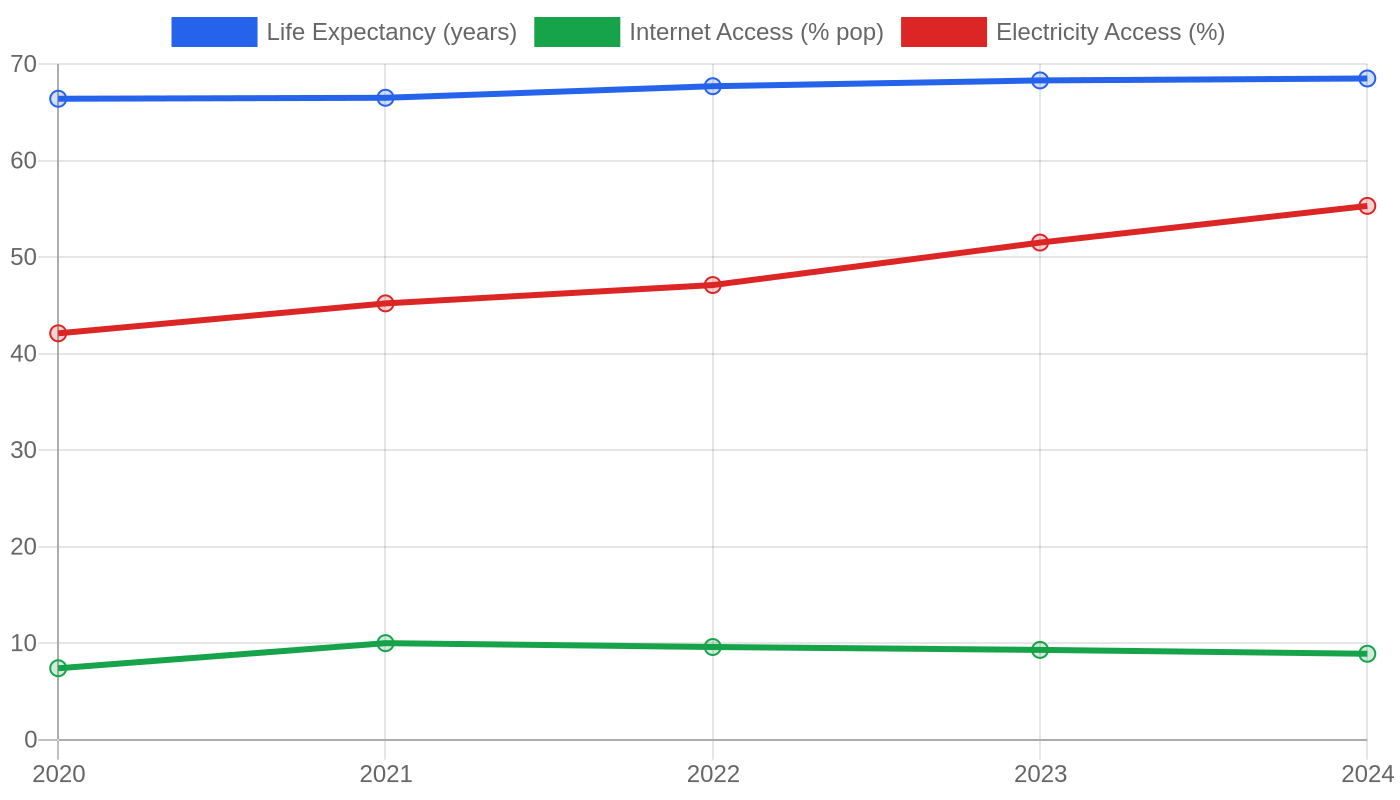
– Uganda’s economic narrative is currently defined by what isn’t measured as much as what is; the World Bank’s latest dataset shows gaps in core indicators like GDP growth and inflation, making independent analysis challenging.
– The financial sector is the undeniable engine of the formal economy, with a dense concentration of commercial and regional banks dominating the list of the country’s top companies.
– The political system is centralized, with the president serving as both head of state and head of government, supported by a vice-president and prime minister — a structure that shapes all economic policy.
– For investors, the opportunity lies in a market where the banking sector is mature enough to attract major regional players, yet the broader economic data remains opaque.
– The absence of hard numbers on cost of living, crime, and unemployment means that on-the-ground intelligence and sector-specific research are essential for any serious market entry.
The Numbers Gap: Reading Uganda’s Economic Signals
The most striking feature of Uganda’s current economic profile, according to the World Bank, is the silence in the data. Growth figures, inflation rates, and unemployment statistics all register as unavailable. For an economist, that is both a frustration and a message in itself. It suggests a statistical infrastructure that is either under-resourced, undergoing revision, or simply lagging behind the pace of events on the ground.
The World Bank’s dataset also leaves GDP per capita and GNI per capita blank, which strips away the usual benchmarks used to gauge living standards and purchasing power.
What we can infer is that Uganda remains a predominantly agrarian economy with a rapidly urbanizing population, though the provided data does not specify the main industries. The absence of numbers does not mean the absence of activity; it means the official picture is incomplete. In neighboring markets, analysts would normally point to inflation as the key pressure point, but here we must look to other signals.
The composition of the top companies list — overwhelmingly financial institutions — tells us where the formal economic muscle is. When a country’s corporate landscape is dominated by banks, it often indicates that credit expansion is a primary growth driver, even if the headline GDP figure is not currently being reported.
The deeper issue is one of transparency. Investors and policymakers need reliable data to allocate capital efficiently. The current vacuum forces a reliance on anecdotal evidence, sectoral reports, and the balance sheets of the major banks. It also raises a critical question: is the data gap a temporary administrative issue, or a symptom of a broader institutional challenge? For now, the economic narrative is one of potential energy without a clear reading on the voltage.
The Cost of Living Puzzle: Housing and Daily Realities
Without a cost-of-living index or housing market data, assessing the daily financial pressure on Ugandan households requires a different lens. The dominance of banks like Bank of Uganda, Barclays Bank of Uganda, and BRAC Uganda Bank Limited suggests a formal financial system that is deeply embedded in the economy.
BRAC’s presence is particularly notable, as it originated as a microfinance operation; its evolution into a full commercial bank indicates a sizable market of lower-income clients who need access to credit for housing improvements, small business inventory, and school fees.
In the absence of rental data, we can look at the banking sector’s focus as a proxy. When microfinance institutions scale up into commercial banking, it is usually because the demand for small-scale loans — often used for incremental housing construction — has become too large to serve through informal channels. The typical Ugandan urban household likely spends a significant portion of its income on rent in Kampala, but the exact figures remain unquantified in the provided data.
What is clear is that the financial infrastructure exists to support both formal mortgages and informal construction loans, which implies a fluid and active property market.
The regional comparison is also difficult to draw without hard data. However, it is reasonable to assume that Uganda’s cost of living is lower than in more industrialized East African hubs, yet the pressure on urban housing is intense. The lack of official statistics means that expatriates and local professionals must rely on real estate agents and personal networks rather than published indices. This is a market where information is a commodity, and those who lack it pay a premium.
Banking Central: The Business and Investment Climate
If you want to understand where Uganda’s economic energy is concentrated, look no further than the list of its top companies. It is a roll call of financial institutions: ABC Bank, Africell (the sole telecom representative), Aya Group, Bank of Africa, Bank of Baroda, Bank of India, and the central Bank of Uganda. The presence of Indian-origin banks like Bank of Baroda and Bank of India underscores a long-standing commercial corridor between South Asia and East Africa.
These are not marginal players; they are institutions that have weathered decades of economic cycles.
For investors, this landscape offers both opportunity and caution. The banking sector is clearly competitive, with international and regional players vying for market share. This is a sign of a maturing financial system, but it also means that new entrants will face stiff competition. Africell’s presence in the top ten signals that telecommunications remains a high-growth sector, likely driven by mobile money adoption and data services.
Aya Group, the only conglomerate on the list, suggests that diversified local capital is still a force to be reckoned with.
The business climate is shaped by the political structure, where the president holds significant executive power. This centralization can be a double-edged sword: it allows for swift policy decisions, but it also concentrates risk. Investors typically favor environments where regulatory changes are predictable. In Uganda, the regulatory framework is heavily influenced by the central bank, which appears to be the most active and visible institution in the corporate landscape.
For those looking to enter the market, the path of least resistance is likely through a joint venture or partnership with an established local bank or telecom operator.
The Political Balance: Safety, Governance, and Daily Life
The political landscape in Uganda is defined by a strong executive. The president is both head of state and head of government, appointing a vice-president and a prime minister to assist with governance. This structure centralizes authority and means that economic policy is often a reflection of presidential priorities rather than parliamentary consensus. For businesses, this means that political connections are not just helpful — they are often essential.
Regarding public safety, the data provided offers no crime index or safety index. This absence is notable, especially for a country that has historically dealt with regional security challenges. The lack of data does not necessarily indicate a crisis, but it does leave a gap in the risk assessment for foreign nationals and investors. In the absence of official statistics, perceptions of safety are often shaped by anecdotal reports and expatriate networks.
The general quality of life, including access to healthcare and education, remains unquantified in this dataset.
What can be said is that Uganda’s political stability has been a relative constant in a volatile region. The centralized governance model has provided continuity, but it also raises questions about succession and institutional resilience. For the average citizen, the daily experience is likely a mix of vibrant informal markets and a formal sector that is heavily reliant on the banking industry.
The quality of life is tied directly to the performance of the agricultural sector and the stability of the shilling, neither of which is captured in the current data.
Current Affairs: The Tension Between Ambition and Transparency
Right now, Uganda is at a crossroads that is difficult to read due to the lack of live indicators. There are no recent news reports provided on inflation trends, policy shifts, or new reforms. What we do know is that the financial sector is active, with major banks like Barclays and Bank of Africa maintaining a strong presence. This suggests that despite the data vacuum, business is proceeding as usual.
The central bank, Bank of Uganda, is clearly the anchor of the formal economy, and its policies on interest rates and reserve requirements will be the primary drivers of credit growth in the coming months.
The most significant current affair is the data gap itself. In an era where investors demand real-time information, Uganda’s silence is a competitive disadvantage. It is likely that international financial institutions are pressuring the government to improve its statistical reporting as a condition for further lending or investment. The presence of multiple foreign banks indicates that international confidence remains, but that confidence is not unconditional. The next few quarters will be telling.
If there is a reform agenda, it is not visible in the provided data. However, the composition of the top companies list suggests a quiet shift toward financial inclusion, with BRAC’s rise from microfinance to commercial banking being a key indicator. The country is also likely benefiting from its position in the East African Community, though the data does not specify trade flows.
The bottom line is that Uganda is open for business, but it needs to improve its data transparency to attract the level of investment its potential warrants.
The Bottom Line
Uganda is a country that investors should watch closely, but with a clear-eyed understanding of the risks. The banking sector is robust and competitive, offering a gateway for those looking to access the broader East African market. However, the lack of core economic data from the World Bank is a red flag that cannot be ignored. For now, this is a market for patient capital — investors who are willing to do the legwork on the ground and build relationships with the established financial institutions.
The potential is significant, but the path is not yet clearly illuminated. Watch for improvements in data reporting as a leading indicator of broader institutional reform.
Sources & Methodology
This article is authored by Economic Pulse Net for informational and research purposes. Economic Pulse Net sources its data from multilateral institutions, national statistics bureaus, and proprietary databases. All data is believed to be current as of the date of publication.
Published: August 13, 2026 | Category: Research — Uganda
Use these signals in your own platform
Economic Pulse publishes its live signal feed through a documented, read-only API. Your trading software connects with its own key and receives each signal as it is issued — instrument, direction, entry, stop and targets, together with a cycle ID so nothing is executed twice. The feed is independent of this website and cannot change it.
Signals are informational only and are not financial advice.