Economic Pulse Net | Sources: World Bank World Development Indicators, Government Sources | 2026
Key Takeaways
– Togo’s economy is being reshaped by its role as a regional banking hub, anchored by pan-African financial giants like Ecobank and Atlantic Bank Group, which are headquartered in Lomé.
– The country’s political system concentrates significant power in the presidency, with the head of state serving as commander-in-chief and holding authority to initiate legislation and dissolve parliament.
– Togo’s top companies are overwhelmingly concentrated in financial services and aviation, signaling a strategic pivot toward service-sector-led growth rather than traditional commodity exports.
– Despite gaps in official economic data, the presence of major regional institutions suggests Togo punches above its weight in West African commerce and connectivity.
– Safety and crime indices are not currently available from the provided data, leaving an incomplete picture of social stability for potential investors and residents.
The Lomé Paradox — Growth Without Numbers
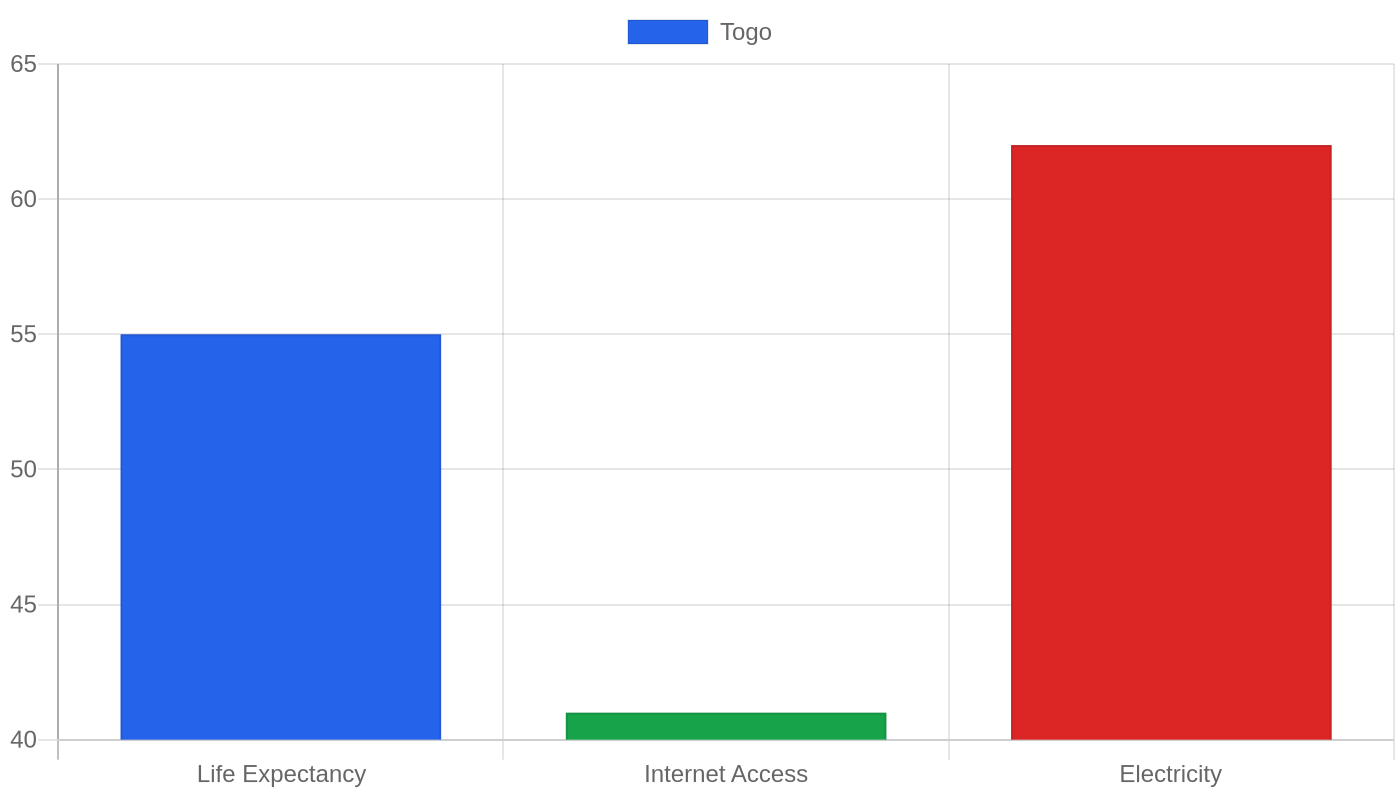
The World Bank data for Togo presents a curious challenge: key indicators including GDP growth, inflation, unemployment, and GDP per capita are all marked as unavailable. This absence is itself a story. For a country that hosts the headquarters of Ecobank—one of Africa’s largest financial institutions—and serves as a critical node in West African aviation through ASKY Airlines and Africa West Airlines, the lack of baseline economic metrics raises questions about data infrastructure and transparency.
What the numbers do not tell us, the corporate landscape does. Togo’s major industries are not agriculture or mining in the traditional sense; they are consumer services, financials, utilities, and industrials. The Communauté Électrique du Bénin, a utility company, and La Poste du Togo, an industrial postal service, round out a portfolio that suggests a government focused on building connective tissue—electricity grids, logistics, and banking networks—rather than extracting raw resources.
The World Bank data gap may reflect a country in transition, where the formal economy is growing faster than the statistical capacity to measure it. For now, analysts must read between the lines of corporate registrations and regional trade flows to gauge Togo’s pulse.
The Price of Living in a Regional Hub
Housing and daily expenses in Togo are not documented in the provided data, but the country’s position as a financial and aviation crossroads offers clues. Lomé, the capital, is a magnet for expatriate bankers, airline staff, and regional bureaucrats, which typically drives up rental costs in city centers compared to inland towns.
The presence of multiple airlines—Air Togo, Air Horizon, ASKY Airlines, and Africa West Airlines—suggests a steady flow of transient professionals whose housing needs shape the market. Rent vs. buy decisions likely tilt toward renting for the mobile workforce, while land ownership remains a long-term goal for locals. Daily expenses such as food, transport, and utilities are influenced by Togo’s reliance on imported goods and the regional currency peg to the euro via the West African CFA franc.
Without hard data, one can infer that cost pressures mirror those of neighboring coastal economies, where imported inflation and fuel costs weigh on household budgets. The absence of official figures does not erase the reality that Lomé’s status as a regional hub comes with a premium—one that is felt most acutely by those earning in local currency rather than foreign exchange.
Banking on the Future — Investment Climate in Togo
Togo’s investment story is written in the ledgers of its top companies. Ecobank and Atlantic Bank Group dominate the financials sector, making Lomé a genuine rival to larger West African financial centers. These institutions are not merely domestic lenders; they are pan-African operations with reach across the continent, and their presence signals a regulatory environment that courts banking and fintech investment.
The aviation sector is equally telling: ASKY Airlines, Africa West Airlines, Air Horizon, and Air Togo all call Togo home, positioning the country as a gateway for regional travel. For investors, the sectors to watch are financial technology, logistics, and aviation support services.
The government’s role, as outlined in the political structure, is heavily centralized—the president appoints the head of government and holds legislative initiative—which means business deals often require high-level political relationships. The utility sector, anchored by Communauté Électrique du Bénin, suggests cross-border energy cooperation, a promising avenue for infrastructure investors.
However, the lack of GDP and inflation data from the World Bank means that risk assessment remains opaque, forcing investors to rely on corporate earnings reports and regional economic trends rather than national statistics.
Power and Precedent — Politics in a Presidential System
Togo’s political landscape is defined by concentrated executive authority. The president is indirectly elected for a double term of four years, serves as commander-in-chief of the armed forces, and holds the power to initiate legislation and dissolve parliament. Executive power is exercised by the council of ministers, led by a president of the council—formerly known as the prime minister—who is appointed by the head of state.
This structure creates a system where policy direction flows from the top, and political stability is closely tied to the president’s tenure. For businesses and investors, this means that regulatory changes, tax incentives, and major infrastructure projects are often personally championed by the executive branch. The indirect election mechanism insulates the president from direct popular vote, which can reduce short-term political volatility but also raises questions about democratic accountability.
The armed forces’ role as a presidential domain further consolidates power. In practical terms, Togo’s political environment offers predictability for those who align with the government’s priorities, but it leaves little room for opposition-driven policy shifts. The absence of crime and safety indices from the provided data leaves a gap in understanding how political authority translates into public security on the ground.
The Skies and Ledgers of Lomé — Current Affairs in Togo
Right now, Togo’s economic narrative is being written in real time through its corporate sector. Ecobank continues to expand its digital banking offerings across Africa, reinforcing Lomé’s status as a fintech incubator. ASKY Airlines, a regional carrier, is likely navigating the post-pandemic recovery in air travel, while Africa West Airlines and Air Horizon compete for market share in a sector still rebuilding passenger confidence.
The Communauté Électrique du Bénin is operating at a moment when energy security is a top concern across West Africa, making cross-border electricity cooperation a strategic priority. La Poste du Togo, as an industrial company, may be modernizing its logistics and parcel services to compete with private couriers. The political structure remains stable under the current presidential system, with no major electoral upheavals reported in the provided data.
However, the lack of recent news from the data means that policy shifts, inflation trends, or reform initiatives are not available to report. What is clear is that Togo’s business environment is dominated by a handful of large, regionally significant companies, and their performance will likely dictate the country’s near-term economic trajectory. For now, the story is one of quiet consolidation—a small country leveraging its corporate champions to punch above its weight.
The Bottom Line
Togo is a country that rewards close attention to its corporate sector rather than its macroeconomic headlines. For investors in African financial services, aviation, and regional infrastructure, Lomé offers a stable, executive-driven business environment with access to wider West African markets.
The gaps in World Bank data are a warning sign for those who rely on official statistics, but the presence of Ecobank, ASKY Airlines, and Atlantic Bank Group suggests a real economy that is more dynamic than the numbers suggest. Watch Togo if you believe in the power of regional hubs—and if you are comfortable making decisions without a full statistical safety net.
Sources & Methodology
This article is authored by Economic Pulse Net for informational and research purposes. Economic Pulse Net sources its data from multilateral institutions, national statistics bureaus, and proprietary databases. All data is believed to be current as of the date of publication.
Published: July 23, 2026 | Category: Research — Togo
Use these signals in your own platform
Economic Pulse publishes its live signal feed through a documented, read-only API. Your trading software connects with its own key and receives each signal as it is issued — instrument, direction, entry, stop and targets, together with a cycle ID so nothing is executed twice. The feed is independent of this website and cannot change it.
Signals are informational only and are not financial advice.