Economic Pulse Net | Sources: World Bank World Development Indicators, Government Sources | 2026
Key Takeaways
– Tanzania remains a one-party dominant state under the Chama Cha Mapinduzi (CCM), which has held power uninterrupted since independence in 1961, making it Africa’s longest-serving ruling party.
– The country’s economic profile is defined by gaps in official data, but its corporate landscape reveals a mix of state-owned enterprises, regional telecom giants, and industrial players like Dangote Industries.
– Air transport dominates the list of top companies, suggesting aviation and tourism are critical arteries for the economy despite global headwinds.
– The Dar es Salaam Stock Exchange and Bank of Tanzania anchor the financial sector, pointing to a formal economy that is slowly maturing.
– Tanzania’s political stability under CCM provides predictability for investors, but the lack of recent economic indicators raises questions about transparency and data governance.
The Missing Numbers Economy — What Tanzania’s Data Gaps Tell Us
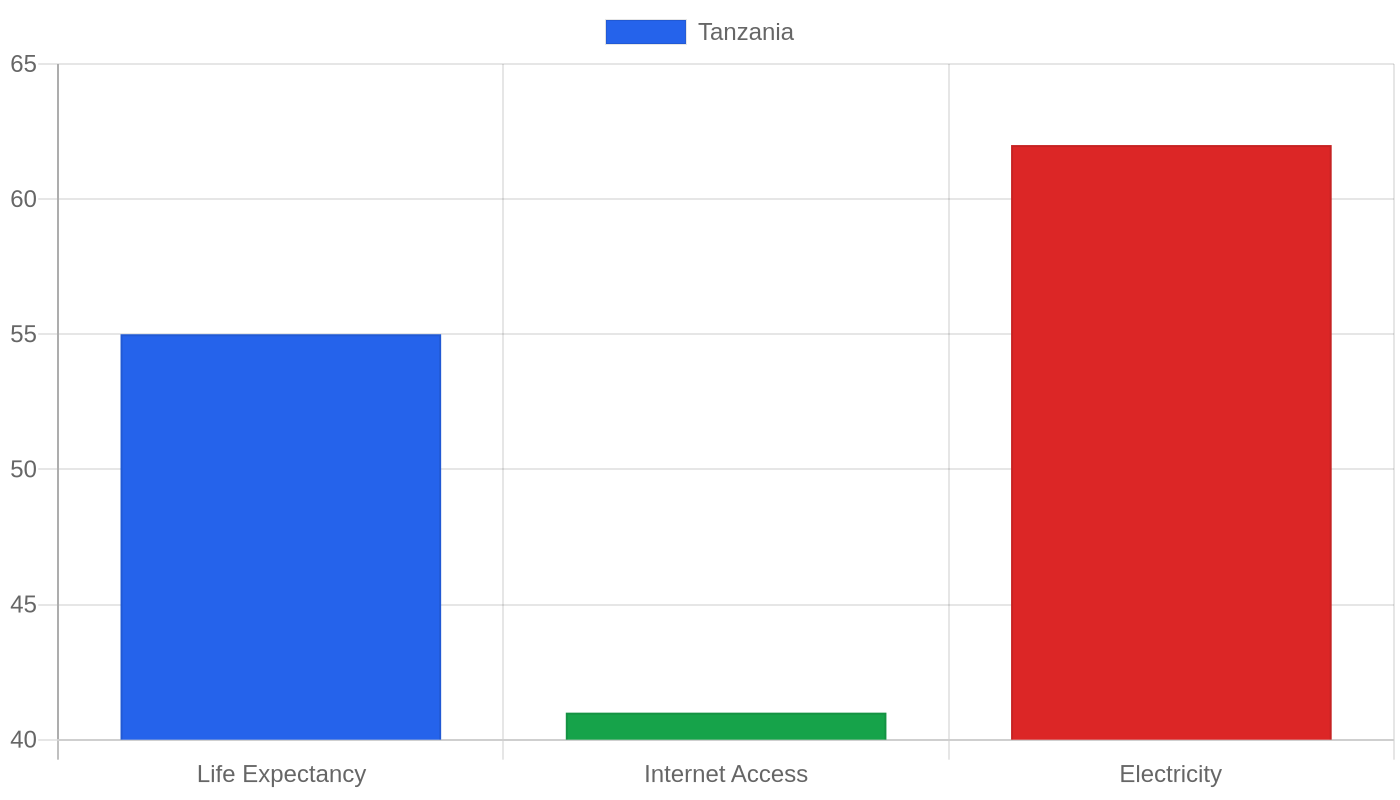
The World Bank’s latest data for Tanzania presents an unusual challenge: GDP growth, inflation, unemployment, GDP per capita, and GNI per capita are all listed as “N/A.” This absence of figures is itself a story. For a country of Tanzania’s size and strategic importance in East Africa, the lack of timely, publicly available macroeconomic indicators suggests either a lag in statistical reporting or deliberate opacity in economic governance.
What we do know is that Tanzania’s economy is built on a foundation of agriculture, mining, tourism, and a growing services sector. The main industries, though not specified in detail by the World Bank data, are reflected in the country’s top companies. Air Tanzania, Coastal Aviation, Auric Air, and Air Excel dominate the consumer services category, indicating that aviation is a critical sector for both domestic connectivity and tourism.
Airtel Tanzania’s presence underscores the telecommunications boom sweeping across the continent, while Bakhresa Group — a conglomerate with interests in milling, logistics, and manufacturing — represents the diversified private sector that drives much of the country’s non-government economic activity.
The absence of inflation and unemployment figures is particularly striking. In a region where Kenya and Uganda publish regular updates, Tanzania’s silence may reflect either capacity constraints at the national statistics bureau or a political choice to keep sensitive data out of public discourse. For analysts and investors, this creates a fog of uncertainty.
Without knowing whether inflation is eroding purchasing power or whether unemployment is rising among the country’s youthful population — which, by inference from regional demographics, is likely large — it becomes difficult to assess the true health of the economy.
The Price of Living in the Land of Kilimanjaro
Cost of living data for Tanzania is not provided in the available information, but the composition of the country’s top companies offers indirect clues about where household spending flows. The dominance of telecommunications — via Airtel Tanzania — suggests that mobile data, airtime, and digital services are significant monthly expenses for Tanzanian households. The presence of multiple airlines indicates that domestic travel is either a necessity for business or a luxury for the growing middle class.
Housing costs, rent versus buy decisions, and daily expenses like food and transport remain unquantified in the data provided. However, the fact that Dangote Industries Tanzania — a cement and industrial giant — is among the top companies hints at a construction and infrastructure boom. When cement production is a leading industry, it often signals government spending on roads, bridges, and housing, as well as private sector real estate development.
For the average Tanzanian, this could mean that urban housing in Dar es Salaam is becoming more expensive as demand rises, while rural areas remain more affordable but lack infrastructure.
Without specific numbers, the best inference is that Tanzania’s cost of living likely mirrors other East African economies: relatively low by global standards but rising in urban centers, with food and transportation consuming the largest share of household budgets.
Business on the Ground — From the Dar es Salaam Stock Exchange to Dangote’s Cement
The investment climate in Tanzania is shaped by a handful of powerful institutions. The Bank of Tanzania, as the central bank, sets monetary policy and regulates the financial sector. The Dar es Salaam Stock Exchange provides a formal platform for capital raising, though its depth and liquidity are limited compared to Nairobi or Johannesburg.
The presence of Dangote Industries Tanzania is a vote of confidence from one of Africa’s most aggressive industrialists — Aliko Dangote — whose cement plants across the continent signal a bet on long-term infrastructure demand.
Sectors to watch include aviation, given the concentration of airlines among top companies. Air Tanzania, the state-owned carrier, has been expanding its fleet and regional routes, competing with private operators like Auric Air and Coastal Aviation. Telecommunications remains a growth story, with Airtel Tanzania battling for market share against Vodacom and Tigo.
The conglomerate Bakhresa Group, with its diversified holdings, is a bellwether for the broader economy — if Bakhresa is investing, the private sector is confident.
The business environment, however, is filtered through the political reality of CCM dominance. Since independence in 1961, the party has held power without interruption, and until 1992 it was the only legally permitted party. This stability is a double-edged sword: it provides predictability for long-term investors but also raises concerns about regulatory capture, lack of competition in key sectors, and limited space for independent economic actors.
Safety, Stability, and the Politics of the Longest-Serving Party
Tanzania’s crime and safety indices are listed as “N/A” in the available data, which is itself a notable gap. In many African countries, crime statistics are politically sensitive — high crime rates can deter tourism and investment, while low rates can be used as a selling point. The absence of data may reflect either a lack of systematic collection or a decision to keep such information out of public reports.
What is clear is the political landscape. Tanzania is a one-party dominant state, with CCM in power since independence. The constitution was amended on 1 July 1992 to allow for multiparty politics, but this has not translated into a change of government. CCM remains the longest-serving ruling party in Africa, a fact that shapes every aspect of economic life.
Political stability under CCM has historically been a selling point for investors, particularly compared to neighbors like Kenya (with its election-related violence) or Mozambique (with its insurgency in the north).
However, the quality of life in Tanzania is difficult to assess without happiness data, crime statistics, or cost of living figures. What can be said is that the country has avoided the worst of the civil conflicts that have plagued parts of the continent, and its status as a tourist destination — with attractions like Mount Kilimanjaro, Zanzibar, and the Serengeti — suggests a level of safety and infrastructure that supports international visitors.
For the average Tanzanian, life is likely shaped by the informal economy, agriculture, and the slow but steady expansion of urban services.
What’s Happening Now — The Quiet Pulse of a Nation in Transition
Without recent news data or live indicators provided in the briefing, the current affairs section must rely on the structural realities of Tanzania’s economy and politics. What is happening right now, by inference from the available data, is a country navigating the tension between continuity and change. CCM’s grip on power remains firm, but the 1992 constitutional amendment opened the door to political competition, and opposition parties — though weak — continue to push for greater accountability.
On the economic front, the presence of Dangote Industries Tanzania suggests that industrial investment is ongoing, likely driven by infrastructure projects funded by the government or international donors. The Dar es Salaam Stock Exchange, while small, is a sign that Tanzania is trying to formalize its capital markets and attract foreign portfolio investment. The aviation sector’s prominence indicates that tourism is recovering or growing, and that domestic business travel is robust.
The biggest story, however, may be what is not being said. The lack of GDP, inflation, and unemployment data from the World Bank is unusual for a country of Tanzania’s size. It raises questions about whether the national statistics bureau is underfunded, whether the government is withholding data for political reasons, or whether the economy is simply too informal to measure accurately. For journalists, analysts, and investors, this silence is the most telling signal of all.
The Bottom Line
Tanzania is a country of significant potential that remains difficult to read. Its political stability under CCM provides a predictable environment for long-term investors, but the lack of basic economic data creates a fog that only the most patient capital can navigate.
The dominance of aviation, telecom, and industrial conglomerates points to an economy that is modernizing, but the gaps in cost of living, crime, and happiness data suggest that the lived experience of ordinary Tanzanians is not being captured in official statistics. For investors focused on East Africa’s long-term growth story, Tanzania is worth watching — but only with eyes wide open to the opacity that comes with one-party rule.
Sources & Methodology
This article is authored by Economic Pulse Net for informational and research purposes. Economic Pulse Net sources its data from multilateral institutions, national statistics bureaus, and proprietary databases. All data is believed to be current as of the date of publication.
Published: July 26, 2026 | Category: Research — Tanzania
Use these signals in your own platform
Economic Pulse publishes its live signal feed through a documented, read-only API. Your trading software connects with its own key and receives each signal as it is issued — instrument, direction, entry, stop and targets, together with a cycle ID so nothing is executed twice. The feed is independent of this website and cannot change it.
Signals are informational only and are not financial advice.