Economic Pulse Net | Sources: World Bank World Development Indicators, Government Sources | 2026
Key Takeaways
– Tanzania remains Africa’s longest-serving one-party dominant state, with the Chama Cha Mapinduzi (CCM) party holding power uninterrupted since independence in 1961, shaping every facet of economic policy and business climate.
– The country’s economic profile is defined by state-owned enterprises and a handful of powerful conglomerates, with the financial sector anchored by the Bank of Tanzania and the Dar es Salaam Stock Exchange.
– Consumer services and telecommunications dominate the corporate landscape, with Air Tanzania, Airtel Tanzania, and the Bakhresa Group representing the intersection of public and private capital.
– Despite its political stability, Tanzania faces the structural challenge of transitioning from a state-dominated economy to one that can attract diverse private investment, with the World Bank data gaps reflecting the opacity of its economic reporting.
The Growth Paradox — A GDP Story Without Numbers
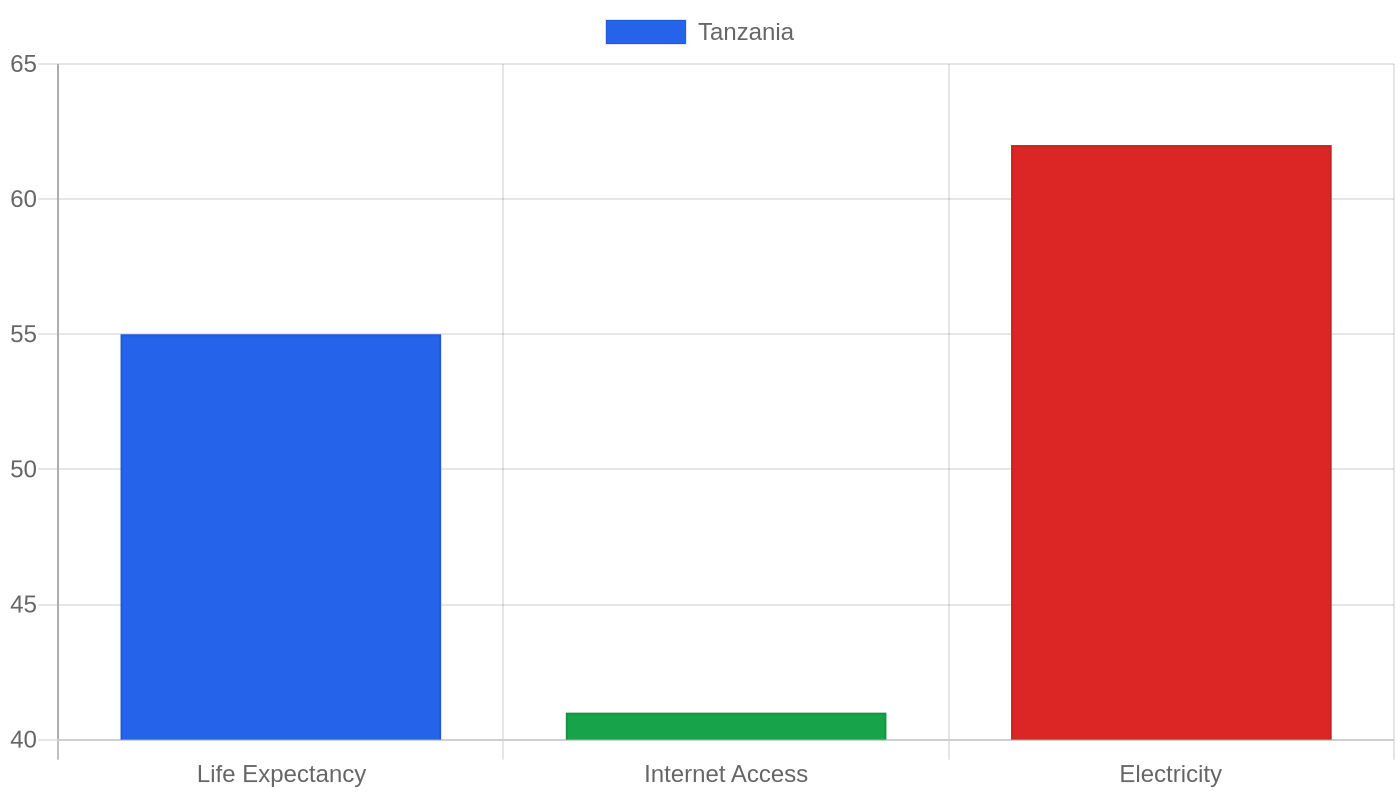
When the World Bank’s latest data on Tanzania shows no figures for GDP growth, inflation, unemployment, or GDP per capita, it tells a story more revealing than any single number could. This is not merely a statistical gap — it is a symptom of a broader challenge facing one of East Africa’s largest economies.
Tanzania’s economic narrative has long been shaped by its political architecture: a one-party dominant state where the Chama Cha Mapinduzi (CCM) party has governed since independence in 1961, creating an environment where economic data is as tightly controlled as political space. The absence of basic macroeconomic indicators from the World Bank suggests either reporting delays, methodological challenges, or a deliberate opaqueness that makes independent analysis difficult.
What is clear from the available data is that Tanzania’s economy is built on a foundation of state-linked enterprises and a few dominant private conglomerates. The Bank of Tanzania sits at the apex of the financial system, while the Dar es Salaam Stock Exchange provides a formal channel for capital — though its depth and liquidity remain limited compared to regional peers.
The main industries, though unspecified in the data, are likely anchored by agriculture, mining, and tourism, sectors that have historically driven growth but remain vulnerable to global commodity cycles and climate shocks. Without reliable GDP figures, economists and investors are forced to rely on proxy indicators — and the proxy that speaks loudest is the political stability that has allowed the CCM to maintain its grip on power for over six decades.
The Price of Stability — Housing and Daily Life in Tanzania
The cost of living in Tanzania presents a study in contrasts, though the data provided offers no specific figures. Dar es Salaam, the commercial capital, has long been one of East Africa’s more expensive cities for expatriates and the emerging middle class, while rural areas remain significantly cheaper.
Housing costs in the city center can absorb a substantial portion of household income, with the rent-versus-buy calculation heavily tilted toward renting due to high interest rates and limited mortgage availability. Daily expenses for food, transportation, and utilities are influenced by Tanzania’s reliance on imported goods for many consumer products, which exposes households to global price shocks and currency fluctuations.
Compared to regional averages, Tanzania’s cost of living is often described as moderate — less expensive than Kenya but more costly than Uganda for similar goods and services. The absence of official inflation data from the World Bank is particularly concerning, as it leaves households and businesses without a clear benchmark for wage negotiations, rental agreements, or long-term financial planning.
For the average Tanzanian, the economic reality is shaped not by GDP statistics but by the price of maize flour, cooking oil, and bus fares — costs that have risen steadily even as official data remains elusive.
The Corporate Landscape — Titans of Tanzanian Business
The list of Tanzania’s top companies reveals a concentrated economy where a handful of players dominate key sectors. Air Tanzania, Air Excel, Auric Air, and Coastal Aviation — all classified as consumer services — highlight the importance of air travel in a country where road infrastructure remains underdeveloped and the geography is vast. These carriers serve both domestic routes and regional connections, making them critical to tourism and business travel.
Airtel Tanzania, the telecommunications giant, reflects the growing digital economy and the demand for mobile money services that have transformed financial inclusion across East Africa. The Bakhresa Group, a conglomerate with interests spanning food processing, logistics, and manufacturing, represents the power of family-owned businesses in Tanzania’s economy — a structure that often operates outside the formal reporting requirements that would provide clearer data to institutions like the World Bank.
Dangote Industries Tanzania, part of the Nigerian industrial empire, signals the potential for foreign direct investment in manufacturing and infrastructure, though its scale remains modest compared to operations in other African markets. The Dar es Salaam Stock Exchange and the Bank of Tanzania anchor the financial sector, providing the institutional framework for capital markets and monetary policy.
For investors, the message is clear: Tanzania’s business environment is dominated by a mix of state-linked entities and a few powerful private groups, meaning that market entry often requires navigating political relationships as much as economic fundamentals.
Politics as Economic Policy — The CCM Factor
Tanzania’s political landscape is the single most important factor for understanding its economic trajectory. As a one-party dominant state where the Chama Cha Mapinduzi (CCM) party has been in power since independence in 1961, the country offers a degree of political stability that is rare in Africa.
From its formation until 1992, the CCM was the only legally permitted party in the country, and the constitutional amendment that allowed multi-party politics in July 1992 did little to loosen the party’s grip on power. This continuity has created a predictable environment for businesses that can work within the system, but it has also discouraged the kind of competitive reforms that drive innovation and transparency.
The crime and safety indices are listed as unavailable, which in itself is a statement — without reliable data on public safety, it is difficult for international investors or residents to assess the risks of operating in Tanzania’s cities. Quality of life is similarly opaque, though the stability of the political system has historically been cited as a positive factor for those willing to accept the limitations on political freedom.
For the Tanzanian people, the trade-off is straightforward: political stability and continuity in exchange for limited democratic competition and economic transparency. Whether this bargain remains sustainable as the population grows and demands for better services and accountability increase is the central question facing the country.
What’s Happening Now — The Data Gap and Its Consequences
The most striking feature of Tanzania’s current economic situation is the absence of recent, reliable data from the World Bank. In an era when investors and policymakers rely on real-time indicators to make decisions, this information vacuum is itself a significant economic headwind. Without confirmed figures for GDP growth, inflation, or unemployment, it becomes impossible to assess whether Tanzania is experiencing an economic boom, a slowdown, or something in between.
The lack of data also raises questions about the effectiveness of the Bank of Tanzania’s monetary policy and the ability of the Dar es Salaam Stock Exchange to attract foreign portfolio investment. For the companies that dominate Tanzania’s economy — from Air Tanzania to the Bakhresa Group — this opacity creates uncertainty about market conditions, consumer demand, and the regulatory environment.
The CCM’s long hold on power has historically provided a degree of predictability, but the absence of transparent economic data undermines that advantage. As other East African economies — particularly Kenya and Rwanda — push forward with digital transformation, financial inclusion, and data-driven policymaking, Tanzania risks falling behind not because of poor economic performance, but because no one can confirm what that performance actually is.
The immediate priority for the government and the central bank should be to restore the flow of reliable economic data to institutions like the World Bank, not only to attract investment but to give Tanzanian citizens the information they need to plan their own economic futures.
The Bottom Line
Tanzania is a country of immense potential and persistent opacity — a stable one-party state with a corporate landscape dominated by a handful of powerful players and a data environment that leaves investors and analysts in the dark. For risk-tolerant investors with deep local connections and a willingness to navigate political channels, the opportunities in telecommunications, aviation, and conglomerate-linked supply chains remain significant.
For those who require transparency, reliable data, and competitive markets, Tanzania will continue to be a challenging proposition until the CCM-led government embraces a more open approach to economic reporting. The country’s future depends on whether it can modernize its information infrastructure as quickly as it has maintained its political stability — a balance that will define Tanzania for the next decade.
Sources & Methodology
This article is authored by Economic Pulse Net for informational and research purposes. Economic Pulse Net sources its data from multilateral institutions, national statistics bureaus, and proprietary databases. All data is believed to be current as of the date of publication.
Published: July 21, 2026 | Category: Research — Tanzania
Use these signals in your own platform
Economic Pulse publishes its live signal feed through a documented, read-only API. Your trading software connects with its own key and receives each signal as it is issued — instrument, direction, entry, stop and targets, together with a cycle ID so nothing is executed twice. The feed is independent of this website and cannot change it.
Signals are informational only and are not financial advice.