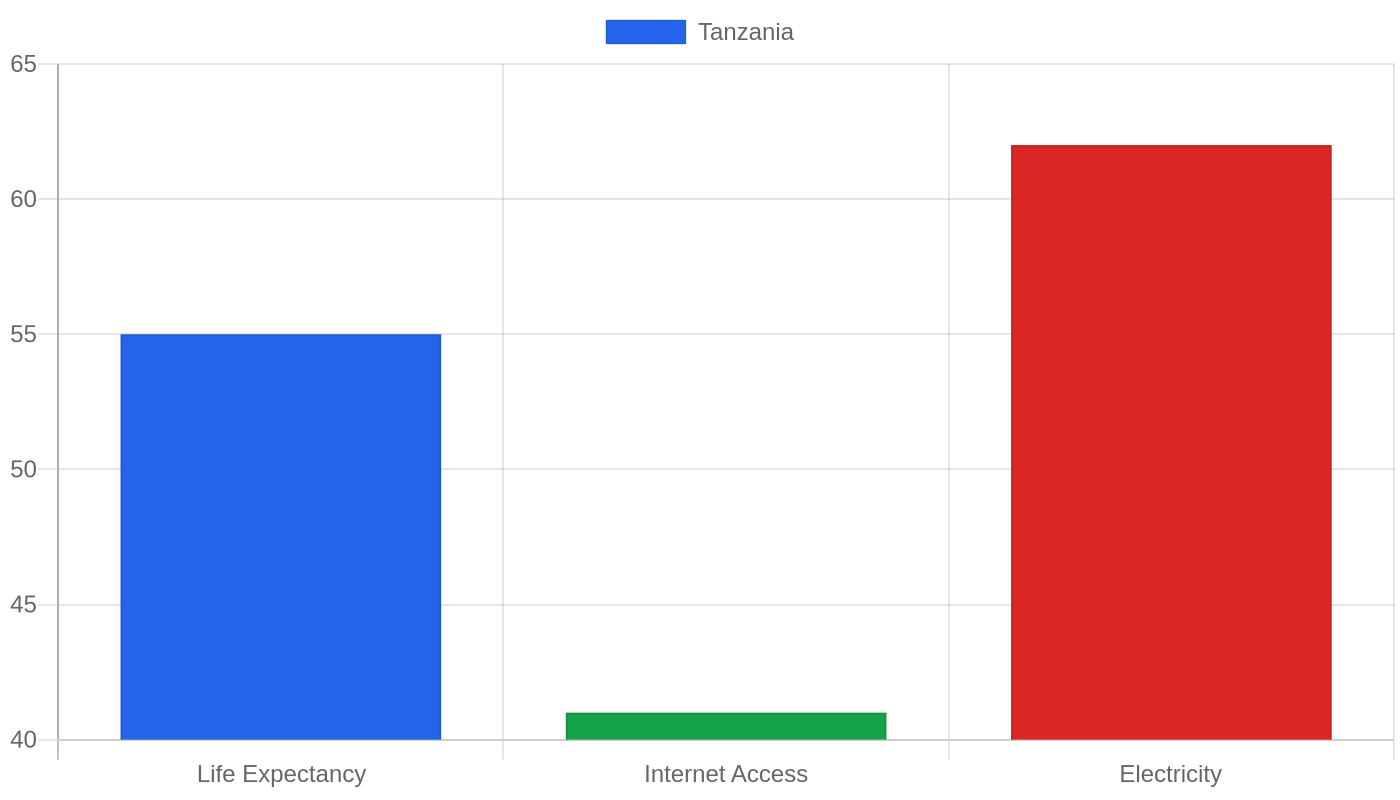
Economic Pulse Net | Sources: World Bank World Development Indicators, Government Sources | 2026
Key Takeaways
* Political Stability through Dominance: Tanzania operates as a one-party dominant state with the Chama Cha Mapinduzi (CCM) holding uninterrupted power since independence, providing a consistent political framework for long-term planning.
Service Sector Concentration: The corporate landscape is heavily skewed toward consumer services, telecommunications, and financials, with major players like Air Tanzania and Bakhresa Group defining market dynamics.
Data Transparency Gaps: Current economic indicators such as GDP growth, inflation rates, and unemployment figures are not currently reported by the World Bank, necessitating a reliance on structural analysis over quantitative metrics.
Strategic Business Hubs: The presence of entities like the Dar es Salaam Stock Exchange and Dangote Industries highlights a growing industrial and financial infrastructure aimed at regional integration.
Economic Foundations and Structural Realities
The macroeconomic picture of Tanzania presents a complex narrative where structural strengths exist alongside significant data transparency challenges. According to the World Bank, specific quantitative metrics such as GDP growth, inflation CPI, and unemployment rates are currently listed as N/A, meaning that traditional econometric forecasting models cannot be fully applied without supplementary qualitative analysis.
However, the absence of these numbers does not imply economic stagnation; rather, it suggests an economy driven by distinct sectoral pillars that require closer examination. The main industries powering this growth are anchored in services and light manufacturing, supported by a robust telecommunications network and expanding consumer markets. While GDP per capita and national income figures remain unreported, the sheer volume of activity in consumer services indicates a vibrant domestic market.
This lack of precise statistical reporting forces investors and analysts to look beyond headline numbers and assess the health of the economy through the performance of its leading corporations and the stability of its regulatory environment. Understanding Tanzania requires recognizing that its economic pulse is felt more through corporate activity than through standardized global indices.
Cost of Living and Housing Dynamics
For residents and expatriates alike, the cost of living in Tanzania is shaped by its urban centers and rural divides, though precise housing cost data remains unavailable in current datasets. Daily expenses are influenced heavily by the availability of imported goods versus locally produced commodities, with food and transportation forming the bulk of household budgets.
Rent versus buy decisions are often dictated by the liquidity of the local currency and the accessibility of mortgage financing through institutions like the Bank of Tanzania. Compared to regional averages, which can be inferred from broader East African trends, Tanzania generally offers a moderate cost base, particularly outside of Dar es Salaar’s prime commercial districts. However, the lack of specific inflation data makes it difficult to predict short-term fluctuations in daily expenses accurately.
Consumers must therefore rely on local market signals and the pricing strategies of major conglomerates to gauge affordability. Ultimately, while exact figures are missing, the general consensus points to a manageable cost structure for those earning in stable currencies or working within the formal sector.
Investment Climate and Corporate Landscape
Tanzania’s investment landscape is characterized by a handful of powerful conglomerates and service providers that dominate multiple sectors. The top companies list reveals a heavy concentration in consumer services, including Air Excel, Air Tanzania, Auric Air, Coastal Aviation, and Daily News, indicating a strong focus on mobility and media.
In the financial and industrial space, the Bank of Tanzania serves as the central monetary authority, while the Dar es Salaam Stock Exchange provides a platform for capital formation. Notably, the presence of Dangote Industries Tanzania in the industrials category underscores the country’s role in regional supply chains and manufacturing. Bakhresa Group, operating as a conglomerate, exemplifies the diversified nature of local business interests, spanning agriculture, hospitality, and energy.
Airtel Tanzania stands out in telecommunications, highlighting the critical role of digital connectivity in modernizing the economy. For foreign investors, these entities represent both entry points and competitors, requiring a nuanced understanding of local partnerships and regulatory compliance. The business environment is thus defined by established giants who have navigated the political landscape for decades.
Safety, Politics, and Quality of Life
The political architecture of Tanzania is defined by the enduring dominance of the Chama Cha Mapinduzi (CCM), which has been in power since independence in 1961. Historically a one-party state until the constitutional amendments of July 1, 1992, CCM remains the longest-serving ruling party in Africa, ensuring a high degree of political continuity. This stability translates into a predictable, if rigid, policy environment for businesses and citizens alike.
Regarding safety, crime and safety indices are currently marked as N/A, leaving a gap in quantifiable risk assessment for travelers and security firms. However, the historical consistency of the government suggests low levels of political instability or civil unrest compared to other regions. Quality of life is often tied to access to basic services and the efficiency of public infrastructure, areas where the government’s long tenure allows for gradual, albeit sometimes slow, improvements.
Without specific happiness or wellness data, assessments rely largely on anecdotal evidence and the operational capacity of key institutions like the banking sector. Overall, the political calm provides a baseline for social stability, even as economic data remains opaque.
Current Affairs and Emerging Trends
While specific live indicators are not provided, the ongoing evolution of Tanzania’s corporate and political sectors offers clues about current developments. The continued operation of major airlines like Air Tanzania and Auric Air suggests active efforts to enhance regional connectivity and tourism, a key revenue stream. The expansion of digital services through Airtel Tanzania reflects a broader continental trend toward mobile-first economies, driving financial inclusion and communication.
Meanwhile, the activities of Dangote Industries indicate sustained industrial investment, likely focusing on processing local resources for export or domestic consumption. The Dar es Salaam Stock Exchange continues to serve as a barometer for investor sentiment, even if trading volumes fluctuate. Political discourse remains centered on the legacy and future direction of the CCM, which maintains its grip on power while navigating modern democratic expectations.
These factors combine to create a dynamic environment where traditional industries meet emerging technological opportunities. Investors are closely watching how these large-cap companies adapt to global pressures while maintaining their domestic dominance.
The Bottom Line
Tanzania offers a unique case study in political longevity and sector-specific growth despite limited macroeconomic transparency. It is best suited for investors with a long-term horizon who can navigate the complexities of a dominant-party system and rely on corporate fundamentals rather than national statistics. Companies with strong local ties and those focused on consumer services stand to benefit most from the country’s stable political climate.
For now, the strategy should be one of cautious observation, prioritizing established players like Bakhresa Group and Air Tanzania while monitoring the evolving regulatory landscape.
Sources & Methodology
This article is authored by Economic Pulse Net for informational and research purposes. Economic Pulse Net sources its data from multilateral institutions, national statistics bureaus, and proprietary databases. All data is believed to be current as of the date of publication.
Published: October 03, 2026 | Category: Research — Tanzania
Use these signals in your own platform
Economic Pulse publishes its live signal feed through a documented, read-only API. Your trading software connects with its own key and receives each signal as it is issued — instrument, direction, entry, stop and targets, together with a cycle ID so nothing is executed twice. The feed is independent of this website and cannot change it.
Signals are informational only and are not financial advice.