Economic Pulse Net | Sources: World Bank World Development Indicators, Government Sources | 2026
Key Takeaways
– A Political Anomaly: Somalia operates as a federal parliamentary representative democratic republic, with a president serving as head of state and commander-in-chief of the Somali Armed Forces, who then selects a prime minister to lead the government — a structure that has proven both resilient and contentious in equal measure.
– A Communications Revolution: Telecommunications giants Hormuud Telecom and Golis Telecom Somalia have leapfrogged traditional infrastructure, positioning Somalia as an unlikely African pioneer in mobile money and digital connectivity.
– The Financial Frontier: Despite the absence of consolidated macroeconomic data from the World Bank, Somalia’s financial sector is quietly consolidating, with the Central Bank of Somalia joined by private institutions like First Somali Bank and Bank of Somaliland.
– An Economy of Fragments: From the tannery floors of Bosaso to the fishing waters off Hafun, Somalia’s industrial base is a patchwork of small-scale enterprise operating against formidable odds.
– A Nation Watching and Waiting: With Eastern Television Network broadcasting to the diaspora and Air Somalia connecting scattered communities, the country’s service sector is responding to the demands of a population that is simultaneously rooted and dispersed.
The Invisible Economy — Reading Between the Dashes
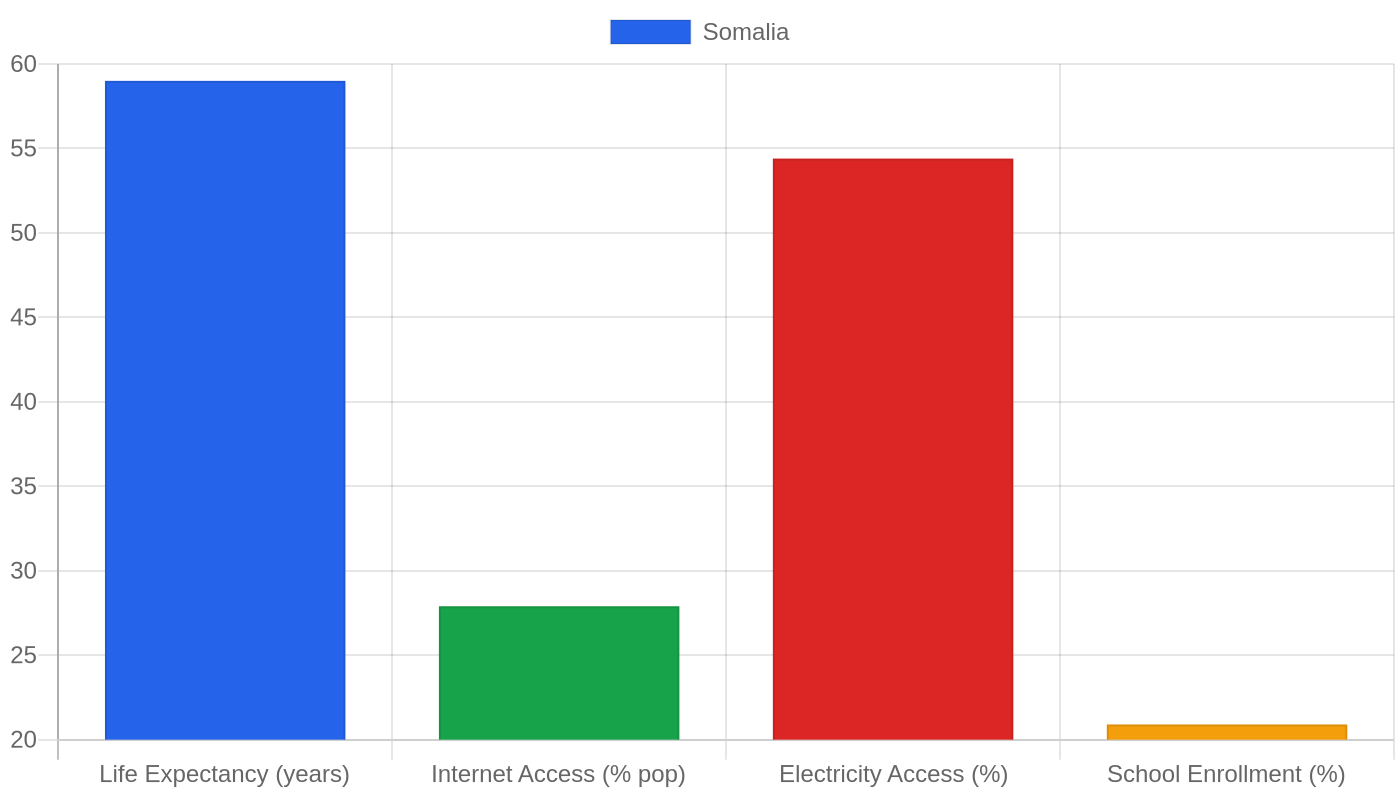
The World Bank’s latest data release for Somalia presents a statistical void — GDP growth, inflation, unemployment, and per capita income all register as “N/A.” This absence is itself a story, a testament to decades of institutional fragility that have made conventional economic measurement nearly impossible. Yet the absence of data is not the absence of economy.
Somalia’s economic life continues, conducted through informal networks, remittance corridors, and a remarkable telecommunications sector that has flourished precisely because the state could not provide basic services.
The country’s main industries, while not enumerated in available statistics, can be inferred from its corporate landscape. The Hafun Fishing Company points to a marine sector with substantial untapped potential — Somalia possesses one of the longest coastlines in Africa, and its waters have long been coveted for their abundance.
The Bosaso Tannery indicates a leather processing industry that draws on pastoral traditions, while the presence of multiple financial institutions suggests a banking sector attempting to rebuild from near-total collapse. What the World Bank cannot measure, the private sector is nonetheless building.
The telecommunications industry deserves particular attention. Hormuud Telecom and Golis Telecom Somalia have constructed networks that serve as the backbone of Somali commerce, enabling mobile money transfers that have made the country a global leader in cashless transactions despite — or perhaps because of — the absence of a functioning central banking system.
The Central Bank of Somalia’s presence on the list of top companies is itself remarkable; a state institution counted among private enterprises, reflecting the blurring of public and private that characterises Somalia’s economic landscape.
The Price of Survival — Housing and Daily Life
Cost of living data for Somalia remains unavailable through the World Bank, but the composition of the country’s major companies offers telling clues about daily existence. The presence of Hargeisa Taxi among the nation’s top firms speaks to urban transportation needs in a country where public infrastructure remains skeletal. Consumer services companies like Air Somalia and Eastern Television Network suggest a population that, despite hardship, continues to demand connectivity and mobility.
Housing in Somalia’s major cities — Mogadishu, Hargeisa, Bosaso — operates largely outside formal markets. Property rights remain contested in many areas, a legacy of conflict and displacement that has made the concept of “rent versus buy” nearly meaningless for most citizens. The wealthy build; the poor rent or shelter with extended family. Reconstruction proceeds unevenly, with diaspora remittances funding much of the new construction in safer neighbourhoods.
The cost of daily goods fluctuates wildly, vulnerable to drought, port disruptions, and the security situation along key trade routes.
The Business Frontier — Enterprise Against the Odds
Somalia’s business environment defies conventional analysis. The top companies list reveals an economy where telecommunications, financial services, and consumer goods coexist in a precarious equilibrium. The First Somali Bank and Bank of Somaliland represent parallel financial systems — the former operating in the context of the federal government, the latter in the self-declared republic of Somaliland, which maintains its own institutions despite lacking international recognition.
The Golis Telecom and Hormuud Telecom duopoly in communications has created a competitive market that has driven innovation in mobile payments, with services that predate and in some ways surpass similar offerings in far wealthier African nations. The consumer goods sector, represented by Hafun Fishing Company, points toward export potential that remains largely unrealised.
And Air Somalia’s presence among the top companies indicates that even aviation — perhaps the most infrastructure-dependent of industries — has found a way to operate in this challenging environment.
For investors, Somalia presents a paradox: the risks are manifest and well-documented, yet the opportunities in telecommunications, fishing, livestock, and reconstruction are substantial. Those who have committed capital — the founders of these top companies — are betting that Somalia’s trajectory, however uneven, is ultimately upward.
Security, Sovereignty, and the Shape of Things to Come
The political landscape of Somalia is defined by its federal parliamentary representative democratic republic structure — a system that distributes power across member states while maintaining a central government in Mogadishu. The president, as commander-in-chief of the Somali Armed Forces, holds significant authority over security matters, while the prime minister manages day-to-day governance. This division of powers, established in the provisional constitution, remains a work in progress.
Crime and safety indices for Somalia are unavailable, which is itself a statement. The country has experienced decades of instability, yet the situation on the ground varies dramatically by region. Somaliland has achieved relative peace and functions as a distinct polity; Mogadishu has seen significant improvement in recent years, even as al-Shabaab retains the capacity for high-profile attacks; and parts of the south remain contested.
The quality of life for ordinary Somalis is shaped less by national statistics than by local conditions — the security of one’s neighbourhood, the reliability of water supplies, the accessibility of schools and clinics.
The Current Moment — A Nation Rebuilding in Real Time
Somalia’s present is defined by the tension between its federal structure and the centrifugal forces that have historically pulled the country apart. The relationship between the central government and member states — particularly Puntland and Jubaland — remains a subject of ongoing negotiation, with disputes over resource sharing and political representation frequently reaching crisis points.
The president’s authority as commander-in-chief is tested by the presence of African Union peacekeeping troops and various clan militias that operate with varying degrees of allegiance to the central state.
The telecommunications sector continues to expand, with Hormuud and Golis launching new services that further entrench mobile money as the currency of daily life. The financial sector is consolidating, with the Central Bank of Somalia taking steps to regulate the remittance flows that constitute a lifeline for millions of households.
Fishing companies are pressing for greater access to the country’s rich marine resources, even as questions of maritime jurisdiction remain unresolved with neighbouring countries.
The business community watches the political process with a mixture of hope and wariness. The selection of a prime minister, the conduct of elections in member states, and the federal government’s ability to deliver basic services all influence the investment climate. For now, the companies that make up Somalia’s corporate landscape continue their work — building networks, processing leather, transporting passengers, and broadcasting to a nation that craves information about its own future.
The economy may be invisible to statisticians, but it is visible everywhere else in Somalia.
The Bottom Line
Somalia is not a country for the faint-hearted investor or the risk-averse observer. It is a nation where the official data is absent but the lived economy is real, where telecommunications flourish amid political fragmentation, and where the private sector has learned to thrive without the state’s support.
Those who should watch Somalia closely include investors in frontier markets seeking asymmetric opportunities, development economists studying how economies function in the absence of strong institutions, and anyone interested in the resilience of human enterprise under the most difficult circumstances. The numbers may be missing, but the story is unmistakable: Somalia is rebuilding, one transaction, one network, one company at a time.
Sources & Methodology
This article is authored by Economic Pulse Net for informational and research purposes. Economic Pulse Net sources its data from multilateral institutions, national statistics bureaus, and proprietary databases. All data is believed to be current as of the date of publication.
Published: August 20, 2026 | Category: Research — Somalia
Use these signals in your own platform
Economic Pulse publishes its live signal feed through a documented, read-only API. Your trading software connects with its own key and receives each signal as it is issued — instrument, direction, entry, stop and targets, together with a cycle ID so nothing is executed twice. The feed is independent of this website and cannot change it.
Signals are informational only and are not financial advice.