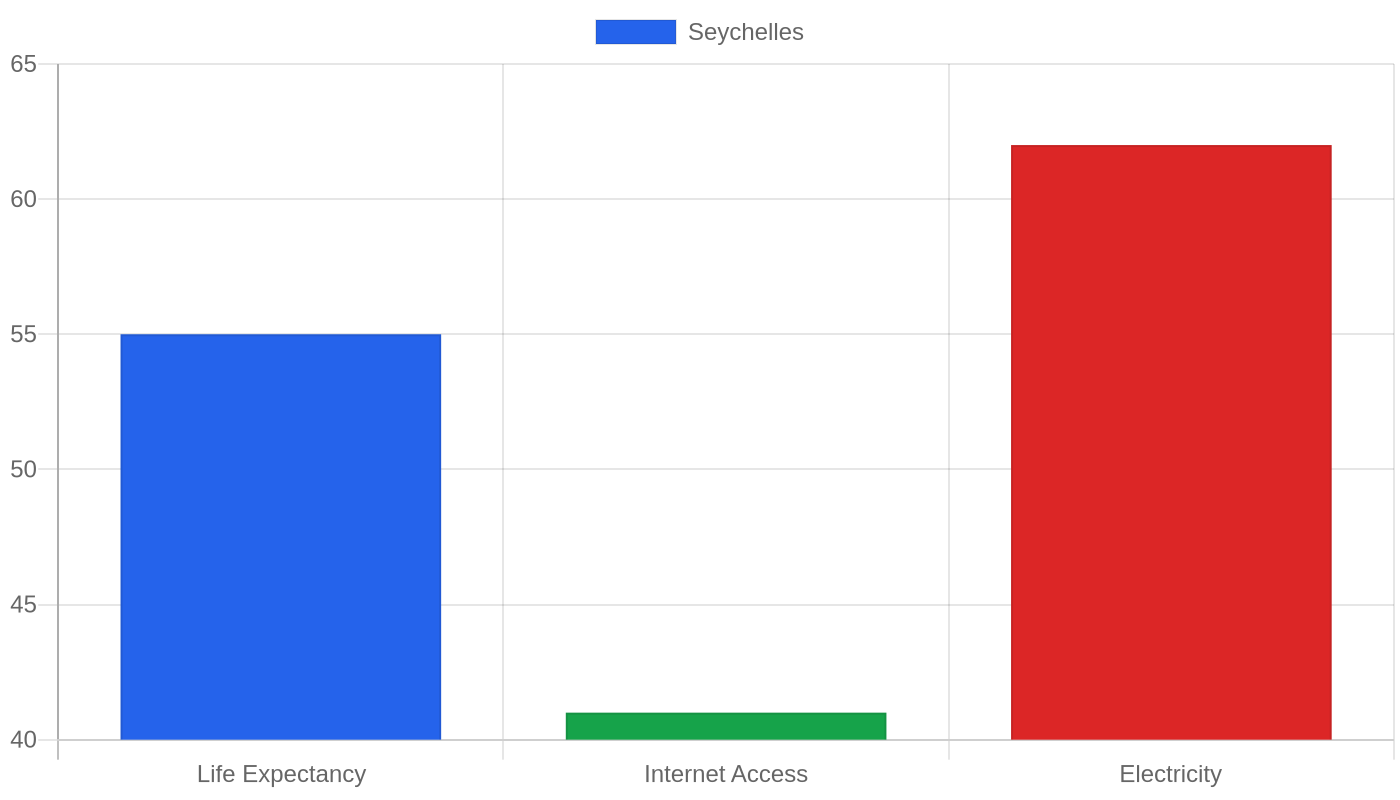
Economic Pulse Net | Sources: World Bank World Development Indicators, Government Sources | 2026
The Seychelles has long been the postcard image of Indian Ocean luxury: powder-white beaches, granite boulders, and turquoise waters that seem almost artificially bright. But beneath the surface of this island paradise lies a sophisticated, if delicate, economic ecosystem. With a population so small that the World Bank does not publish standard aggregate data for GDP growth, inflation, or unemployment, the Seychelles operates as a case study in how micro-states manage macroeconomic pressures.
The nation’s economy is overwhelmingly service-based, with tourism and aviation acting as the twin engines of prosperity. Yet, as 2026 unfolds, the Seychelles faces the same global headwinds as larger economies—supply chain disruptions, climate vulnerability, and the challenge of maintaining fiscal discipline in a world of rising costs.
President Patrick Herminie, who leads both government and state, must now steer this archipelago through a period where the line between economic resilience and fragility is razor-thin.
Key Takeaways
– The Seychelles economy is dominated by consumer services and aviation, with five of the seven top companies operating in the airline sector, making the country acutely sensitive to global travel trends.
– President Patrick Herminie, elected by popular vote for a five-year term, holds significant executive power as both head of state and head of government, with cabinet appointments subject to legislative approval.
– The Central Bank of Seychelles plays a pivotal role in financial stability, yet the absence of published World Bank data on GDP growth, inflation, or unemployment underscores the challenges of data transparency in micro-states.
– The Seychelles Marketing Board, a state-linked consumer goods entity, indicates the government’s continued involvement in essential supply chains, a legacy of the country’s history as a small island developing state.
– Without published crime or safety indices, the country’s reputation as a stable, high-end tourist destination serves as a proxy for social order, though this should not be mistaken for comprehensive data.
The Service State — Why Tourism and Aviation Define Everything
The World Bank provides no specific figures for Seychelles’ GDP growth, inflation, or unemployment, which is itself a revealing data point. For micro-states with populations in the low six figures, aggregate economic data is often suppressed or unavailable due to statistical insignificance on a global scale. Yet the structure of the economy is unmistakable from the list of top companies.
Air Seychelles, Lignes Aérienne Seychelles, Orion Air, and Seychelles International Airways dominate the corporate landscape, all classified under consumer services. This is not coincidence—it is economic identity. The Seychelles has built its modern prosperity on the ability to move people across the Indian Ocean, from Europe, Asia, and the Middle East, to its shores. When global aviation thrives, the Seychelles thrives.
When airlines struggle—due to fuel costs, geopolitical shocks, or pandemic-era border closures—the entire economy feels the turbulence. The Central Bank of Seychelles, listed among the top companies, serves as the financial anchor, managing currency stability and monetary policy in a country that imports nearly everything.
The Seychelles Marketing Board, a consumer goods entity, hints at the government’s role in ensuring food security and price stability in a nation where most goods arrive by ship or plane. Without published inflation data from the World Bank, analysts must infer price pressures from the country’s high import dependency and global commodity trends.
The Seychelles does not manufacture its way to growth; it services its way there, and that service model is both its greatest strength and its most profound vulnerability.
The Price of Paradise — Housing and Daily Life in an Import Economy
Cost of living data for the Seychelles is not provided by the World Bank, but the economics of island life are well understood by regional observers. In a nation that imports the vast majority of consumer goods, from food to fuel to construction materials, prices are structurally higher than in continental economies.
Housing costs in the main island of Mahé, particularly around the capital Victoria, command a premium driven by limited land availability and high demand from expatriate workers in the tourism and financial services sectors. Renting is the norm for most of the workforce, as property ownership remains aspirational for many Seychellois families. Daily expenses for staples such as rice, cooking oil, and fresh produce are subject to global shipping costs and exchange rate fluctuations managed by the Central Bank.
Compared to other Indian Ocean island economies, the Seychelles sits at the higher end of the cost spectrum, reflecting its status as a luxury destination. For the average citizen, this means that while the scenery is spectacular, the wallet feels the strain. The absence of published inflation data from the World Bank does not mean prices are stable—it means the data infrastructure has not yet caught up with the lived reality of households who watch their purchasing power erode with every imported shipment.
Sky-High Stakes — The Business Climate of an Aviation Republic
The corporate landscape of the Seychelles is dominated by aviation, and the implications for investors are clear: this is a bet on travel. Air Seychelles, the national carrier, operates alongside Lignes Aérienne Seychelles, Orion Air, and Seychelles International Airways, creating a dense ecosystem of consumer services that extends to ground handling, hospitality, and retail. For a country of its size, the concentration of airline-related companies is extraordinary.
The Seychelles Postal Service, classified under industrials, represents the non-tourism backbone, but it is the airlines that drive the economy. The Central Bank of Seychelles, as a top company, signals the importance of financial regulation and currency management in a nation that must maintain confidence among international investors and tourists alike.
Sectors to watch include sustainable tourism infrastructure, marine conservation-linked enterprises, and digital financial services that could reduce the economy’s reliance on physical imports. The business environment is shaped by the political structure: President Patrick Herminie appoints the cabinet with legislative approval, providing a degree of policy continuity that investors value.
However, the small size of the economy means that any major disruption—a cyclone, a global recession, a pandemic—can have outsized effects. The Seychelles is not a market for the risk-averse, but for those who understand the dynamics of island micro-states, it offers opportunities that larger, more diversified economies cannot match.
Stability in a Small State — Politics, Safety, and the Quality of Life Question
The political landscape of the Seychelles is defined by its presidential system. Patrick Herminie serves as both head of state and head of government, elected by popular vote for a five-year term. The president appoints the cabinet, subject to approval by a majority of the legislature, creating a system where executive power is concentrated but checked by parliamentary consent. This structure has provided political stability in a region where some neighbors have experienced coups or civil unrest.
The Seychelles has no published crime index or safety index from the data provided, but the country’s reputation as a high-end tourist destination suggests a relatively secure environment, at least in the areas frequented by visitors. Quality of life in the Seychelles is a study in contrasts: world-class natural beauty and a relaxed island pace are offset by high living costs and limited economic diversification.
The absence of happiness or well-being data from the provided sources does not diminish the reality that for many Seychellois, the trade-off between paradise living and economic opportunity is a daily negotiation. The political system, while stable, offers limited avenues for rapid change, meaning that economic policy shifts tend to be gradual rather than transformative.
Navigating the Now — The Herminie Presidency and the Path Forward
As of 2026, President Patrick Herminie leads the Seychelles through a period of global economic recalibration. The World Bank data provided does not include recent news or live indicators, but the political structure itself offers clues to the current moment. Herminie’s five-year term places him at the helm during a time when the Seychelles must confront the twin challenges of climate change and economic resilience.
Rising sea levels threaten coastal infrastructure, while the dominance of aviation makes the economy vulnerable to fuel price volatility and shifting travel patterns. The Central Bank of Seychelles is likely focused on maintaining currency stability in the face of global inflationary pressures, even if specific CPI data is not published. The Seychelles Marketing Board continues to play a role in managing essential goods, suggesting that food security remains a government priority.
Without specific recent news reports, the narrative of the Seychelles in 2026 is one of cautious navigation: a small state using its political stability and service-sector expertise to weather global storms. The absence of published economic indicators does not mean the economy is stagnant—it means the story is being written in real time, beyond the reach of standard data collection.
The Bottom Line
The Seychelles is a country that defies easy categorization—it is simultaneously a luxury travel destination, a fragile micro-state, and a sophisticated service economy. Investors and analysts should watch this nation for its unique exposure to global aviation trends and its ability to maintain political stability in a volatile region. For travelers, it remains a dream destination. For economists, it is a laboratory of how small, open economies adapt to a world that does not always publish their data.
Sources & Methodology
This article is authored by Economic Pulse Net for informational and research purposes. Economic Pulse Net sources its data from multilateral institutions, national statistics bureaus, and proprietary databases. All data is believed to be current as of the date of publication.
Published: July 21, 2026 | Category: Research — Seychelles
Use these signals in your own platform
Economic Pulse publishes its live signal feed through a documented, read-only API. Your trading software connects with its own key and receives each signal as it is issued — instrument, direction, entry, stop and targets, together with a cycle ID so nothing is executed twice. The feed is independent of this website and cannot change it.
Signals are informational only and are not financial advice.