Economic Pulse Net | Sources: World Bank World Development Indicators, Government Sources | 2026
Key Takeaways
– Senegal’s economy is defined by a striking concentration of state-linked enterprises in aviation, telecommunications, and utilities, with companies like Sonatel, Senelec, and multiple airlines dominating the corporate landscape.
– The country’s political system has undergone repeated constitutional changes to presidential term limits, shifting between five- and seven-year cycles since independence, reflecting deep debates about executive power.
– Senegal’s first president, Léopold Sédar Senghor, was a poet and the first African elected to the Académie française, establishing a unique tradition of intellectual leadership that shaped the nation’s identity.
– The corporate sector reveals a heavy state footprint, with La Poste, the Dakar–Niger Railway, and Senelec operating alongside private players like Ikatel and Amsa assurances.
– Despite gaps in current macroeconomic data, Senegal’s story is one of institutional continuity and gradual economic transformation, with its political history providing crucial context for understanding its present trajectory.
The Economy of a Nation in Waiting
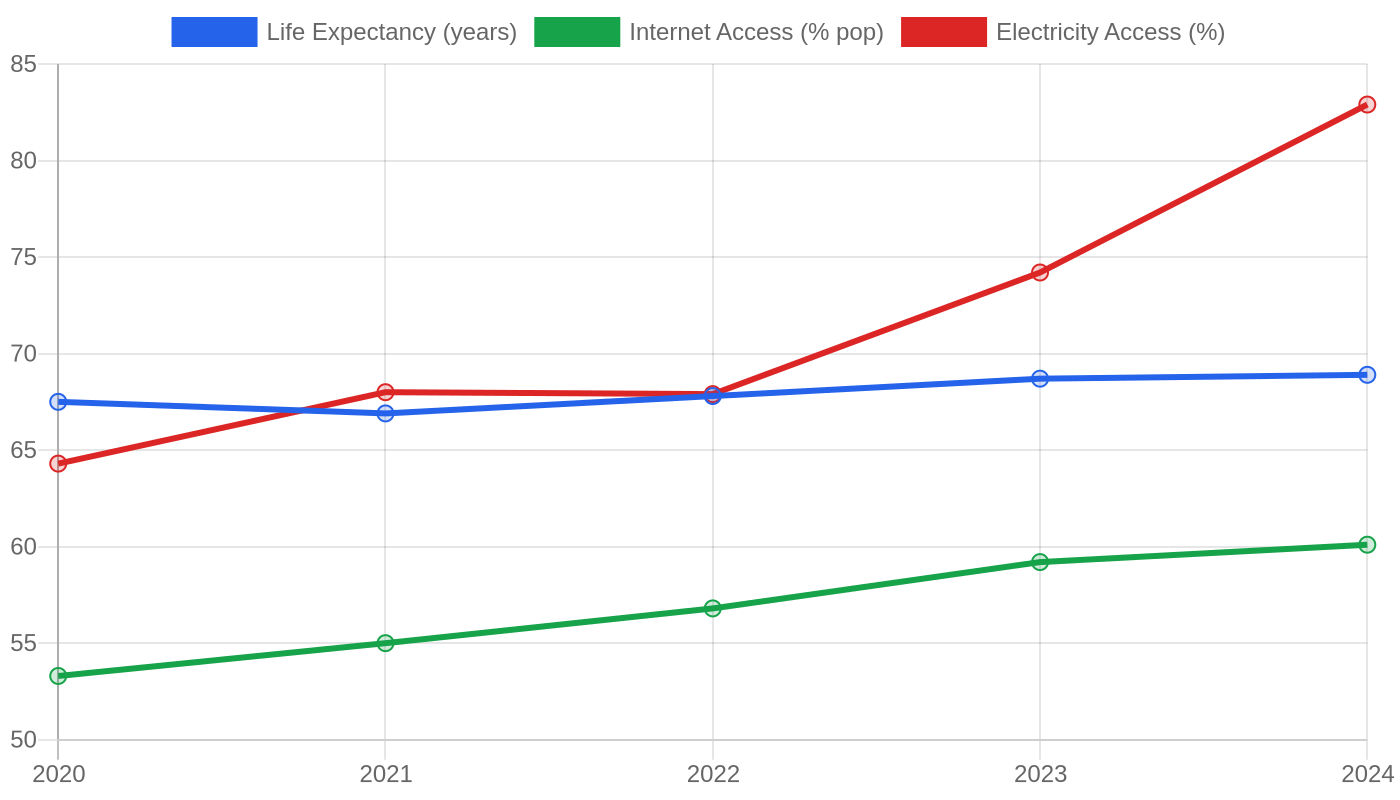
Senegal’s economic narrative is written in the spaces between data points. The World Bank provides no current figures for GDP growth, inflation, or unemployment — a silence that itself tells a story about the challenges of economic measurement and reporting in a developing West African nation. What we do know, from the available data, is the architecture of Senegal’s productive base. The country’s major industries are not a diversified manufacturing powerhouse or a resource-extraction giant.
Instead, Senegal’s economy is built around services, infrastructure, and state-led enterprises.
The corporate landscape is dominated by consumer services — particularly aviation. Air Sénégal International, Atlantis Airlines, Groupement Aérien Sénégalais, and Senegal Airlines all appear on the list of top companies, suggesting a sector that has seen multiple iterations and restructurings. This concentration in air travel is unusual for a country of Senegal’s size and income level, and it speaks to the nation’s role as a regional hub in West Africa.
The Dakar–Niger Railway, an industrial-era relic connecting Senegal’s capital to landlocked Mali, remains a significant enterprise, underscoring the enduring importance of transport infrastructure to the Senegalese economy.
Utilities and telecommunications round out the picture. Senelec, the state electricity company, and Sonatel, the dominant telecom operator, alongside Ikatel, form the backbone of modern economic activity. The presence of Amsa assurances in financial services hints at a developing insurance sector. What is absent from this list is equally telling: no major agricultural, mining, or manufacturing firms appear among the top companies.
Senegal’s economy, according to this data, is one of services and state-owned enterprises, operating in a region where informal economic activity often dwarfs formal sector statistics.
The Price of Dakar — Housing and Daily Life in a Capital City
The cost of living in Senegal presents a picture shaped by the stark divide between Dakar, the bustling Atlantic capital, and the rural interior. The World Bank data provided does not include specific housing costs or price indices, but the structure of Senegal’s economy — dominated by state enterprises and service companies concentrated in the capital — suggests significant urban-rural disparities.
Dakar, a city of roughly three million people, has long been one of West Africa’s more expensive urban centers, driven by limited housing supply, high demand from international organizations and diplomatic missions, and the concentration of economic activity.
Rental costs in desirable neighborhoods of Dakar — such as the Plateau, Almadies, or Mermoz — can rival those in middle-income countries, while wages remain low by global standards. The presence of multiple airlines among Senegal’s top companies hints at the importance of international connectivity and expatriate presence, which further pressures housing markets. For the average Senegalese worker in the formal sector, employed by Sonatel or Senelec, housing likely consumes a substantial portion of income.
In rural areas, where the majority of the population still lives, the cost of living is lower but access to services and quality housing is more limited. The gap between the two Senegals — urban and rural, formal and informal — defines the country’s economic reality as much as any inflation statistic.
Business and Investment — Airlines, Telecoms, and the State’s Long Shadow
For investors considering Senegal, the corporate landscape offers both opportunity and caution. The top companies list reveals an economy where the state remains a dominant force. Senelec, La Poste, the Dakar–Niger Railway, and multiple airlines are either wholly or partially state-owned. Sonatel, while partially privatized, retains strong government connections. This state presence creates stability but also limits the space for private-sector dynamism.
The telecommunications sector, with Sonatel and Ikatel both among the top firms, is a bright spot. West Africa’s mobile revolution has transformed economies across the region, and Senegal is no exception. Mobile money, digital services, and expanding internet access offer growth opportunities. The insurance sector, represented by Amsa assurances, remains underdeveloped relative to the region’s potential, suggesting room for expansion. Aviation, however, tells a more complicated story.
The presence of four different airlines among the top companies — some of which have faced financial difficulties or ceased operations over the years — indicates a sector that has struggled to find a sustainable model. Investors should note that Senegal’s business environment, while relatively stable by regional standards, requires navigating a complex web of state involvement, regulatory frameworks, and infrastructure constraints that the data only hints at.
Stability and Succession — Senegal’s Political Tradition
Senegal’s political landscape is one of the most distinctive in Africa. The country is a republic with a presidency, and the data reveals a fascinating history of constitutional tinkering with term limits. From independence until 2001, presidents served seven-year terms. Then came a shift to five years from 2001 to 2008, followed by a return to seven years from 2008 to 2016, and finally a permanent move to five-year terms as of 2016.
This back-and-forth reflects the personalization of political power and the difficulty of institutionalizing democratic rules.
The lineage of Senegal’s presidents is remarkable. Léopold Sédar Senghor, the first president, was a poet and writer, and the first African elected to the Académie française — the elite institution that guards the French language. This choice of a literary intellectual as founding father set Senegal apart from many post-colonial African states led by military officers or liberation fighters.
Abdou Diouf, the second president, later served as secretary-general of the Organisation Internationale de la Francophonie, continuing the tradition of Senegalese leaders playing prominent roles on the continental and Francophone stage. Abdoulaye Wade, the third president, was a lawyer and opposition figure who came to power after years of activism.
This succession of presidents — each with intellectual or professional credentials beyond mere political ambition — has given Senegal a reputation for political maturity and institutional continuity, even as the country has faced economic challenges and occasional political tensions.
Current Affairs — Navigating the Data Gap
The most striking feature of Senegal’s current economic situation is what the data does not tell us. With no recent figures from the World Bank on GDP growth, inflation, or unemployment, analysts and investors are left reading tea leaves. This data gap is itself newsworthy. It may reflect reporting lags, statistical capacity challenges, or the disruptions of recent global shocks.
In a region where timely economic data is often scarce, Senegal’s silence is not unique, but it is notable for a country that has historically prided itself on institutional strength.
What can be inferred from the available information is that Senegal is navigating a period of transition. The political system, having settled on five-year presidential terms, is entering a new phase of electoral politics. The economy, dominated by state enterprises in aviation, utilities, and telecommunications, faces the challenge of modernization and private-sector development. The presence of multiple airlines among the top companies suggests a sector in flux, with consolidation or restructuring likely.
The telecommunications sector, with both Sonatel and Ikatel, is poised for growth as digital services expand across West Africa. The absence of recent macroeconomic data should not be mistaken for economic stagnation — rather, it points to the need for better statistical infrastructure to tell Senegal’s full story.
The Bottom Line
Senegal is a country that rewards patient observation. Its political tradition of intellectual leadership, its relatively stable institutions, and its position as a West African hub make it a nation to watch for investors and analysts interested in the region’s long-term trajectory.
The data gaps are real, but they should not obscure the underlying story: a country with a distinctive political culture, a services-oriented economy, and a corporate sector dominated by state-linked enterprises in aviation, telecoms, and utilities. For those willing to look beyond the missing numbers, Senegal offers a case study in how a small West African nation navigates the intersection of politics, economics, and history.
Sources & Methodology
This article is authored by Economic Pulse Net for informational and research purposes. Economic Pulse Net sources its data from multilateral institutions, national statistics bureaus, and proprietary databases. All data is believed to be current as of the date of publication.
Published: July 26, 2026 | Category: Research — Senegal
Use these signals in your own platform
Economic Pulse publishes its live signal feed through a documented, read-only API. Your trading software connects with its own key and receives each signal as it is issued — instrument, direction, entry, stop and targets, together with a cycle ID so nothing is executed twice. The feed is independent of this website and cannot change it.
Signals are informational only and are not financial advice.