Economic Pulse Net | Sources: World Bank World Development Indicators, Government Sources | 2026
Key Takeaways
– Rwanda operates as a de facto one-party state under the Rwandan Patriotic Front (RPF) and President Paul Kagame, who has ruled continuously since 1994, with elections marred by the banning of opposition parties, arrests of critics, and electoral fraud.
– The financial sector dominates the corporate landscape, with ten of the twelve largest companies being banks, including Bank of Kigali, Equity Bank Rwanda, and Access Bank Rwanda.
– Consumer goods and services are represented by Bralirwa Brewery and Bourbon Coffee, indicating a narrow but stable non-financial private sector.
– Crime and safety indices are not available, but the political environment is described by the World Bank as nominally democratic yet tightly controlled.
– Without specific GDP, inflation, or employment figures from the World Bank, the country’s economic narrative must be understood through its political structure and corporate concentration rather than traditional macroeconomic metrics.
The Known Unknowns — Rwanda’s Economic Black Box
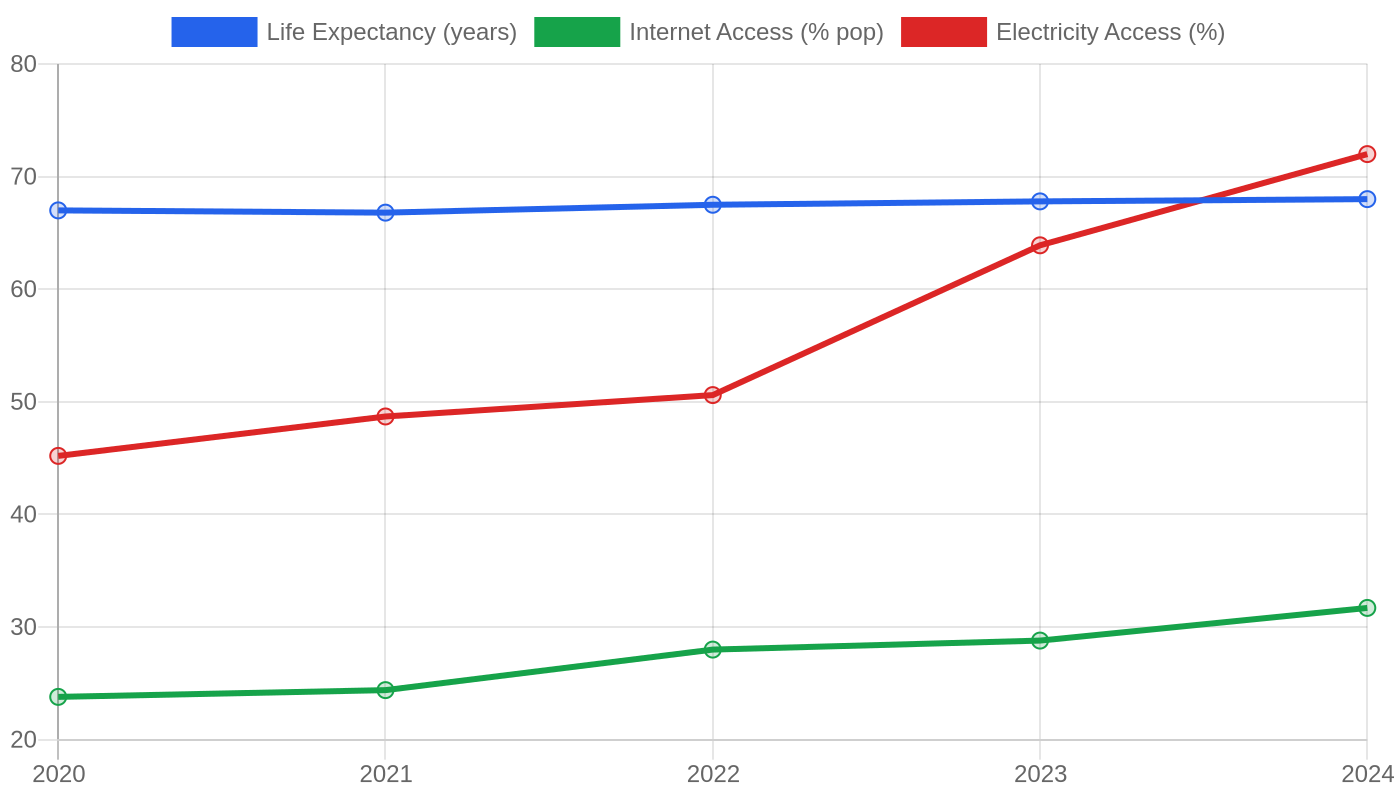
The World Bank provides no GDP growth figure, no inflation rate, no unemployment statistic, no GDP in US dollars, no GDP per capita based on purchasing power parity, no GNI per capita, and no population count for Rwanda. This absence of data is itself a story. For a country often hailed by international institutions as a developmental success story, the lack of basic macroeconomic indicators from the world’s premier economic data source is striking.
It forces the analyst to look beyond the numbers and into the structure of the economy itself.
What we do know is that Rwanda’s corporate landscape is overwhelmingly financial. Of the twelve largest companies identified, ten are banks. AB Bank Rwanda, Access Bank Rwanda, Bank of Africa Rwanda Limited, Bank of Kigali, Banque Populaire du Rwanda SA, Banque Populaire du Rwanda, Compagnie Générale de Banque, and Equity Bank Rwanda Limited form a dense web of financial institutions that dominate formal economic activity.
This concentration suggests an economy where credit intermediation, rather than manufacturing or agriculture, drives what measurable growth exists. The remaining two companies — Bralirwa Brewery in consumer goods and Bourbon Coffee in consumer services — hint at a small but present consumer economy, but one that is dwarfed by the banking sector’s footprint.
The absence of data from the World Bank may reflect reporting gaps, political opacity, or the challenges of measuring informal economic activity that likely constitutes a significant portion of Rwandan livelihoods. Without inflation or employment figures, it is impossible to assess whether the banking sector’s dominance translates into broad-based prosperity or merely financial sector enrichment.
Where the Kigali Franc Goes — Cost of Living in a Controlled Economy
The World Bank provides no cost of living data for Rwanda, and no housing costs, rental prices, or daily expense figures are available from the provided information. This silence is particularly notable given that Kigali, the capital, is frequently cited in regional discourse as one of East Africa’s more expensive cities relative to local incomes.
Without specific numbers, we can infer from the corporate structure that the financial sector’s employees — bankers, loan officers, and compliance staff — likely command salaries that support a higher cost of living, while the majority of Rwandans working outside the formal banking economy face a different economic reality.
The presence of Bourbon Coffee, a chain that positions itself as a premium brand, suggests a consumer class exists, but its size and purchasing power remain unquantified. Rent versus buy decisions, utility costs, and food prices cannot be compared to regional averages without data. What can be said is that in an economy dominated by banks, access to credit — not income alone — likely determines housing and consumption patterns.
The cost of living in Rwanda remains, for now, a story told anecdotally rather than statistically.
Banking on a Narrow Base — Investment and Business Climate
For investors looking at Rwanda, the message from the corporate data is clear: this is a financial services story with a consumer goods footnote. The ten banks listed include both local institutions like Bank of Kigali and Banque Populaire du Rwanda, as well as regional players like Equity Bank Rwanda and Access Bank Rwanda. This mix suggests a banking sector that is both domestically rooted and connected to broader East African financial networks.
Bralirwa Brewery, a consumer goods staple, and Bourbon Coffee, a retail brand, represent the non-bank private sector’s modest scale.
The business environment, as filtered through the political landscape, operates within the constraints of a de facto one-party state. The World Bank notes that Rwanda is nominally democratic but that elections are manipulated through banning opposition parties, arresting or assassinating critics, and electoral fraud. The RPF is described as a Tutsi-dominated party that also receives support from other communities.
For investors, this political stability — enforced rather than democratically contested — provides predictability but also risk. The absence of political turnover means policy continuity, but the lack of democratic checks raises questions about long-term governance sustainability and the rule of law.
Sectors to watch would logically extend beyond banking, but the data provides no indications of emerging industries in technology, manufacturing, or agriculture. The investment climate is thus defined by what is present — a concentrated financial sector — rather than by diversification or innovation.
Order Without Liberty — Safety, Politics, and Quality of Life
The crime and safety indices for Rwanda are listed as “N/A” in the provided data, leaving a gap in understanding daily security conditions. However, the political landscape offers a detailed picture of governance. Rwanda is described as a de facto one-party state ruled by the Rwandan Patriotic Front and Paul Kagame continuously since the end of the civil war in 1994.
The World Bank data characterizes the system as nominally democratic but systematically manipulated through the banning of opposition parties, the arrest or assassination of critics, and electoral fraud.
This political structure has implications for quality of life that go beyond crime statistics. The RPF’s dominance, while providing stability and efficient governance in certain areas, comes at the cost of political pluralism and civil liberties. The Tutsi-dominated nature of the party, even with cross-community support, raises ongoing questions about ethnic representation and reconciliation in a country still recovering from the 1994 genocide.
Without happiness data or broader quality-of-life indicators, the trade-off between order and freedom becomes the central framework for understanding life in Rwanda. Citizens may enjoy physical security and efficient public services, but they do so within a system that actively suppresses political dissent.
The Rwanda Model Under Scrutiny — What’s Happening Now
The provided data carries no recent news, live indicators, or current affairs updates. There are no inflation trends, policy shifts, reform announcements, or business developments to report. This absence is itself noteworthy for a country that frequently features in international development discourse. Rwanda’s silence in the data stream may reflect a period of relative stability — or a lack of transparency in reporting.
What can be said is that the political framework described — a de facto one-party state with manipulated elections — remains the operating reality. The RPF’s grip on power shows no signs of loosening, and the financial sector’s dominance continues. Without fresh data, the current moment in Rwanda appears to be one of continuity rather than change. The banking sector that dominates the corporate list likely continues to expand credit, while Bralirwa and Bourbon Coffee serve the consumer market.
The absence of news does not mean nothing is happening; it means the available information does not capture it.
For a country that presents itself as a hub for conferences, technology, and development innovation, the lack of current economic indicators is a reminder that the narrative of Rwandan success rests more on reputation and political branding than on transparent, publicly available data. The World Bank’s silence may be the most telling indicator of all.
The Bottom Line
Rwanda is a country to watch for those interested in the intersection of authoritarian governance and economic development, but the available data provides more questions than answers. Investors focused on financial services may find opportunity in a concentrated banking sector, but they must navigate a political system where opposition is suppressed and electoral outcomes are predetermined.
Development economists and political scientists should monitor Rwanda as a case study in the efficiency-stability trade-off, but they will need to look beyond the World Bank’s data gaps to understand the full picture. For the general reader, Rwanda remains a paradox: a country praised for its order and progress, yet one that provides remarkably little measurable evidence of either.
Sources & Methodology
This article is authored by Economic Pulse Net for informational and research purposes. Economic Pulse Net sources its data from multilateral institutions, national statistics bureaus, and proprietary databases. All data is believed to be current as of the date of publication.
Published: July 21, 2026 | Category: Research — Rwanda
Use these signals in your own platform
Economic Pulse publishes its live signal feed through a documented, read-only API. Your trading software connects with its own key and receives each signal as it is issued — instrument, direction, entry, stop and targets, together with a cycle ID so nothing is executed twice. The feed is independent of this website and cannot change it.
Signals are informational only and are not financial advice.