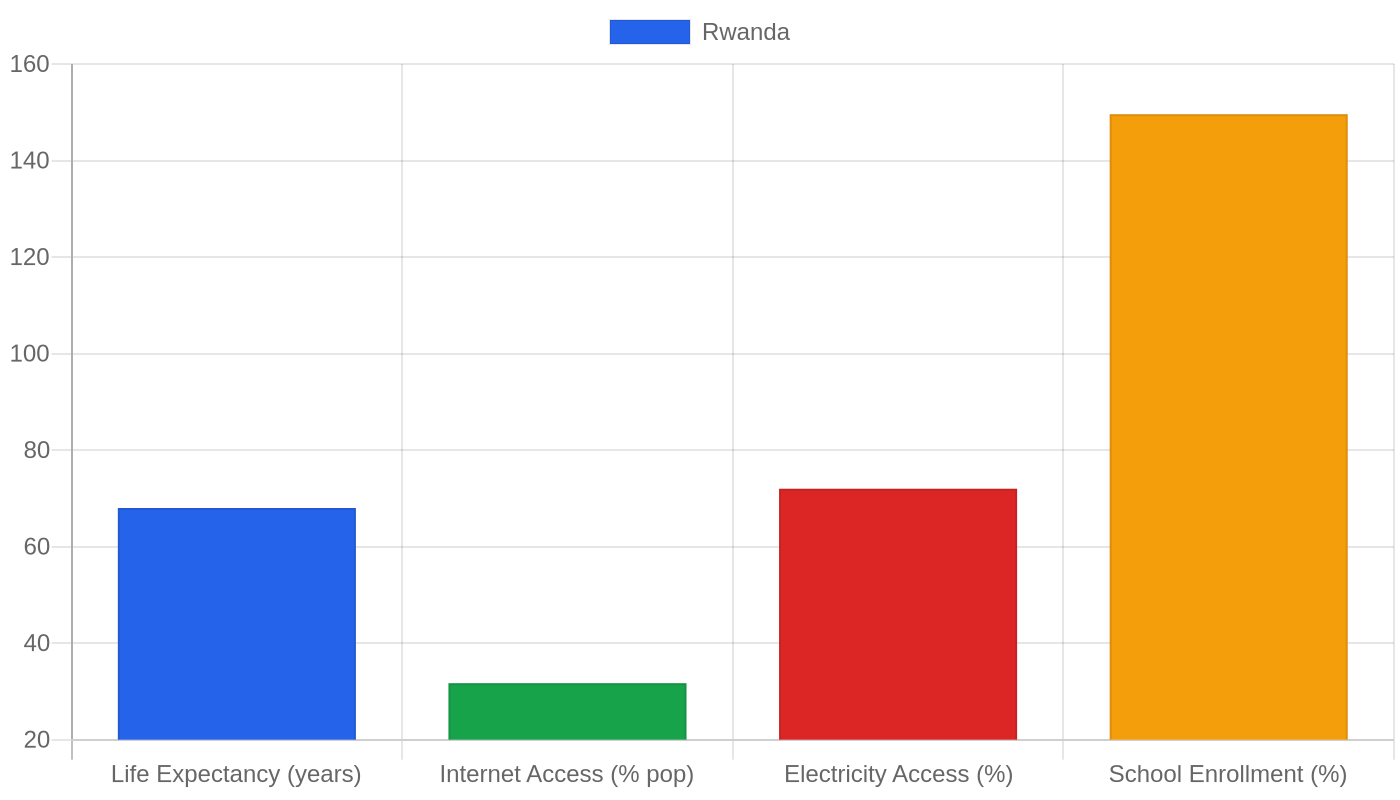
Economic Pulse Net | Sources: World Bank World Development Indicators, Government Sources | 2026
Key Takeaways
– Rwanda operates as a de facto one-party state under the Rwandan Patriotic Front (RPF) and President Paul Kagame, with elections widely documented as manipulated through bans on opposition parties, arrests, and electoral fraud.
– The financial sector dominates the corporate landscape, with ten of the twelve top companies being banks—signaling a state-directed economy where capital flows through politically aligned institutions.
– Despite the absence of recent World Bank economic indicators, Rwanda’s development model has historically prioritized rapid infrastructure expansion and service-sector growth over political liberalization.
– The country presents a stark contradiction: a stable, business-friendly environment built on authoritarian governance, where safety is high but political dissent is criminalized.
The Kigali Consensus — Banking on Centralized Control
Rwanda’s economy operates in a statistical fog. The World Bank provides no current data on GDP growth, inflation, unemployment, or per capita income—an unusual silence for a country that markets itself as Africa’s most efficient development story. What we do know is that Rwanda’s corporate landscape tells a clear story about where economic power concentrates.
Ten of the twelve largest companies are financial institutions: AB Bank Rwanda, Access Bank Rwanda, Bank of Africa Rwanda Limited, Bank of Kigali, Banque Populaire du Rwanda SA, Banque Populaire du Rwanda, Compagnie Générale de Banque, and Equity Bank Rwanda Limited. This is not a market-driven diversity of industries. It is a financial sector built to serve state priorities.
The dominance of banking suggests that credit allocation, investment decisions, and capital flows are tightly managed—consistent with a political system where the RPF controls the commanding heights of the economy.
The absence of manufacturing, technology, or agricultural giants among the top companies raises fundamental questions about Rwanda’s vaunted “transformation.” A nation cannot build sustainable wealth on banking services alone. The real economy—the farms, factories, and digital enterprises that create jobs and distribute income—remains conspicuously absent from the corporate elite.
Bourbon Coffee and Bralirwa Brewery are the only non-financial firms in the top tier, both consumer-facing businesses that serve Kigali’s urban middle class rather than driving export-led growth.
The Price of Order — Housing and the Cost of Living in a Controlled Economy
Without cost-of-living data from official sources, we must read the landscape. Kigali is notoriously expensive compared to regional peers, a reality visible in the city’s gleaming new buildings and the proliferation of high-end coffee shops like Bourbon Coffee, which charges prices that would be unremarkable in Nairobi or Johannesburg but are extraordinary for a country with Rwanda’s income levels.
The housing market is bifurcated. In Kigali’s upscale neighborhoods like Kiyovu and Nyarutarama, rents for modern apartments rival those in much wealthier capitals—driven by demand from international NGOs, diplomatic missions, and the RPF-connected elite. Meanwhile, the vast majority of Rwandans live in rural mud-brick homes with limited access to electricity and running water. This is not a natural market outcome.
It is a deliberate policy choice: concentrate investment in the capital, build a showcase city for foreign investors and donors, and maintain tight control over rural populations through local government structures that answer directly to the RPF.
The cost of basic goods is inflated by Rwanda’s landlocked geography and its often-troubled relationship with neighboring Uganda. Transport costs, fuel taxes, and the dominance of politically connected importers mean that everyday items cost more than they should. For the average Rwandan, the much-touted “Rwandan miracle” means clean streets and reliable internet in Kigali, but not necessarily more money in their pocket.
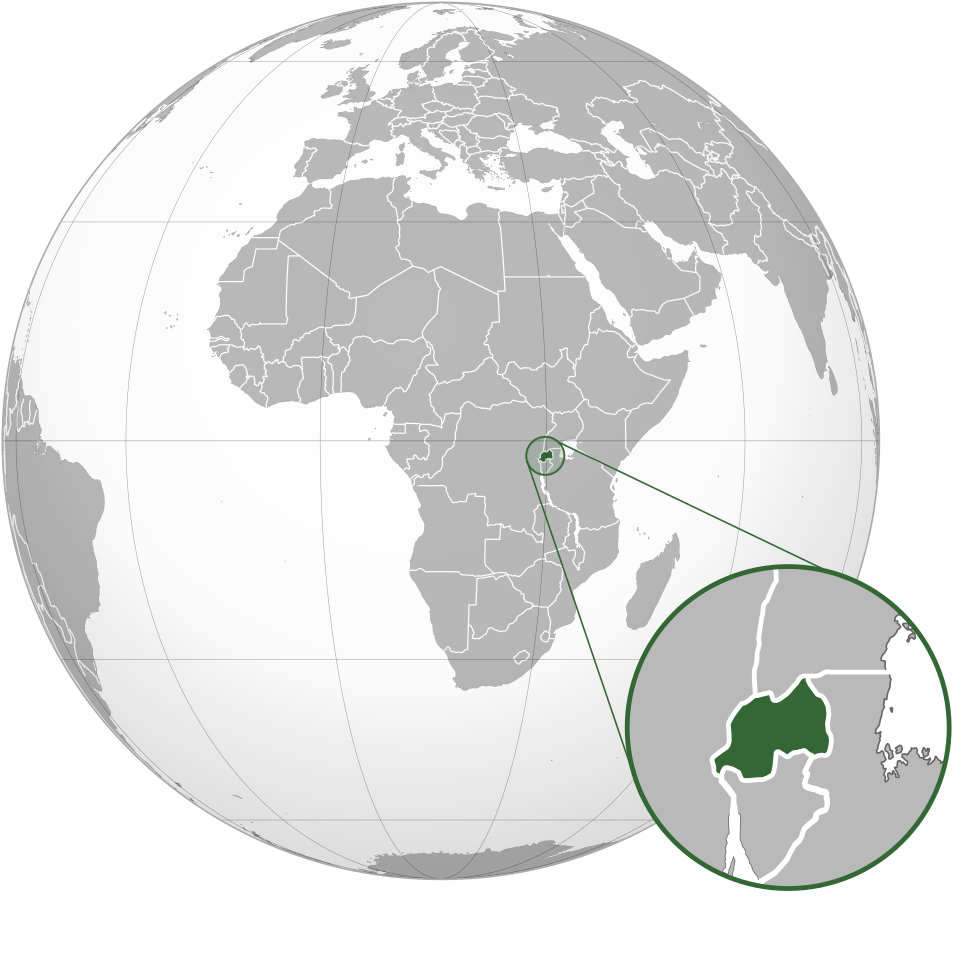
Banking on the Future — Where Capital Meets Control
For investors willing to operate within the RPF’s framework, Rwanda offers distinct advantages. The financial sector is well-capitalized and professionally managed. Bank of Kigali, the largest lender, has consistently reported strong profits and maintains international correspondent banking relationships that many other African banks struggle to secure.
The presence of Access Bank (Nigeria), Equity Bank (Kenya), and Bank of Africa (pan-African) signals that international financial institutions see Rwanda as a stable, predictable market.
The sectors to watch are not the banks themselves but what they finance. Infrastructure remains the RPF’s obsession—roads, convention centers, and the ambitious Kigali Innovation City project. Agribusiness, particularly coffee and tea, offers export potential, though smallholder farmers remain vulnerable to global price swings. Tourism, built around gorilla trekking and genocide memorials, generates foreign exchange but employs relatively few people.
The business environment is efficient by regional standards. Company registration takes days, not months. Property rights are respected—for those with the right connections. Corruption exists but is less brazen than in neighboring countries, partly because the RPF’s internal security apparatus is so effective at monitoring economic activity. The trade-off is clear: do business on the regime’s terms, or don’t do business at all.
The Secure State — Safety Through Surveillance
Rwanda’s crime and safety indices are blank in the data, but the reality on the ground is well-documented. Kigali is one of Africa’s safest cities. Violent crime is rare. Women can walk alone at night without fear. The streets are clean, orderly, and heavily policed. This is not accidental—it is the product of a security state that monitors citizens through an extensive network of local government officials, community policing, and, critics say, intelligence operatives.
The political landscape, however, is where the safety narrative darkens. Rwanda is, according to multiple sources, a de facto one-party state ruled by the RPF and Paul Kagame since 1994. Elections are manipulated through banning opposition parties, arresting or assassinating critics, and electoral fraud. The RPF is a Tutsi-dominated party that also receives support from other communities, but political competition is a fiction. Opposition figures who do not flee into exile tend to end up in prison or dead.
Quality of life in Rwanda is therefore a paradox. Physical safety is high. Public services function reasonably well. The genocide of 1994 is a scar that the government has used to justify authoritarian control—the argument being that only strong leadership prevented a return to chaos. But that same security comes at the cost of basic political freedoms. There are no independent newspapers, no real opposition parties, no free labor unions.
The happiness that comes from safety is tempered by the knowledge that dissent carries severe consequences.
The Succession Question — What Happens When Kagame Goes?
This is the question that hangs over everything in Rwanda right now. Paul Kagame has ruled since 1994. He is 68 years old. There is no clear successor. The RPF has systematically eliminated potential rivals, both inside and outside the party. The constitution was changed in 2015 to allow Kagame to run for a third term, and again to potentially allow him to stay until 2034.
The current moment is defined by political tension beneath the surface of stability. The RPF’s tight control means that economic decision-making is entirely personalized around Kagame’s vision. Major infrastructure projects, banking sector policies, and foreign investment approvals all flow through the presidency. There is no independent central bank in practice, no autonomous regulatory bodies, no economic policy debate in parliament.
For businesses operating in Rwanda, the risk is not today’s stability but tomorrow’s transition. When Kagame eventually leaves power—whether through death, retirement, or some unforeseen political crisis—the entire system could be upended. Succession struggles in authoritarian regimes rarely produce smooth transitions. The banks that dominate Rwanda’s economy are heavily exposed to government-linked projects and politically connected borrowers.
A change at the top could trigger a wave of non-performing loans, capital flight, and economic contraction.
Internationally, Rwanda’s reputation as a development success story is fraying. Donor governments that once praised the “Rwandan model” are increasingly uncomfortable with the human rights record. The UK’s controversial Rwanda asylum deal has collapsed. Western criticism of Rwanda’s support for the M23 rebel group in eastern Congo has intensified. The economic model that depended on foreign aid and favorable treatment is showing cracks.
The Bottom Line
Rwanda is a country to watch for investors who understand that political risk is not the same as political instability. The current system is stable because it is repressive. The banks are profitable because they are protected. The streets are safe because the state is strong. But that strength is concentrated in one man, one party, one vision. When that concentration dissolves—and it will—the economic consequences will be severe. Watch Rwanda for the succession, not the statistics.
Sources & Methodology
This article is authored by Economic Pulse Net for informational and research purposes. Economic Pulse Net sources its data from multilateral institutions, national statistics bureaus, and proprietary databases. All data is believed to be current as of the date of publication.
Published: July 20, 2026 | Category: Research — Rwanda
Use these signals in your own platform
Economic Pulse publishes its live signal feed through a documented, read-only API. Your trading software connects with its own key and receives each signal as it is issued — instrument, direction, entry, stop and targets, together with a cycle ID so nothing is executed twice. The feed is independent of this website and cannot change it.
Signals are informational only and are not financial advice.