Economic Pulse Net | Sources: World Bank World Development Indicators, Government Sources | 2026
Key Takeaways
– Nigeria’s GDP surged to 4.01% in 2025, its strongest performance in years, but inflation remains punishing at 23%, eroding real household incomes.
– Unemployment is officially just 3.06%, yet this masks a vast informal economy where underemployment and subsistence work are the norm.
– Food inflation, according to the Centre for the Promotion of Private Enterprise (CPPE), remains the single biggest threat to Nigerian families despite a slight easing in the headline rate.
– The country’s GNI per capita of just $1,360 places it squarely in low-middle-income territory, meaning the growth story has not yet translated into widespread prosperity.
– Political stability under a federal presidential system provides continuity, but soaring cooking gas prices are creating a new front in the cost-of-living crisis.
The Growth Paradox — 4% Expansion Meets 23% Inflation
On paper, Nigeria’s economy is humming. The World Bank reports GDP growth of 4.01% for 2025 — a figure that would be the envy of many emerging markets. But any celebration must be tempered by the inflation figure sitting alongside it: 23.01%. That gap between growth and price stability tells the story of an economy expanding in nominal terms while real purchasing power shrinks for millions.
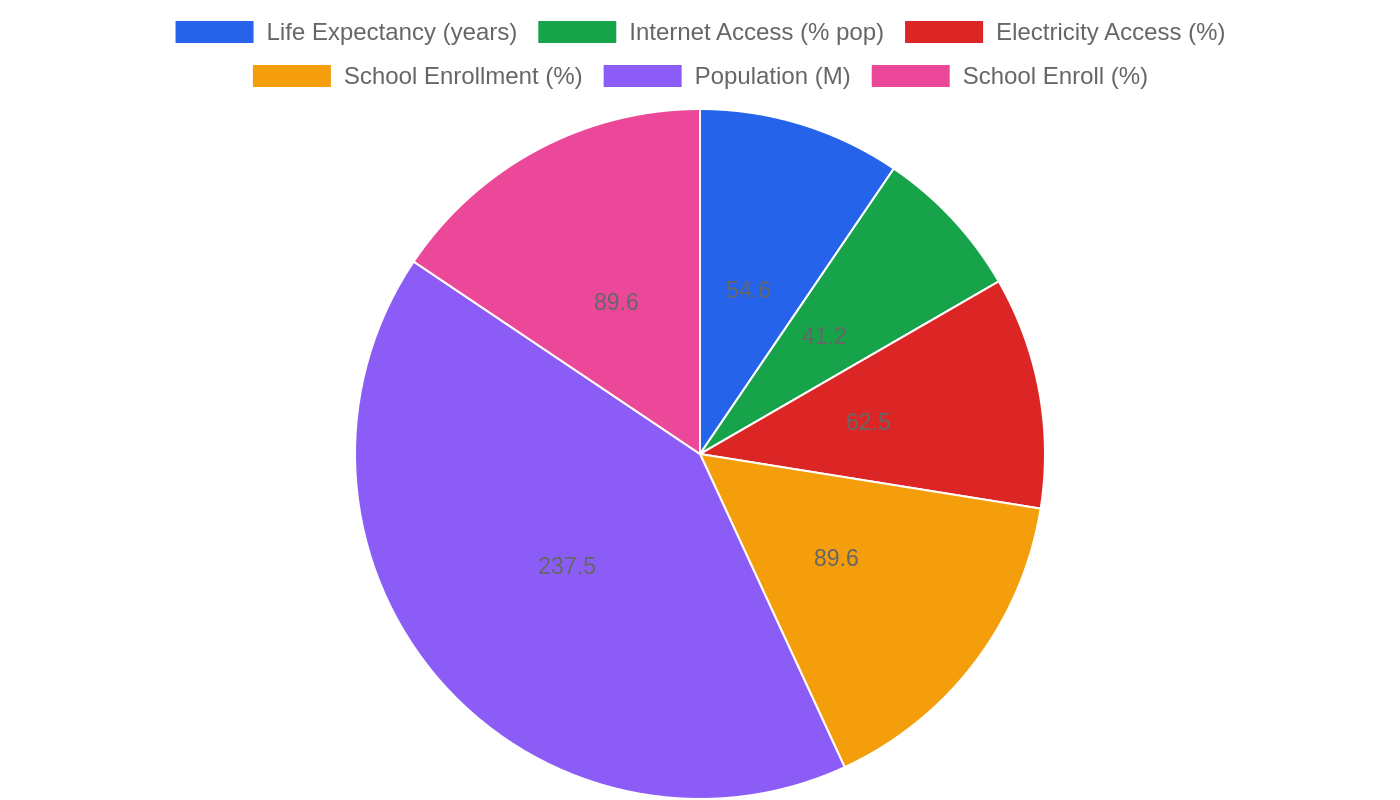
The GDP per capita, measured at purchasing power parity, stands at $9,531.61. That is not a poverty wage by regional standards, but it is hardly comfortable. When you factor in that the GNI per capita is just $1,360, the picture becomes clearer: a nation of more than 237 million people where the gap between what the economy produces and what individuals earn remains vast. The World Bank data reveals a country growing, but not yet distributing that growth widely.
Unemployment at 3.06% seems enviably low, particularly when compared to many developed economies. But this figure requires careful reading. In Nigeria, the vast majority of workers are in the informal sector — market traders, artisans, small-scale farmers, and gig workers. Low unemployment here does not mean good jobs; it means almost everyone has to do something to survive. The headline rate tells us little about the quality, security, or dignity of work.
The main industries driving this growth are diverse. Financial services, led by institutions like Access Bank, remain a pillar. Consumer goods companies such as BUA Foods are feeding a rapidly urbanising population. Industrials including BUA Cement and C&I Leasing Group PLC are building the physical infrastructure of Africa’s most populous nation. Yet the economy remains heavily dependent on oil revenues, and the data provided does not suggest a dramatic shift away from that vulnerability.
The Cost of Living — When Cooking Gas Becomes a Luxury
For the average Nigerian household, the macroeconomic headlines translate into a daily struggle. The national statistics bureau, through its recent sensitisation workshop on GDP and CPI rebasing, acknowledges that the way inflation is measured may need updating. But for now, the lived reality is clear: prices are rising faster than incomes.
A recent special report from Premium Times, a national newspaper, documents how soaring cooking gas prices are squeezing households and businesses alike. Cooking gas, once a relatively affordable alternative to charcoal and kerosene, has become a luxury for many urban families. This is not merely an inconvenience — it is a public health issue, as families revert to dirtier fuels that cause respiratory problems.
Food inflation remains the biggest threat, according to the CPPE. Even as the headline inflation rate shows signs of easing, food prices continue to climb. In a country where households typically spend more than half their income on food, this is existential. The World Bank data does not provide a detailed breakdown of housing costs, but regional context suggests that rent in major cities like Lagos and Abuja consumes a large share of disposable income.
Buying a home remains out of reach for all but the wealthiest, with mortgage penetration among the lowest in the world.
The cost-of-living crisis is not evenly felt. In the rural north, subsistence farming provides a buffer against market prices, but also leaves families vulnerable to climate shocks. In the urban south, the cash economy means every price hike hits immediately. Nigeria in 2025 is a country where the macroeconomic data says “growing,” but the kitchen table says “struggling.”
Investment & Business Climate — Giants and Gaps
Nigeria’s corporate landscape is dominated by a mix of financial institutions, consumer goods conglomerates, and industrials that are betting on the country’s long-term potential. Access Bank stands as a titan of the financial sector, with a reach that extends across the continent. BUA Cement and BUA Foods represent the industrial and consumer goods pillars of the economy, both part of a conglomerate that has become synonymous with Nigerian capitalism.
But the list of top companies also reveals something about the economy’s character. Aero Contractors, Arik Air, and Chanchangi Airlines all appear — a reminder that domestic aviation remains a volatile but essential sector in a country where road travel is dangerous and rail networks are underdeveloped. Cassava Republic Press and Chocolate City Records show that Nigeria’s creative economy, though smaller in revenue terms, is culturally dominant across Africa and the diaspora.
The Central Bank of Nigeria features on the list, not as a commercial enterprise but as a reflection of the state’s heavy hand in the financial system. Monetary policy is a constant battleground, as the bank tries to tame inflation without choking off the growth that the World Bank numbers celebrate.
For investors, the message is mixed. The growth rate is real, and a population of 237 million offers a massive domestic market. But the inflation rate, the infrastructure deficits, and the regulatory unpredictability remain serious headwinds. The sectors to watch are financial services, consumer goods, and technology — but success requires patience and local knowledge.
Safety, Politics & Quality of Life — Democracy’s Uneven Rewards
Nigeria is a federal republic modelled on a presidential system, with 36 states and the Federal Capital Territory of Abuja. The president is elected by popular vote to a maximum of two four-year terms, as are state governors. This political structure provides a degree of stability and predictability, but it does not guarantee effective governance.
The crime and safety indices are not available in the data provided, but any honest assessment of life in Nigeria must acknowledge the security challenges. Kidnapping for ransom, banditry in the northwest, separatist violence in the southeast, and the ongoing insurgency in the northeast are all part of the fabric of daily life for many Nigerians. The quality of life is heavily determined by where you live and how much you can spend on private security.
Yet Nigeria also offers a vibrancy that is hard to quantify. The same cities that struggle with crime are home to the continent’s most dynamic music scene, a thriving film industry (Nollywood), and a literary culture that produces global stars. The Cassava Republic Press on the top companies list is a reminder that Nigerian creativity is a major export.
Happiness data is not provided, but one can infer from the economic numbers that life is hard for the majority. A GNI per capita of $1,360 means most families are living on less than $4 per day. The democracy delivers elections and transitions of power, but it has not yet delivered the broad-based prosperity that citizens expect.
What’s Happening Now — Inflation Eases, But Food Still Bites
The most recent news from Nigeria paints a picture of cautious optimism tempered by persistent hardship. The National Bureau of Statistics recently celebrated African Statistics Day 2024, an event that underscores the importance of data in policymaking. More significantly, the Statistician General of the Federation delivered a keynote address at a sensitisation workshop for stakeholders on the GDP and CPI rebasing exercise.
This is not bureaucratic trivia — rebasing the consumer price index could change how inflation is measured and, consequently, how monetary policy is set.
The CPPE has warned that food inflation remains the biggest threat despite an easing headline rate. This is the critical nuance: the overall inflation number may be trending down, but the prices of staple foods — rice, beans, yams, cooking oil — are still rising at a pace that outpaces wage growth. The headline figure masks the pain felt at the market.
Premium Times’ special report on cooking gas prices adds another dimension. As global energy prices fluctuate and domestic refining capacity remains inadequate, the cost of cooking has become a political issue. Households are being squeezed, and businesses that rely on gas — from restaurants to small-scale manufacturers — are struggling to pass on costs without losing customers.
The policy response is still unfolding. The Central Bank of Nigeria is navigating a narrow path between supporting growth and controlling inflation. The rebasing of GDP and CPI could provide a more accurate picture of the economy, but it will not, by itself, lower prices or create jobs. What is happening now in Nigeria is a test of whether strong GDP growth can be sustained while the cost-of-living crisis is brought under control.
The Bottom Line
Nigeria in 2025 is a study in contrasts: a 4% growth rate that would be the envy of many peers, paired with 23% inflation that is crushing household budgets. The country deserves the attention of investors willing to take a long view, policymakers looking for lessons in managing a large, informal economy, and anyone interested in where Africa’s demographic future is heading. But the numbers from the World Bank and the warnings from the CPPE and Premium Times make clear that growth alone is not enough.
Until food inflation is tamed and the gains of expansion reach the kitchen table, Nigeria’s economic story will remain one of potential waiting to be fulfilled.
Sources & Methodology
This article is authored by Economic Pulse Net for informational and research purposes. Economic Pulse Net sources its data from multilateral institutions, national statistics bureaus, and proprietary databases. All data is believed to be current as of the date of publication.
Published: July 17, 2026 | Category: Research — Nigeria
Use these signals in your own platform
Economic Pulse publishes its live signal feed through a documented, read-only API. Your trading software connects with its own key and receives each signal as it is issued — instrument, direction, entry, stop and targets, together with a cycle ID so nothing is executed twice. The feed is independent of this website and cannot change it.
Signals are informational only and are not financial advice.