Economic Pulse Net | Sources: World Bank World Development Indicators, Government Sources | 2026
Key Takeaways
– Niger’s political system operates under a semi-presidential framework established by a 2010 referendum, but the country’s economic data remains largely opaque, with the World Bank reporting no recent figures on GDP growth, inflation, or unemployment.
– The nation’s corporate landscape is dominated by state-linked utilities and resource extraction companies, including SOMAIR and COMINAK in basic materials, alongside SONIDEP in oil and gas.
– Consumer services companies form the largest cluster of major enterprises, including Arik Niger, Dounia TV, and the state broadcaster, suggesting a domestic-focused service economy.
– Despite significant mineral wealth, the absence of cost-of-living or safety index data from the World Bank leaves critical gaps in understanding daily life for Nigeriens.
The Silent Economy — What the Numbers Don’t Tell Us
When the World Bank publishes no GDP growth figure, no inflation rate, and no unemployment statistic for a country of over 25 million people, it is not merely an administrative oversight. It is a statement. Niger, the vast Sahelian nation that sits atop some of West Africa’s most promising uranium deposits, has become something of an economic ghost in international data sets.
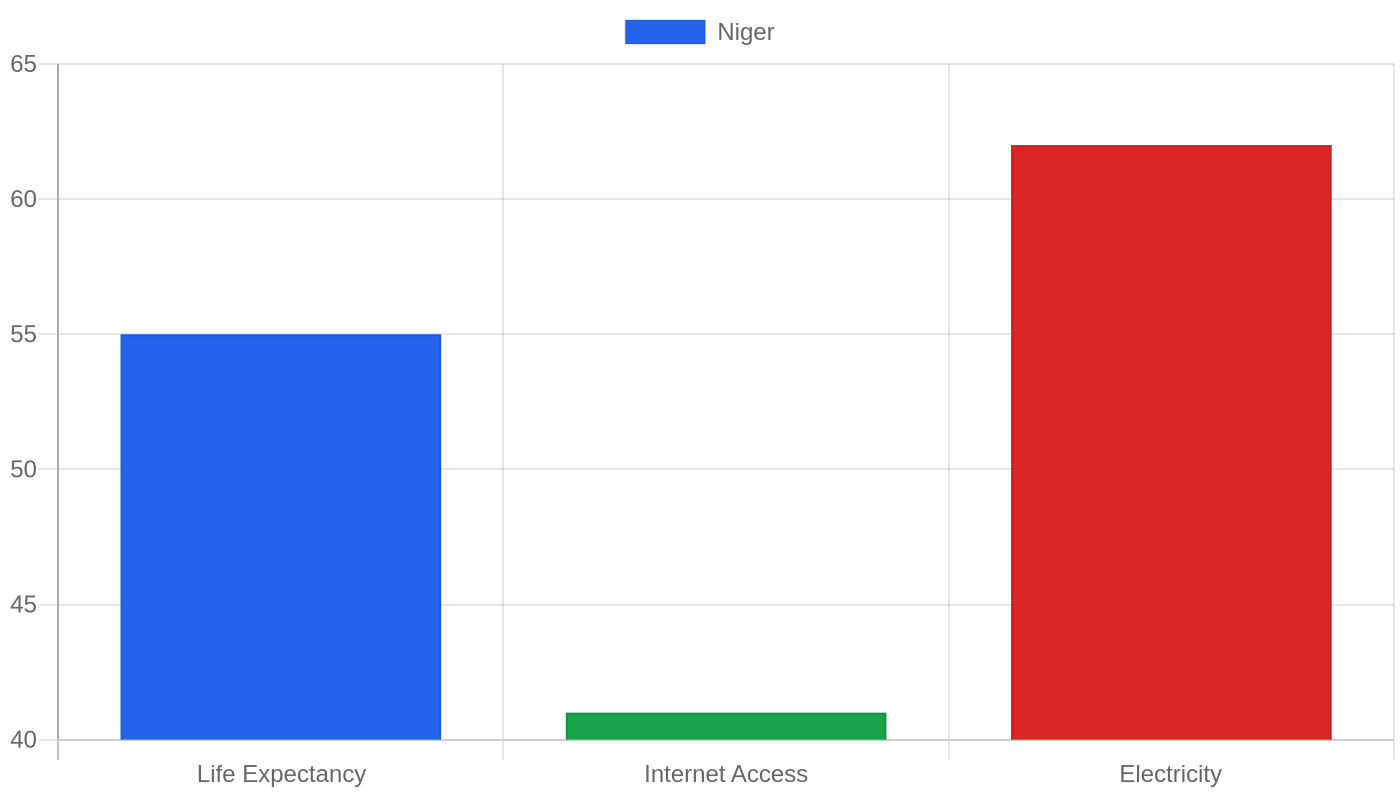
The World Bank’s latest indicators for the country are empty placeholders — GDP per capita (PPP), GNI per capita, even population figures remain unreported in the most recent available data.
This data vacuum is itself a story. For a nation that has long relied on uranium mining — operated primarily by SOMAIR and COMINAK, both listed as major basic materials companies — the absence of economic metrics suggests either a breakdown in statistical collection or a deliberate opacity. The World Bank typically tracks these figures through national statistical agencies and treasury departments. When they go dark, it often signals deeper institutional challenges.
What we do know is that Niger’s economy has historically been agrarian, with uranium providing the primary export revenue. The presence of SONIDEP in the oil and gas sector hints at growing hydrocarbon ambitions, while NIGELEC, the state utility, indicates a formal energy grid that likely struggles to meet demand across the country’s vast desert expanses.
Without inflation data, it is impossible to say whether the cost of basic goods has spiraled, as it has in many Sahelian nations facing food security pressures. The silence from the World Bank on these metrics is not just a statistical gap — it is a warning sign that Niger’s economic governance may be struggling to keep pace with its challenges.
Living on the Edge — Housing and Daily Life in an Unmeasured Economy
With no cost-of-living data provided by the World Bank, painting a precise picture of daily expenses in Niger requires reading between the lines of what is available. The country’s corporate roster offers some clues.
The presence of Sociéte Nigerienne de Transports de Voyageurs — a state transport company — suggests that public mobility is considered a necessity worth formalizing, while Niger Poste maintains a foothold in the industrials sector, indicating that basic postal and logistics infrastructure exists but may be limited.
Housing costs in Niamey, the capital, have historically been shaped by the presence of international organizations and mining companies, which drive up rents in secure neighborhoods. For the average Nigerien, however, the housing market is largely informal — family compounds in urban peripheries or traditional mud-brick homes in rural areas.
The absence of rental data from the World Bank means we cannot compare Niger to its regional neighbors like Burkina Faso or Mali, but anecdotal patterns across the Sahel suggest that housing consumes a significant portion of household income, particularly when water and electricity from NIGELEC are factored in.
Daily expenses for food staples — millet, sorghum, rice — fluctuate with rainfall and regional trade routes. Without CPI data, it is impossible to quantify whether inflation is eroding purchasing power, but the lack of reported figures itself raises questions. If the World Bank cannot get inflation numbers, it likely means price volatility is either severe enough to defy measurement or that reporting mechanisms have collapsed entirely.
The Corporate Landscape — Uranium, Oil, and State Control
Niger’s top companies list reads like a who’s who of state capitalism and resource extraction. SOMAIR and COMINAK dominate the basic materials sector, representing the legacy of French-led uranium mining that has been both a blessing and a curse for the country. These operations have provided revenue but also created dependency and environmental concerns.
SONIDEP, the national oil company, signals that Niger is looking to diversify into hydrocarbons, though the scale of these operations relative to global producers remains unclear.
The consumer services sector is remarkably crowded for a country with limited formal economic data. Arik Niger, Dounia TV, Escadrille Nationale du Niger, and the Office of Radio and Television of Niger all suggest a media and transportation ecosystem that is domestically focused. Escadrille Nationale du Niger — essentially the national air squadron — hints at state involvement in aviation, likely for both official transport and potential military applications.
What is striking is the absence of major private-sector banks, telecoms, or agricultural exporters in the top companies list. This suggests that Niger’s formal economy remains heavily state-directed, with utilities like NIGELEC and logistics firms like Niger Poste filling roles that in more developed markets would be private-sector domains.
For investors, this means navigating a landscape where the state is both regulator and dominant competitor — a challenging environment for foreign capital seeking transparent returns.
Governance Under the Fifth Republic — Politics in a Data Void
Niger’s most recent constitution, approved by referendum on 31 October 2010, restored the semi-presidential system of government that had been established in the 1999 constitution, known as the Fifth Republic. Under this framework, executive power is shared between a president elected by universal suffrage for a five-year term and a prime minister appointed by the president. This system was designed to balance power after a series of coups and political crises that had plagued the country since independence.
The 2010 referendum was intended to provide stability, but the political landscape remains fragile. The World Bank provides no crime index or safety index for Niger, which is notable given the country’s location in the Sahel, a region grappling with jihadist insurgencies and cross-border violence. The absence of safety data does not mean safety is assured — it means the data is not being collected or shared at an international level.
Without happiness indices or quality-of-life metrics, we are left to infer from the corporate and political structures. A country with a state-dominated economy, a semi-presidential system designed to prevent authoritarian overreach, and no reported crime statistics is a country in a holding pattern — neither collapsing nor thriving, but existing in a state of managed uncertainty.
The political system provides a framework, but without economic data to measure its effects, governance remains an abstraction rather than a measurable outcome.
Current Affairs — The Story Behind the Silence
The most telling current development in Niger is not a specific policy or election, but the continued absence of economic data from the World Bank’s latest reporting. This silence speaks volumes about the challenges facing the country in 2026.
When a nation cannot provide basic GDP, inflation, or population figures to international institutions, it suggests either a breakdown in statistical capacity, a lack of political will to share data, or economic conditions so volatile that meaningful measurement has become impossible.
The corporate landscape offers some clues about where the economy is heading. The presence of SONIDEP in oil and gas, alongside SOMAIR and COMINAK in mining, suggests that resource extraction remains the primary driver of formal economic activity. But without production figures or export data from the World Bank, it is impossible to verify whether these industries are expanding or contracting.
The consumer services companies — particularly the media entities like Dounia TV and the state broadcaster — indicate that domestic consumption and information dissemination remain priorities, even if the scale is unknown.
What is happening right now in Niger is a test of whether the 2010 constitutional framework can deliver stability in the face of economic uncertainty. The semi-presidential system was designed to prevent the concentration of power that led to past coups, but without economic data to measure its success, the political system operates in a vacuum.
For Nigeriens, daily life continues — farming, trading, commuting via the state transport company, paying electricity bills to NIGELEC — but the absence of data means that neither citizens nor international observers can fully assess whether the country is moving forward or standing still.
The Bottom Line
Niger is a country of strategic importance and untapped potential, but it remains a cipher in international economic data. The World Bank’s empty cells for GDP, inflation, and unemployment are not just missing numbers — they are a signal that the nation’s economic governance needs urgent attention. For investors, the dominance of state-linked companies in mining, oil, and utilities offers opportunities but also significant political risk.
For policymakers and development organizations, Niger represents a challenge: how to support a country where the basic metrics of economic health are unavailable. Watch Niger not for what the data shows, but for what the silence reveals about the state of governance in the Sahel.
Sources & Methodology
This article is authored by Economic Pulse Net for informational and research purposes. Economic Pulse Net sources its data from multilateral institutions, national statistics bureaus, and proprietary databases. All data is believed to be current as of the date of publication.
Published: July 21, 2026 | Category: Research — Niger
Use these signals in your own platform
Economic Pulse publishes its live signal feed through a documented, read-only API. Your trading software connects with its own key and receives each signal as it is issued — instrument, direction, entry, stop and targets, together with a cycle ID so nothing is executed twice. The feed is independent of this website and cannot change it.
Signals are informational only and are not financial advice.