Economic Pulse Net | Sources: World Bank World Development Indicators, Government Sources | 2026
Key Takeaways
– Niger’s political framework is anchored in a semi-presidential system, restored by a constitution approved via referendum on 31 October 2010, which balances power between an elected president and a prime minister.
– The nation’s economic narrative is currently shaped by a reliance on extractive industries, with SOMAIR and COMINAK standing as pillars in the basic materials sector.
– State-owned enterprises dominate the formal economy, spanning utilities, transport, and media, indicating a significant public sector footprint.
– Consumer services, including broadcasting and national transport, represent a substantial portion of the country’s top corporate entities.
– With a governance structure that has survived a decade and a half, Niger presents a case study in political endurance amid economic transformation.
The Uranium Economy: Digging Deeper into Niger’s Economic Bedrock
The engine room of Niger’s formal economy is unapologetically extractive. According to the World Bank, the country’s economic indicators—GDP growth, inflation, and unemployment—are currently unpublished, leaving analysts to piece together the picture from the nation’s industrial composition. What is abundantly clear is that the nation’s wealth lies beneath its soil.
The presence of SOMAIR and COMINAK, both classified under basic materials, is not incidental; these are the operational giants that have historically driven export revenues and foreign exchange earnings. The significance of these mining operations cannot be overstated—they are the primary source of formal employment and government revenue in a country where the vast majority of the population engages in subsistence agriculture outside the formal statistical net.
The absence of hard data on inflation and GDP growth from the World Bank creates a challenge for economists, but the structural reality is that Niger’s economic health is inextricably linked to global commodity prices. When uranium prices surge on international markets, the benefits ripple through the state’s coffers; when they falter, the budget tightens.
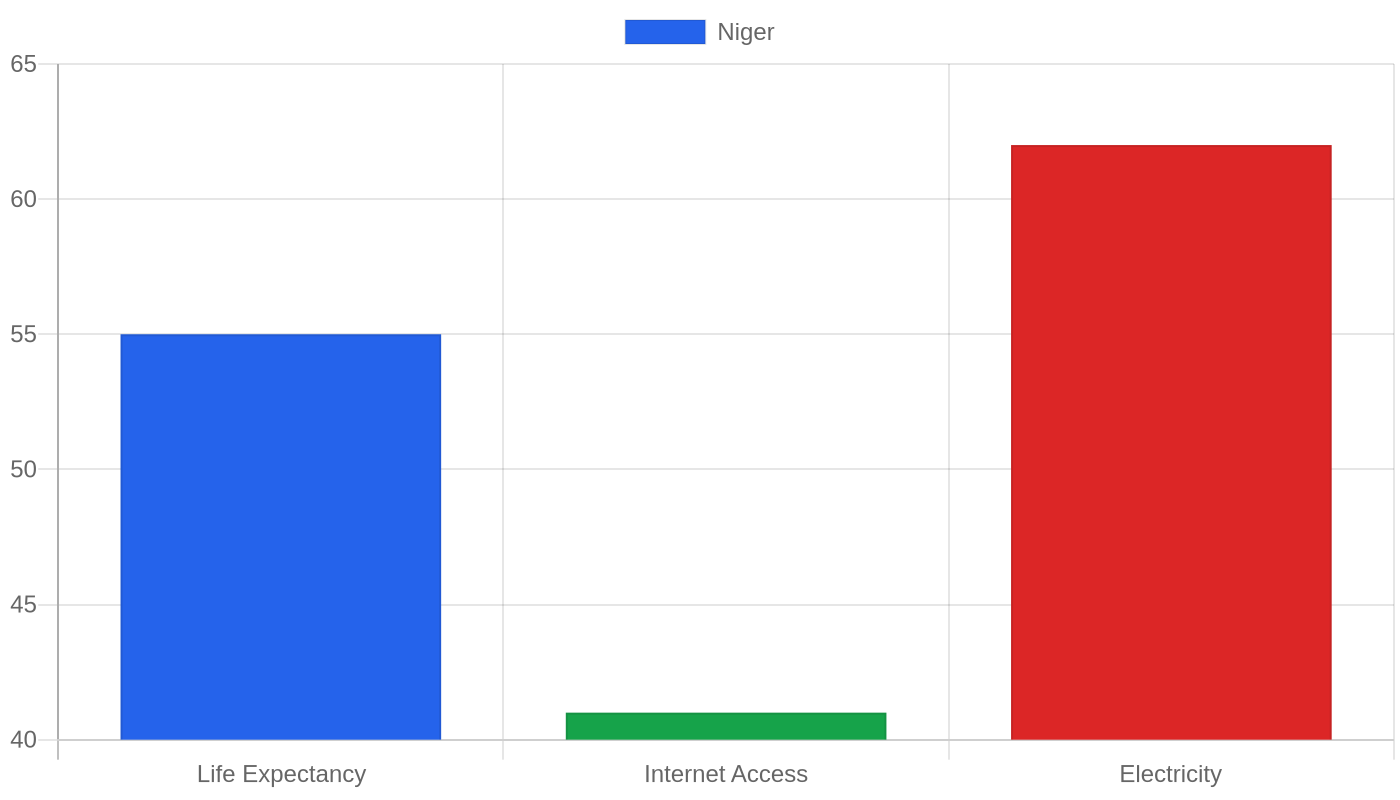
The utility sector, represented by NIGELEC, underscores the nation’s ongoing struggle with infrastructure development—providing reliable electricity remains a fundamental constraint on industrial expansion beyond the mining enclaves. The economic narrative here is one of potential energy—both literal and figurative—waiting to be harnessed.
The country’s fiscal stability depends on diversifying beyond the mining sector, yet the capital and technical expertise required for such a transition remain concentrated in the very extractive industries that currently dominate.
The Cost of Living: Between Subsistence and State Provision
In the absence of indexed cost-of-living data, the economic reality for the average Nigerien is best understood through the lens of the nation’s corporate structure. With companies like Niger Poste and the Société Nigérienne de Transports de Voyageurs operating as state-owned entities, the government effectively subsidizes and controls key components of daily life, from postal services to intercity travel.
This state-centric approach to essential services suggests that the cost of living is partially shielded from market volatility, with administered prices rather than competitive market forces determining the cost of basic utilities and transportation. Housing, however, remains a market-driven commodity, and in the capital Niamey, the disparity between formal and informal housing markets continues to shape the urban landscape.
The dominance of consumer services companies—including Dounia TV and the Office of Radio and Television of Niger—points to a media landscape that is both a public service and a state enterprise. For citizens, this means access to information is often subsidized, but the quality and diversity of that information may be constrained by state involvement.
The practical cost of living in Niger is likely characterized by a stark divide: those employed in the formal sector, particularly in mining or government, enjoy a degree of stability, while the informal sector—which employs the majority—faces daily price fluctuations without social safety nets.
Regional comparisons are difficult without hard data, but the structure of the economy suggests that Niger remains a low-cost, low-income environment where the state plays a paternalistic role in managing the basic levers of daily economic life.
Investment & Business Climate: The State as Entrepreneur
The business landscape of Niger is a fascinating study in state capitalism, where the lines between public service and commercial enterprise blur. The top companies list is dominated by entities that are either wholly state-owned or heavily state-influenced, from NIGELEC in utilities to SONIDEP in oil and gas. This creates a paradoxical environment for investors: the state is both the primary regulator and the dominant market player.
For foreign direct investment, particularly in the mining sector, the rules of engagement are clear—partnership with state entities is not optional but mandatory. The presence of Arik Niger in consumer services and the Escadrille Nationale du Niger, which serves as the national air squadron, further illustrates how the state extends its reach into every corner of the economic landscape.
For the private sector, opportunities exist primarily in the gaps that state enterprises do not fill—retail trade, agriculture, and small-scale manufacturing. The business climate is characterized by a need for political connections and patience, as navigating the regulatory environment requires engagement with a pervasive state apparatus. However, the stability of the political system since the 2010 constitutional referendum provides a degree of predictability that investors crave.
The semi-presidential system, which shares executive power between a president and a prime minister, has created a governance structure that, while complex, has maintained continuity. For those willing to navigate the intricacies of Niger’s political economy, the potential rewards are significant, particularly in sectors adjacent to the mining industry, such as logistics, security services, and equipment supply.
Safety, Politics & Quality of Life: The Fifth Republic’s Enduring Compromise
Niger’s political landscape is defined by its constitutional journey, with the 31 October 2010 referendum serving as the foundational moment for the current Fifth Republic. This charter restored a semi-presidential system of government, a model borrowed from the 1999 constitution, which divides executive authority between a directly elected president and a prime minister appointed by the president.
This power-sharing arrangement was designed to prevent the concentration of authority that had plagued earlier republics, and its endurance over the past decade and a half suggests a political settlement that, while imperfect, has achieved a measure of stability. The system’s resilience is notable in a region where constitutional order has often been fragile, and it provides a framework within which political contestation can occur without resorting to extra-constitutional means.
The quality of life in Niger is intrinsically linked to this political stability, though the absence of crime and safety indices makes objective assessment difficult. What can be inferred is that the heavy presence of state institutions in daily life—from state media to state transport—creates a social fabric that is closely woven with the government’s fortunes.
The political system’s emphasis on power-sharing between the presidency and the prime minister’s office can lead to periods of cohabitation that test the patience of the electorate, but it also ensures that no single faction dominates the political arena. For the average citizen, this translates into a governance environment where accountability is diffused, but also where the risk of authoritarian overreach is mitigated by the structural checks inherent in the semi-presidential model.
What’s Happening Now: The Uranium Question and Constitutional Continuity
As of the latest reporting, Niger finds itself at a critical juncture where its constitutional framework is being tested by economic realities. The 2010 constitution, which restored the semi-presidential system, continues to provide the operational framework for governance, but the economic pressures on the state are mounting. The World Bank’s lack of updated economic data suggests either a reporting lag or a period of transition that has yet to be captured in official statistics.
The ongoing operations of SOMAIR and COMINAK remain the primary drivers of export revenue, but global shifts in energy policy, including the movement toward nuclear power as a clean energy source, could either bolster or undermine Niger’s uranium market depending on international demand.
The current political moment is defined by the tension between the constitutional order established in 2010 and the evolving pressures of governance. The shared executive power between the president and prime minister is being tested by the need for decisive economic action, and the state-owned enterprises that dominate the economy are under increasing pressure to modernize and operate more efficiently.
The media landscape, dominated by state entities like Dounia TV and the Office of Radio and Television of Niger, is adapting to a more connected citizenry that demands more than official communications. For Niger, the immediate future hinges on whether the political system can generate the economic reforms necessary to diversify beyond uranium extraction, and whether the constitutional framework can accommodate the dynamism required for such transformation.
The Bottom Line
Niger is a country that defies easy categorization—it is a stable democracy in a volatile region, an extractive economy seeking diversification, and a state-centric society navigating the pressures of globalization. Investors and policymakers should watch Niger closely because its constitutional experiment in power-sharing offers lessons for governance across the Sahel, and its uranium reserves make it a strategic player in the global energy transition.
The nation’s fate will be determined by its ability to leverage its mineral wealth for broader development while maintaining the political equilibrium that has held since 2010. For those seeking to understand the future of West Africa, Niger is not a sideshow but a central stage.
Sources & Methodology
This article is authored by Economic Pulse Net for informational and research purposes. Economic Pulse Net sources its data from multilateral institutions, national statistics bureaus, and proprietary databases. All data is believed to be current as of the date of publication.
Published: August 11, 2026 | Category: Research — Niger
Use these signals in your own platform
Economic Pulse publishes its live signal feed through a documented, read-only API. Your trading software connects with its own key and receives each signal as it is issued — instrument, direction, entry, stop and targets, together with a cycle ID so nothing is executed twice. The feed is independent of this website and cannot change it.
Signals are informational only and are not financial advice.