Economic Pulse Net | Sources: World Bank World Development Indicators, Government Sources | 2026
Key Takeaways
– Niger’s political framework rests on a semi-presidential system restored by a 2010 constitutional referendum, creating a power-sharing arrangement between a directly elected president and a prime minister.
– The country’s economic landscape is anchored by extractive industries, with uranium mining giants COMINAK and SOMAIR standing as the nation’s most prominent corporate players.
– State-owned enterprises dominate key sectors, from electricity distribution (NIGELEC) to petroleum (SONIDEP), indicating a heavily state-influenced economy.
– Consumer services and media companies, including Dounia TV and the Office of Radio and Television of Niger, form a notable cluster of the country’s largest employers.
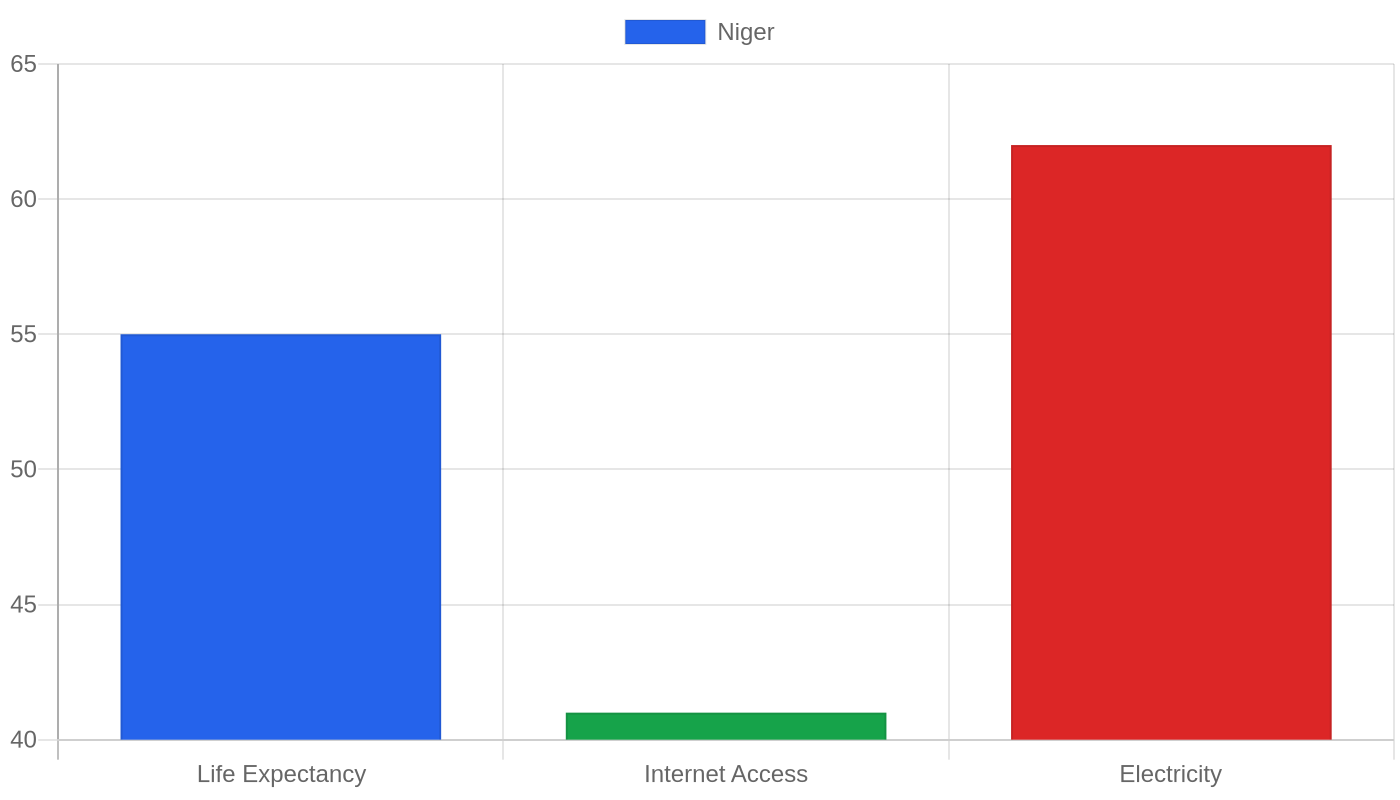
– With limited World Bank data available, Niger’s economic story must be told through its institutional framework and industrial composition rather than headline statistics.
The Uranium Economy — Mining, State Power, and the Shape of Niger’s Growth
Niger’s economic identity is inseparable from its soil. The World Bank’s latest data on GDP growth, inflation, and unemployment remains unpublished, leaving analysts to piece together the nation’s economic trajectory through its industrial backbone. What emerges is a picture of a country that has built its modern economy on a single, strategic resource: uranium.
The presence of COMINAK and SOMAIR — two of the world’s most significant uranium mining operations — at the top of Niger’s corporate registry tells a story of an economy oriented around extraction and export.
The dominance of these mining giants has profound implications for Nigerien living standards. Uranium revenues have historically funded state budgets, but they have also created a classic resource-dependence challenge: when global uranium prices fluctuate, Niger’s fiscal stability follows suit.
The World Bank’s silence on GDP per capita figures and GNI data leaves a gap in understanding individual prosperity, but the corporate landscape suggests wealth generation remains concentrated in capital-intensive extraction rather than broad-based employment.
Inflation and unemployment figures are similarly absent from the World Bank’s latest release, yet the structure of Niger’s economy offers clues. A nation with a handful of large enterprises — NIGELEC in utilities, SONIDEP in oil and gas, Niger Poste in industrials — points to a formal economy that is relatively small. The majority of Nigeriens likely work in subsistence agriculture and informal trade, sectors that rarely appear in official statistics.
The state’s heavy hand in the economy, visible through state-owned enterprises across every major sector, shapes both the opportunities and constraints faced by ordinary citizens.
Housing and Daily Life — The Cost of Living in a State-Driven Economy
Without World Bank price data or cost-of-living indices, assessing Niger’s everyday economics requires reading between the lines of its corporate and political structures. The prominence of state enterprises like NIGELEC and Niger Poste suggests that basic services — electricity, postal delivery, transportation — are provided through public channels, with pricing likely subject to government oversight rather than market competition.
For Nigerien households, this means utilities and public services may be more affordable than in privatized systems, but potentially less responsive to consumer needs.
The consumer services sector, represented by companies like Arik Niger and the Société Nigérienne de Transports de Voyageurs, points to a domestic market that supports transportation, media, and retail activities. Housing costs and rental markets remain undocumented in the available data, but the concentration of corporate activity around extractive industries suggests that urban centers like Niamey and mining towns face distinct housing pressures.
The presence of national media outlets — Dounia TV and the state broadcaster — indicates a society with access to information, though the quality of housing and living standards across Niger’s vast territory likely varies dramatically between urban and rural areas.
Business and Investment — Mining Giants and the Search for Diversification
For investors eyeing Niger, the corporate landscape presents both opportunity and caution. The basic materials sector, anchored by COMINAK and SOMAIR, offers exposure to global uranium markets and represents Niger’s most established industrial capacity. These operations have deep roots in the country and bring decades of technical expertise and international connections. Alongside them, SONIDEP in the oil and gas sector signals Niger’s ambitions to expand its energy profile beyond uranium.
The utilities sector, dominated by NIGELEC, and the industrial presence of Niger Poste suggest that infrastructure and public services remain core government priorities. However, the absence of a robust private sector beyond these major players indicates that entrepreneurship and foreign direct investment outside the extractive industries may face significant barriers.
The World Bank’s lack of data on GDP and business climate metrics makes it difficult to quantify these challenges, but the composition of Niger’s largest companies — overwhelmingly state-linked or tied to natural resources — paints a clear picture of an economy still seeking diversification.
Security, Governance, and the Political Framework
Niger’s political system, as outlined in the constitution approved by referendum on 31 October 2010, represents a deliberate attempt to balance executive power. The semi-presidential structure, restored from the 1999 constitution, creates a dual executive: a president elected by universal suffrage for five years who shares power with a prime minister.
This framework is designed to prevent the concentration of authority that has historically destabilized Nigerien politics, though it also creates potential for friction between the two executive offices.
Crime and safety indices remain unpublished, and happiness data is unavailable, making it difficult to assess quality of life through conventional metrics. However, the political architecture suggests a nation committed to democratic governance despite challenging circumstances. The restoration of the Fifth Republic’s system indicates that Niger’s leadership recognizes the importance of constitutional checks and balances.
For a country in a volatile region, this institutional stability may be as valuable as economic growth in shaping citizens’ daily experiences.
Current Affairs — Uranium, State Enterprises, and the Road Ahead
Niger’s immediate economic narrative is being written in the boardrooms of its state-owned enterprises and the mines of its northern territories. The continued operation of COMINAK and SOMAIR remains central to national revenue, while NIGELEC’s performance directly affects the daily lives of citizens who depend on reliable electricity.
The government’s ongoing commitment to a state-led economic model, visible in the prominence of public enterprises across every major sector, suggests that privatization is not on the immediate agenda.
The political landscape, shaped by the 2010 constitutional settlement, continues to provide the framework for economic decision-making. With the president and prime minister sharing executive power, policy direction depends on the working relationship between these offices.
For observers watching Niger, the key question is whether the country can leverage its uranium wealth and state enterprises to build a more diversified economy — one that creates jobs beyond the mining sector and improves living standards for its population. The World Bank’s data gap makes precise analysis difficult, but the structural foundations for Niger’s next chapter are clearly visible in its corporate registry and constitutional framework.
The Bottom Line
Niger is a country that rewards patient observation. Its economic significance rests on uranium, its political stability on a carefully balanced constitution, and its future on the ability of state institutions to deliver services and opportunities. For investors interested in extractive industries and regional development, Niger offers exposure to a strategic resource economy. For political analysts, it presents a case study in semi-presidential governance in a challenging security environment.
And for those seeking to understand West Africa’s economic diversity, Niger’s state-led model provides a counterpoint to more market-oriented neighbors. The data may be sparse, but the institutional architecture tells a compelling story of a nation navigating the complexities of resource wealth and democratic governance.
Sources & Methodology
This article is authored by Economic Pulse Net for informational and research purposes. Economic Pulse Net sources its data from multilateral institutions, national statistics bureaus, and proprietary databases. All data is believed to be current as of the date of publication.
Published: August 11, 2026 | Category: Research — Niger
Use these signals in your own platform
Economic Pulse publishes its live signal feed through a documented, read-only API. Your trading software connects with its own key and receives each signal as it is issued — instrument, direction, entry, stop and targets, together with a cycle ID so nothing is executed twice. The feed is independent of this website and cannot change it.
Signals are informational only and are not financial advice.