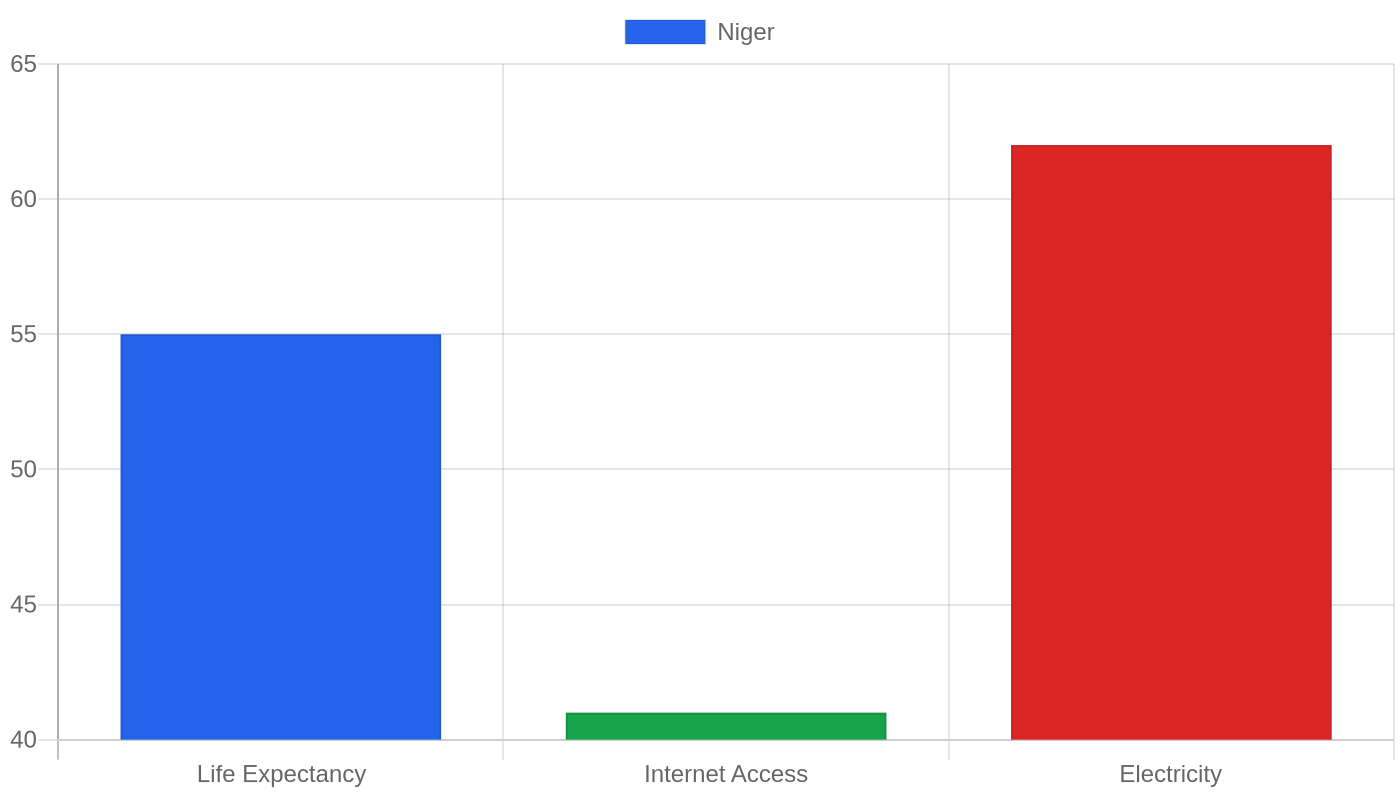
Economic Pulse Net | Sources: World Bank World Development Indicators, Government Sources | 2026
Key Takeaways
* Political Upheaval: The July 2023 coup d’état has dissolved the existing constitution, replacing the semi-presidential system with military-led governance under Abdourahamane Tiani.
Resource-Dependent Economy: Key economic activity remains anchored in basic materials and utilities, dominated by major players like SOMAIR, COMINAK, and SONIDEP.
Data Gaps: Current World Bank metrics for GDP growth, inflation, and unemployment are not available, requiring investors to look at structural industry indicators rather than macroeconomic aggregates.
Service Sector Growth: Consumer services and utilities form a significant portion of the corporate landscape, featuring entities like NIGELEC and Dounia TV.
Strategic Caution: The dissolution of the constitutional framework introduces significant political risk, making long-term investment planning contingent on the stability of the current transitional government.
The Structure of the Economy
Niger’s economic architecture is defined less by broad macroeconomic aggregates and more by its specific industrial pillars and state-controlled utilities. While the World Bank does not currently provide figures for GDP growth, inflation, or unemployment rates, the underlying structure of the economy reveals a nation heavily reliant on extractive industries and essential services.
The presence of major companies such as SOMAIR and COMINAK in the basic materials sector indicates that mining, particularly uranium, remains a critical component of the national output. Similarly, SONIDEP’s role in oil and gas underscores the importance of energy resources in driving industrial activity. These sectors do not operate in a vacuum; they are supported by a robust utilities infrastructure managed by NIGELEC, which ensures the power supply necessary for industrial operations.
Furthermore, the consumer services sector, represented by entities like Arik Niger and the Sociéte Nigerienne de Transports de Voyageurs, highlights the domestic demand for transportation and communication services. This mix suggests an economy where foreign direct investment and state regulation intersect closely within resource extraction and public service delivery.
Without recent data on per capita income or overall GDP size, the focus must remain on these foundational industries that sustain daily life and export revenue. The absence of standardized employment statistics also points to a labor market that may be largely informal or structurally opaque, typical of emerging markets undergoing rapid political shifts. Understanding Niger today requires looking past headline numbers to see the machinery of extraction and utility provision that keeps the country functioning.
Cost of Living and Daily Expenses
For residents and expatriates alike, navigating the cost of living in Niger involves understanding the price dynamics of essential goods and housing within a constrained market. Detailed indices for crime and safety are currently unavailable, which often correlates with limited data availability on local purchasing power and housing rents.
However, the presence of established utilities providers like NIGELEC suggests that energy costs are a fixed component of household budgets, likely influencing the overall expense of maintaining a residence. Housing costs are presumably driven by the availability of secure properties in urban centers, given the broader context of national security concerns.
Daily expenses would naturally fluctuate based on the reliability of transport networks operated by companies such as Arik Niger and the national transport society. In the absence of specific CPI data, one must infer that prices for imported goods and basic necessities are subject to supply chain disruptions common in landlocked nations. Rent versus buy decisions are complicated by the political uncertainty, potentially favoring short-term leasing arrangements over long-term property acquisition.
The lack of a Safety Index further complicates the calculation of “hidden costs” associated with security measures, private guards, or fortified housing options. Ultimately, the cost of living is shaped by the interplay between state-regulated utilities and the informal markets that fill gaps in formal retail distribution. Residents must budget for variability, as official inflation metrics are not provided to guide financial planning.
Investment and Business Climate
The business environment in Niger is characterized by a handful of dominant corporations that span critical sectors, offering both opportunities and concentrated risks for investors. The corporate landscape is led by major players in basic materials, including SOMAIR and COMINAK, which are central to the country’s mining exports. For international firms, joint ventures or partnerships with these established entities may be the primary route to entry into the resource sector.
The oil and gas industry, represented by SONIDEP, offers another avenue for capital deployment, though it is heavily regulated by the state. In the consumer services space, companies like Dounia TV and the Office of Radio and Television of Niger indicate a growing media and communications sector, potentially ripe for advertising or technological investment.
Utilities remain a closed but stable field, with NIGELEC controlling the power grid, suggesting that infrastructure projects require high-level government approval. Industrial activities are also supported by logistics and postal services through Niger Poste, which facilitates commercial transactions across the country. The aviation sector, marked by Escadrille Nationale du Niger, provides critical connectivity for business travel and cargo.
Investors must navigate a landscape where large state-linked or historically entrenched private firms hold significant market share. Due diligence is paramount, especially given the recent political transition, as regulatory frameworks may shift without immediate legislative oversight. The concentration of key industries among a small number of listed or known entities simplifies market analysis but increases dependency on their operational stability.
Safety, Politics, and Quality of Life
Niger’s political landscape has undergone a radical transformation following the July 2023 coup d’état, fundamentally altering the rules of governance and civic life. The constitution approved by referendum in 2010, which had restored a semi-presidential system with a president elected by universal suffrage and a prime minister sharing executive power, has been dissolved.
Power now rests with the government led by Abdourahamane Tiani, marking a departure from the democratic norms established in the Fifth Republic era. This political rupture creates an uncertain environment for civil liberties and legal continuity, impacting the quality of life for citizens who previously benefited from predictable institutional frameworks.
Crime and safety indices are currently listed as not available, which may reflect either a lack of reporting infrastructure or the sensitive nature of security data during a transitional period. The dissolution of the constitution means that the checks and balances previously enforced by the judiciary and parliament are effectively suspended. For expatriates and locals, this political volatility translates into heightened caution regarding movement and assembly.
The absence of clear safety metrics makes it difficult to assess personal risk, forcing individuals to rely on real-time advice from diplomatic missions and local contacts. Happiness data is similarly unreported, but the general atmosphere of political suspension likely weighs on social morale and community cohesion. The shift from a multi-party democratic system to military-led governance represents a significant break from the recent past, reshaping the social contract between the state and its citizens.
What’s Happening Now
The most defining feature of Niger’s current affairs is the ongoing consolidation of power by the transitional government following the military takeover in July 2023. With the constitution dissolved, the legal framework governing elections, judicial appointments, and economic policy is in flux, creating a period of significant uncertainty. Abdourahamane Tiani’s leadership marks a new chapter where executive authority is centralized, bypassing the traditional roles of the prime minister and parliament.
This political shift has immediate implications for foreign policy and economic partnerships, as the new regime redefines its alliances and internal priorities. Businesses operating in the country are adapting to this new reality, with some likely pausing expansion plans until the political direction becomes clearer. The lack of updated World Bank data suggests that international institutions are waiting for greater political clarity before releasing fresh economic assessments.
Meanwhile, domestic industries such as mining and utilities continue to operate, albeit under the watchful eye of the new administration. Media outlets like Dounia TV and the state radio office play a crucial role in disseminating information, potentially shaping public perception of the transition. The dissolution of the 2010 constitution removes the previous legal safeguards, meaning that any future reforms will be dictated by the current leadership.
Observers are watching closely to see if this interim period will lead to a new democratic roadmap or a prolonged military rule. The immediate focus for all stakeholders is stability and the maintenance of essential services amidst the political overhaul.
The Bottom Line
Niger presents a complex case study for observers interested in how resource-rich economies navigate sudden political transitions. The dissolution of the constitution and the rise of military leadership create a high-risk, high-uncertainty environment that demands extreme caution from foreign investors. Those with exposure to the mining and utility sectors should monitor the actions of key players like SOMAIR, COMINAK, and NIGELEC closely, as they remain the backbone of the economy.
For other sectors, the lack of transparent data and shifting political rules make short-term engagement risky. Ultimately, Niger is a country where political stability currently outweighs economic potential, and patience is the most valuable asset for any external observer.
Sources & Methodology
This article is authored by Economic Pulse Net for informational and research purposes. Economic Pulse Net sources its data from multilateral institutions, national statistics bureaus, and proprietary databases. All data is believed to be current as of the date of publication.
Published: October 21, 2026 | Category: Research — Niger
Use these signals in your own platform
Economic Pulse publishes its live signal feed through a documented, read-only API. Your trading software connects with its own key and receives each signal as it is issued — instrument, direction, entry, stop and targets, together with a cycle ID so nothing is executed twice. The feed is independent of this website and cannot change it.
Signals are informational only and are not financial advice.