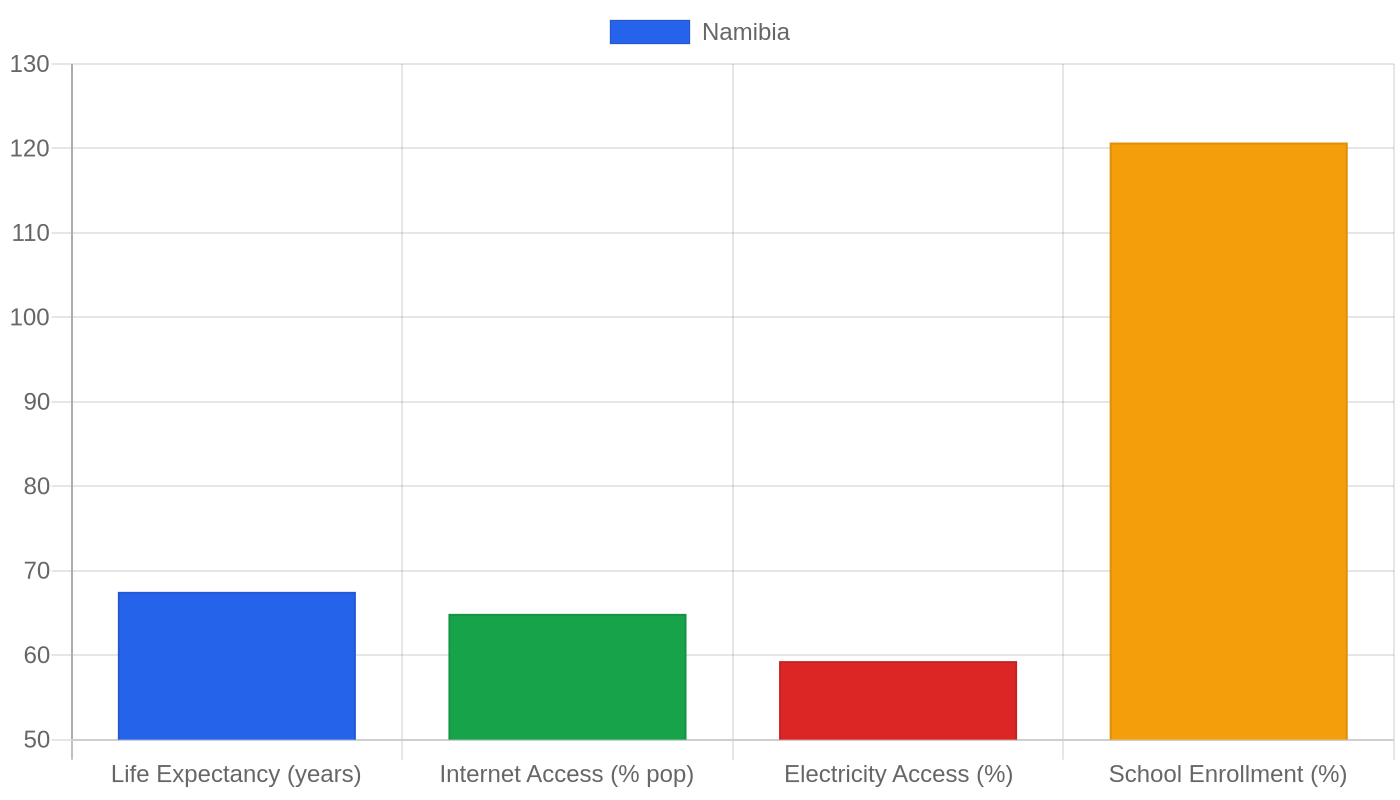
Economic Pulse Net | Sources: World Bank World Development Indicators, Government Sources | 2026
Key Takeaways
– Namibia operates as a unitary semi-presidential representative democratic republic, with a President elected to a five-year term who serves as both head of state and head of government, creating a stable political framework for economic planning.
– The country’s financial sector is robust, anchored by institutions like the Bank of Namibia, Bank Windhoek, and the Development Bank of Namibia, which provide a foundation for investment and monetary policy.
– Namibia’s telecommunications sector, led by MTC Namibia, positions the country as a potential hub for digital services in the region, even as traditional industries like aviation face headwinds.
– With a crime and safety index currently unavailable from the World Bank data, the country presents an incomplete picture on security, though its political stability offers a counterbalance.
– The economy’s reliance on consumer services and financials, as evidenced by the top companies list, suggests a service-oriented economy still finding its industrial footing.
The Numbers Game — Navigating Growth in a Data-Scarce Environment
The World Bank data for Namibia presents an unusual challenge for economic analysts: key indicators including GDP growth, inflation CPI, unemployment, GDP in USD, GDP per capita (PPP), GNI per capita, and even population figures are all listed as N/A. This absence of data is itself a story worth telling.
For a country that has long been considered one of Africa’s more stable and well-governed nations, the lack of fresh economic metrics raises questions about data collection capacity, reporting timelines, or perhaps a deliberate shift in how the World Bank aggregates its statistics.
What we do know is that Namibia’s economic structure leans heavily on the service sector. The top companies list reveals a predominance of financial institutions — the Bank of Namibia, Bank Windhoek, the Development Bank of Namibia, and FIDES Bank Namibia all feature prominently. This concentration suggests that Namibia has built a sophisticated banking and financial services ecosystem relative to its regional peers.
The presence of the Bank of Namibia as the central monetary authority implies that the country maintains its own currency and monetary policy, giving it tools to manage inflation and exchange rates that many smaller African economies lack.
The consumer services sector also plays a significant role, with Air Namibia and Kalahari Express Airlines representing aviation, while Gazza Music Productions and Mshasho Productions point to a growing creative economy. This mix of financial depth and cultural production suggests an economy in transition — moving from traditional resource extraction toward value-added services.
Without hard GDP numbers, we cannot quantify this shift, but the corporate landscape tells us that Namibia is not a subsistence economy; it is a place where formal financial institutions and commercial aviation exist, indicating a certain level of economic maturity.
Inflation, typically a critical concern for any emerging economy, remains unquantified in the available data. However, the presence of multiple commercial banks and a central bank suggests that monetary authorities are actively managing price stability. The Development Bank of Namibia’s existence further implies that there is institutional focus on long-term infrastructure and industrial projects, which can help dampen inflationary pressures by improving supply-side capacity.
The Cost of Living — Housing, Daily Life, and Regional Comparisons
Without specific cost-of-living data from the World Bank, we must piece together an understanding from the broader economic context. Namibia is a geographically large but sparsely populated country, and this geography directly impacts living costs. In urban centers like Windhoek, the capital, housing demand tends to concentrate, pushing up prices for both rental and purchase markets.
The presence of multiple financial institutions suggests that mortgage lending is available, which typically supports a functional housing market where buying is an option for those with steady formal employment.
Rent versus buy decisions in Namibia likely mirror patterns seen across Southern Africa. In cities with stable banking sectors, buying a home becomes a long-term investment strategy, particularly when inflation erodes the real value of fixed-rate mortgages. However, the lack of population data makes it impossible to estimate housing density or vacancy rates.
What we can infer is that the cost of living in Namibia is shaped by its import dependence — the country imports a significant portion of its consumer goods, and transportation costs across its vast territory add to retail prices.
Daily expenses for essentials like food, transportation, and utilities would be influenced by the same factors that affect the broader economy: the strength of the local currency, fuel prices, and the efficiency of logistics networks. The presence of Bidvest Namibia, a consumer goods company, on the list of top companies suggests that there is a formal retail and distribution sector capable of supplying urban populations with packaged goods.
For the average Namibian, the cost of living likely represents a significant portion of income, as is common in emerging economies where the formal sector employs a minority of the workforce.
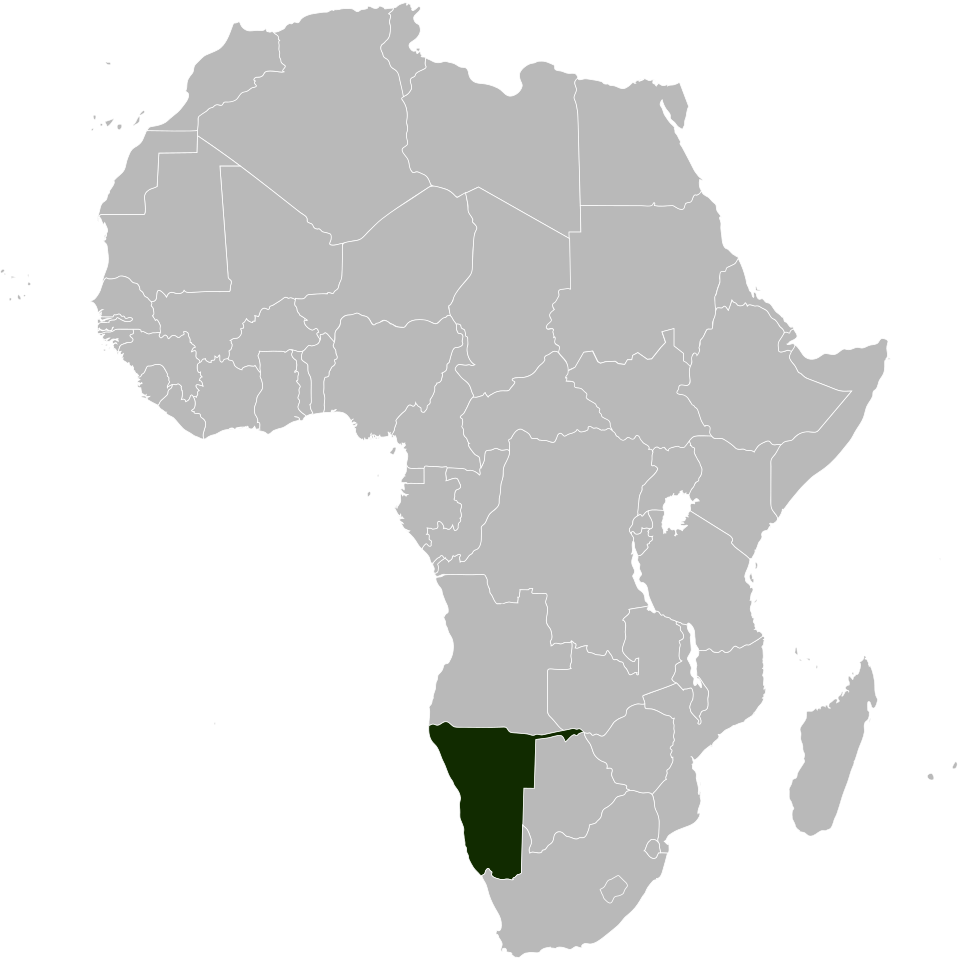
Investment and Business Climate — Where Capital Meets Opportunity
The business environment in Namibia is defined by its financial sector depth. With four major financial institutions — Bank of Namibia, Bank Windhoek, Development Bank of Namibia, and FIDES Bank Namibia — all operating within the country’s borders, the infrastructure for capital allocation is well-established. This concentration of financial services creates a competitive banking market, which typically benefits businesses through better access to credit and more favorable lending terms.
For investors looking at Namibia, the telecommunications sector stands out as a key opportunity. MTC Namibia is a major player, and in the modern economy, telecom infrastructure is the backbone of everything from mobile banking to e-commerce. A country with a strong telecom provider is better positioned to leapfrog traditional development stages, enabling digital services that can reach remote populations without building physical branches or retail outlets.
The aviation sector, represented by Air Namibia and Kalahari Express Airlines, indicates that the country has invested in connectivity — both domestically and internationally. For a nation with a small population spread across a large area, air travel is not a luxury but a necessity for business and government operations.
However, the presence of two airlines also suggests potential competition or, alternatively, a market that may be too small to support both, raising questions about profitability and subsidy requirements.
Consumer services and creative industries, including Gazza Music Productions and Mshasho Productions, point to a growing cultural economy. These companies represent Namibia’s soft power — its music, entertainment, and media — which can attract tourism and international attention. For investors, the creative sector offers lower capital requirements and higher potential returns on intellectual property, though it also carries higher risk due to its dependence on discretionary consumer spending.
Safety, Politics, and Quality of Life — Stability as a Currency
Namibia’s political landscape is clearly defined in the data: it is a unitary semi-presidential representative democratic republic. The President serves a five-year term and holds dual roles as head of state and head of government. All members of the government are individually and collectively responsible to the legislature, creating a system of checks and balances that is relatively rare in the region.
This political structure provides predictability for both citizens and foreign investors — elections happen on schedule, transitions follow constitutional procedures, and the legislature has oversight power.
The crime and safety indices are listed as N/A in the World Bank data, which is a notable gap. In the absence of hard numbers, we can look to the political stability as a proxy for overall security. Countries with functioning democratic institutions and regular electoral cycles tend to have lower rates of political violence, though this does not directly correlate with street crime or property crime.
Namibia’s status as a stable democracy in a region that has seen its share of turmoil suggests that the security environment is likely manageable, particularly in formal business districts and expatriate residential areas.
Quality of life in Namibia is shaped by its natural beauty and low population density. The country is known for its dramatic landscapes, wildlife, and outdoor recreation opportunities. For those who value space and nature, Namibia offers a quality of life that cannot be measured in GDP alone. However, the lack of population data makes it impossible to assess pressure on public services like healthcare, education, and infrastructure.
A small population spread across a large area can mean excellent service in some areas and complete absence in others.
What’s Happening Now — The Pulse of a Nation in Transition
The most current picture of Namibia is one of a country leveraging its institutional strengths while navigating global economic headwinds. The financial sector, anchored by the Bank of Namibia and its commercial counterparts, continues to provide stability in an uncertain global environment. The Development Bank of Namibia is likely focused on infrastructure projects that can reduce the country’s dependence on imports and create domestic employment opportunities.
In the telecommunications sector, MTC Namibia is positioned to drive digital inclusion, potentially partnering with government initiatives to expand internet access to rural areas. This digital push could transform the economy by enabling remote work, online education, and telemedicine — services that are particularly valuable in a geographically dispersed population.
The creative economy, represented by Gazza Music Productions and Mshasho Productions, is gaining international attention. Namibian music and entertainment are finding audiences beyond the country’s borders, creating export revenue and cultural influence that can support tourism and brand Namibia as a destination for both business and leisure.
Air Namibia and Kalahari Express Airlines face the challenge of maintaining operations in a market where fuel costs, maintenance expenses, and competition from regional carriers put pressure on margins. The aviation sector’s health is a leading indicator for the broader economy — if airlines are struggling, it suggests that business travel and tourism are facing headwinds.
Bidvest Namibia, as a consumer goods company, provides insight into domestic consumption patterns. Its performance reflects the purchasing power of Namibian households and the health of the retail sector. In an environment where formal employment is concentrated in financial services and government, consumer goods companies must navigate a market where a significant portion of the population may rely on informal economic activities.
The Bottom Line
Namibia is a country of institutional strength and natural beauty, but it remains an economy in search of its next growth engine. The financial sector provides stability, the telecom sector offers connectivity, and the creative industries add cultural depth, but the absence of basic economic data from the World Bank suggests either reporting challenges or a period of transition.
Investors and observers should watch Namibia for its political stability and service-sector sophistication, recognizing that the country’s small population and geographic challenges require patience and a long-term horizon. For those willing to look beyond the data gaps, Namibia offers a unique combination of democratic governance, natural resources, and human capital that could unlock significant value in the years ahead.
Sources & Methodology
This article is authored by Economic Pulse Net for informational and research purposes. Economic Pulse Net sources its data from multilateral institutions, national statistics bureaus, and proprietary databases. All data is believed to be current as of the date of publication.
Published: July 17, 2026 | Category: Research — Namibia
Use these signals in your own platform
Economic Pulse publishes its live signal feed through a documented, read-only API. Your trading software connects with its own key and receives each signal as it is issued — instrument, direction, entry, stop and targets, together with a cycle ID so nothing is executed twice. The feed is independent of this website and cannot change it.
Signals are informational only and are not financial advice.