Economic Pulse Net | Sources: World Bank World Development Indicators, Government Sources | 2026
Key Takeaways
– Strategic Infrastructure Hub: Mozambique’s economic identity is anchored by its ports and railways, with state-owned enterprises like Mozambique Ports and Railways and the Beira Railroad Corporation serving as critical links to landlocked southern African nations.
– State-Driven Economy: The corporate landscape is dominated by public and parastatal entities, including the Bank of Mozambique, the central bank, and Electricidade de Moçambique, the national power utility, signalling a government-heavy economic model.
– Political Structure Defined by Strong Presidency: The constitution vests significant power in the directly elected president, who serves as head of state, government, and military commander, shaping the business and policy environment.
– Aviation Sector in Focus: With three airlines operating domestically, including the flag carrier LAM Mozambique Airlines, the country is investing in connectivity, though the sector remains a challenging frontier for growth.
– Data Transparency Gaps: Key macroeconomic indicators such as GDP growth and inflation are currently unpublished by the World Bank, making qualitative and structural analysis essential for understanding the country’s trajectory.
The Structural Backbone: Ports, Power, and Public Enterprise
While the World Bank has not released official GDP, inflation, or unemployment figures for Mozambique in its latest update, the absence of numbers does not equate to an absence of economic activity. The country’s economic narrative is written through its infrastructure and state-owned enterprises. Mozambique Ports and Railways, a massive industrial conglomerate, operates the logistics corridors that move coal, aluminium, and natural gas from the interior to the coast, generating vital export revenues.
Alongside it, the Beira Railroad Corporation serves as a critical artery connecting Mozambique to neighbouring landlocked economies, underscoring the nation’s role as a regional trade facilitator.
The financial sector is similarly state-anchored. The Bank of Mozambique steers monetary policy, while the Banco Nacional de Investimento functions as a key development finance institution, channeling capital into long-term projects that commercial banks often shy away from. The utilities sector is dominated by Electricidade de Moçambique, which manages the national grid and is central to expanding energy access.
For investors, the takeaway is clear: understanding Mozambique means engaging with its public institutions, which are not merely regulators but primary economic actors driving industrial strategy.
The Cost of Living: An Urban-Rural Divide in the Making
Without specific CPI data from the World Bank, a precise cost-of-living index remains elusive, but the structural indicators point to a pronounced divide between urban and rural Mozambique. In Maputo, the capital, the presence of international firms and a growing services sector has created a demand for modern housing that far outstrips supply, pushing rental prices in prime neighbourhoods to a premium that is inaccessible to the average public sector worker.
The cost of imported goods, from vehicles to electronics, carries significant markups due to logistical bottlenecks at the ports, which the railway system is still working to alleviate.
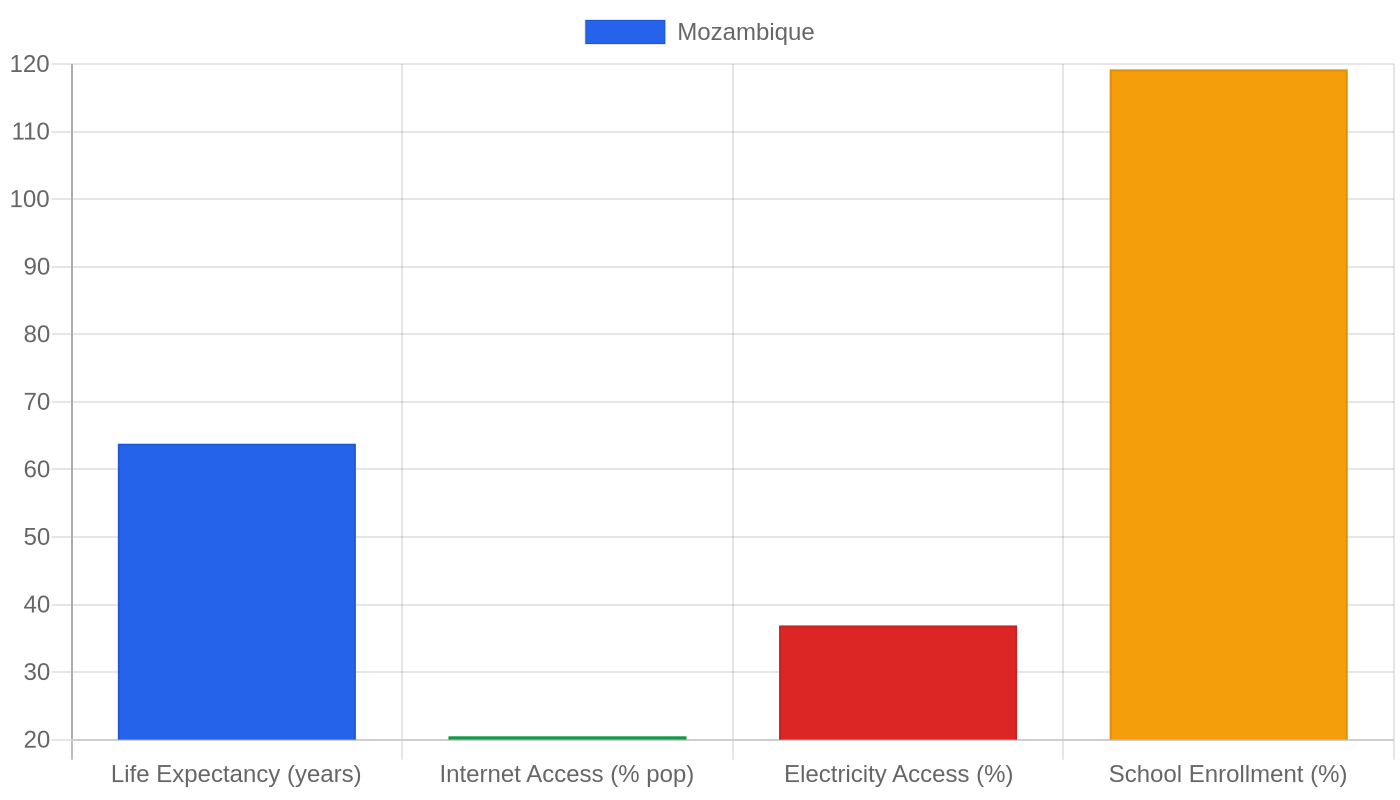
For the majority of Mozambicans, however, the daily economy remains informal and agricultural. The absence of reliable national data on consumer prices suggests a reality where household budgets are more sensitive to weather patterns and harvest yields than to central bank interest rates. Electricity access, managed by Electricidade de Moçambique, remains a key variable in quality of life.
The government’s ongoing push to expand the grid is a direct response to the high cost of alternative energy sources, which disproportionately burden low-income households.
The Investment Climate: Where State and Capital Converge
Mozambique presents a unique investment proposition: a frontier market where the most reliable partners are often the state-controlled giants. The presence of three domestic airlines — LAM Mozambique Airlines, Kaya Airlines, and Moçambique Expresso — alongside the industrial logistics of the ports and railways, indicates a market with active, albeit challenging, opportunities in transportation and mobility.
For foreign direct investors, the primary gateway is often through public-private partnerships with entities like Mozambique Ports and Railways, which control the country’s most valuable strategic assets.
The financial infrastructure, led by the Bank of Mozambique and Banco Nacional de Investimento, provides a formal channel for investment, but it is a system designed with a strong developmental mandate. The consumer services sector, represented by Air Corridor, suggests an attempt to build domestic travel networks, though the viability of such ventures is heavily dependent on the broader economic growth that is currently difficult to quantify.
The business environment remains one where political connections and alignment with national development goals are as important as balance sheet fundamentals.
Safety, Politics, and the Quality of Life Equation
Mozambique’s political landscape is defined by a powerful executive. The Constitution stipulates that the President serves as head of state, head of government, and commander-in-chief of the armed forces, functioning as a symbol of national unity. This centralisation of power provides a degree of policy continuity, but it also means that the business climate is highly sensitive to the political dynamics within the ruling party.
The prime minister, appointed by the president, is tasked with chairing the council of ministers and coordinating government functions, operating more as a chief operating officer than a rival power centre.
Regarding safety and crime, the World Bank data does not currently provide a Crime Index or Safety Index for Mozambique. Similarly, there is no published data on unemployment or GNI per capita, which complicates any definitive assessment of social welfare. However, the emphasis on infrastructure investment and the existence of a national airline network suggest a government attempting to knit together a vast territory with significant logistical challenges.
For the average citizen, quality of life is likely tied more to the reliability of public services — electricity, transport, and postal services via Correios de Moçambique — than to high-frequency economic indicators.
What’s Happening Now: The Logistics State in Motion
Right now, the most significant developments in Mozambique are occurring in the corridors of transportation and energy. With the World Bank’s macroeconomic data currently silent, the most telling signals come from the operational activities of the country’s key enterprises. The ongoing operations of Mozambique Ports and Railways are critical, as global demand for energy transition minerals places a premium on the export routes that pass through Mozambican territory.
The Beira Railroad Corporation remains a focal point for regional trade, and any modernisation or expansion of its capacity would have immediate ripple effects on the broader southern African economy.
In the skies, the presence of three airlines — LAM, Kaya, and Moçambique Expresso — points to a competitive, if strained, domestic aviation market. The continued functioning of Air Corridor and the national carrier LAM suggests that the government is prioritising connectivity as a means of unifying the market. Meanwhile, the Banco Nacional de Investimento is likely focused on financing the capital-intensive projects that underpin these logistics networks.
The political stability provided by the strong presidential system offers a predictable, if hierarchical, environment for these enterprises to operate, even as the country awaits a fresh set of hard economic data to confirm its trajectory.
The Bottom Line
Mozambique is not a country to be understood through spreadsheets alone. With key data points like GDP and inflation currently unpublished by the World Bank, the nation’s story is best read through the lens of its strategic assets: the ports, the railways, the power grid, and the airlines. Investors and policymakers should watch Mozambique for its role as a logistics hub for southern Africa, but they must be prepared to navigate a landscape where the state is the dominant economic force.
For those focused on infrastructure, energy, and regional trade, Mozambique offers a high-stakes, high-reward frontier. The watchword is patience — this is a country building its future through heavy machinery, not quick fixes.
Sources & Methodology
This article is authored by Economic Pulse Net for informational and research purposes. Economic Pulse Net sources its data from multilateral institutions, national statistics bureaus, and proprietary databases. All data is believed to be current as of the date of publication.
Published: August 11, 2026 | Category: Research — Mozambique
Use these signals in your own platform
Economic Pulse publishes its live signal feed through a documented, read-only API. Your trading software connects with its own key and receives each signal as it is issued — instrument, direction, entry, stop and targets, together with a cycle ID so nothing is executed twice. The feed is independent of this website and cannot change it.
Signals are informational only and are not financial advice.