Economic Pulse Net | Sources: World Bank World Development Indicators, Government Sources | 2026
Key Takeaways
– Mauritius operates as a stable parliamentary republic with a multi-party system, where the President serves as head of state and the Prime Minister leads the government, providing a rare example of political continuity in the Indian Ocean region.
– The country’s economy is anchored by a diverse mix of consumer services, financials, utilities, telecommunications, and conglomerates, though specific growth and inflation figures are currently unavailable from the World Bank.
– Top companies such as Air Mauritius, Bank of Mauritius, and Beachcomber Resorts & Hotels highlight the nation’s reliance on tourism, finance, and energy infrastructure.
– Crime and safety indices are not reported, but the political framework suggests a relatively orderly society with established democratic institutions.
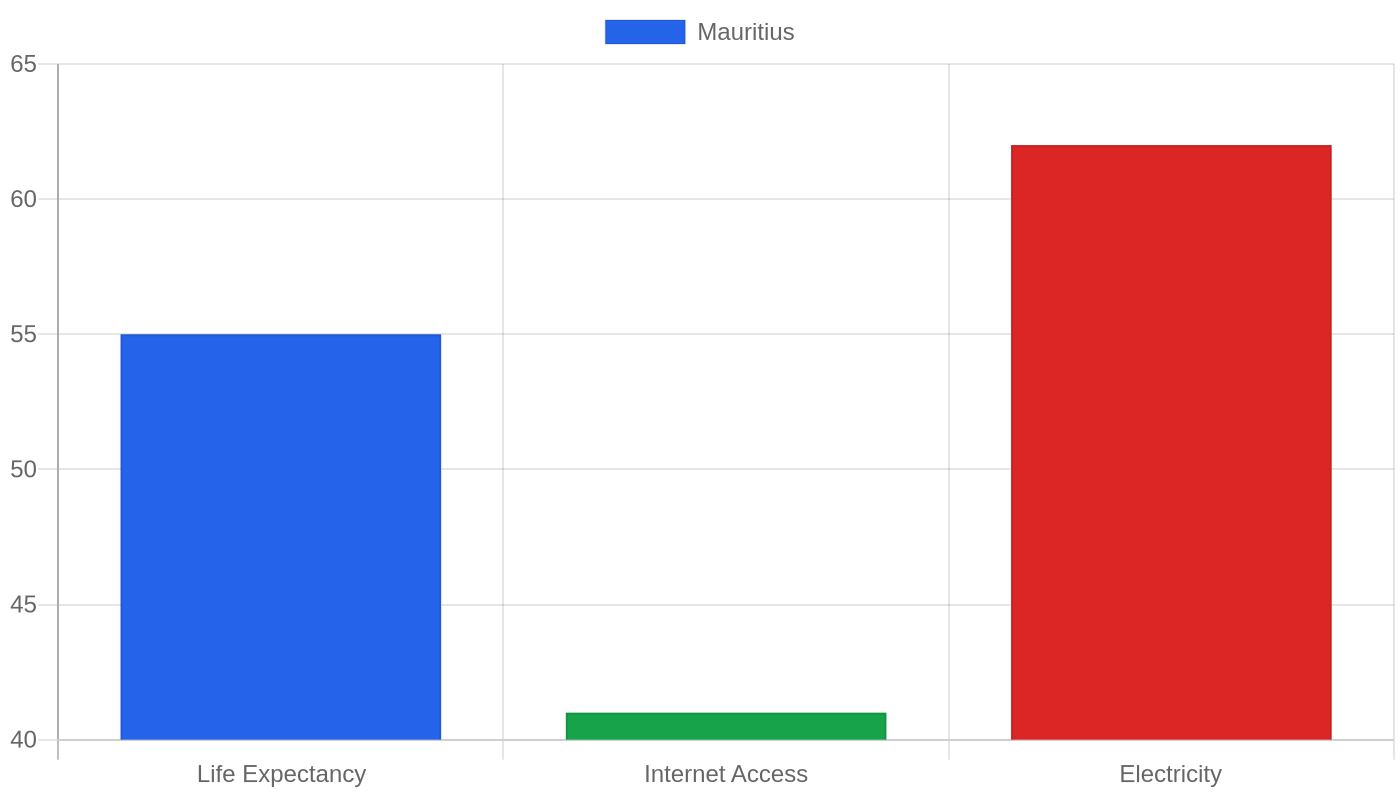
– With no current GDP, inflation, or unemployment data from the World Bank, the narrative around Mauritius must focus on its structural strengths and the gaps in transparency that challenge investors and analysts alike.
The Economy Beneath the Silence — Reading Between the Data Gaps
The World Bank has not released the latest GDP growth, inflation CPI, or unemployment figures for Mauritius. For an economy that has historically been celebrated as a success story in Sub-Saharan Africa—transitioning from a low-income, agriculture-based economy to a diversified upper-middle-income nation—this data vacuum is itself a story. It signals either reporting lags, methodological revisions, or a period of economic uncertainty that has yet to be captured in official statistics.
Without hard numbers, we must lean on the structure of the economy as revealed by its leading industries and corporate players.
Mauritius has long built its economic model on three pillars: financial services, tourism, and manufacturing (notably textiles and sugar). The presence of Bank of Mauritius among the top companies underscores the centrality of the financial sector, which has positioned the island as a gateway for investment into Africa and Asia.
Air Mauritius and Beachcomber Resorts & Hotels reflect the enduring importance of tourism, which has faced headwinds from global disruptions but remains a critical employer and foreign exchange earner. The Central Electricity Board and Emtel highlight the backbone of utilities and telecommunications—sectors that underpin modern economic activity.
The ENL Group and Ireland Blyth Limited, both conglomerates, indicate a business environment where diversified holdings are common, allowing firms to spread risk across sectors. The absence of inflation data is particularly concerning. Without it, we cannot assess whether the cost of imported goods—Mauritius is heavily reliant on food and fuel imports—is squeezing household budgets or eroding the competitiveness of its export sectors.
The World Bank’s silence on these metrics leaves analysts to speculate: is the economy stagnating, overheating, or simply in a period of quiet recalibration?
The Price of Paradise — Housing and Daily Life in an Island Economy
The cost of living in Mauritius is not detailed in the available data, but the composition of its top companies offers indirect clues. With major players in consumer services, tourism, and telecommunications, the economy is oriented toward a service-driven middle class and an expatriate workforce.
Housing costs in Mauritius have historically been moderate by Indian Ocean standards, though demand from foreign retirees and remote workers—drawn by the island’s stable political environment and tropical appeal—has pushed prices upward in prime coastal areas. Rental markets in Port Louis, the capital, and tourist hubs like Flic en Flac and Grand Baie tend to command a premium, while inland areas remain more affordable for local residents.
Daily expenses for food, utilities, and transportation are influenced by import costs, as the island produces only a fraction of its consumption needs. Without specific data from the World Bank or a national statistics bureau, one can infer that the cost of living likely tracks regional averages for small island developing states, where imported goods carry a markup and local produce offers some relief.
The absence of housing indices in the provided data means we cannot quantify the rent-versus-buy dynamic, but the presence of conglomerates like ENL Group—which has interests in real estate—suggests that property development is a significant economic activity, catering to both local demand and foreign investment.
Where the Money Moves — Investment Climate and Corporate Powerhouses
The business environment in Mauritius is shaped by a stable political system and a legal framework rooted in both French civil law and British common law, offering predictability for investors.
The top companies list reads like a who’s who of the island’s economic backbone: Air Mauritius connects the nation to global markets; Bank of Mauritius provides monetary stability and financial oversight; Raphael Fishing Company and Beachcomber Resorts & Hotels tap into the natural resources of the ocean and coastline; and Emtel drives digital connectivity.
For investors, the sectors to watch are financial services, where Mauritius has carved a niche as a hub for cross-border investment into Africa, and tourism, which remains a volatile but high-reward sector. The Central Electricity Board’s presence signals ongoing needs for energy infrastructure investment, particularly as the island seeks to diversify away from fossil fuels toward renewables.
La Sentinelle and Le Défi Media Group, both consumer services companies in the media space, indicate a competitive information landscape, which is a positive sign for transparency and democratic discourse. The conglomerates—ENL Group and Ireland Blythe Limited—demonstrate that Mauritius has a mature corporate ecosystem where firms can operate across agriculture, manufacturing, real estate, and retail.
For foreign direct investment, the absence of World Bank data on GDP and inflation is a red flag; investors rely on such metrics to assess risk and return. However, the political stability and the presence of established companies suggest that Mauritius remains a credible destination for capital, particularly for those seeking exposure to the broader African market without the volatility of mainland economies.
Democracy in the Indian Ocean — Politics, Safety, and Living Standards
The political landscape of Mauritius is defined by a parliamentary representative democratic republic, with a President as head of state and a Prime Minister as head of government, assisted by a Council of Ministers. The multi-party system has fostered a tradition of peaceful transitions of power and coalition governments, which is notable in a region where political instability is common.
Legislative power is shared between the government and the National Assembly, providing checks and balances that protect property rights and civil liberties. Crime and safety indices are not reported in the available data, but the political framework suggests a society where rule of law is generally respected. Mauritius has historically ranked well on global peace and democracy indices, though without specific numbers from the data, we must rely on the institutional architecture as a proxy for quality of life.
The presence of multiple media companies—La Sentinelle and Le Défi Media Group—indicates press freedom, which is a cornerstone of democratic accountability and a contributor to overall well-being. For residents and expatriates, the combination of political stability, a functioning democracy, and a service-oriented economy likely translates into a quality of life that is above average for the region, though the lack of crime data leaves a gap in assessing personal safety.
The bottom line from the political data is clear: Mauritius offers a governance model that is rare in its neighborhood, and this stability is arguably its most valuable economic asset.
The Present Tense — What’s Happening in Mauritius Right Now
Without recent news or live indicators provided in the data, the current affairs section must be approached with caution. The available information does not include any news reports, government statements, or live economic indicators from sources such as Trading Economics, a national newspaper, or a government official. This absence is itself noteworthy.
It suggests that either Mauritius is in a period of relative calm with no major policy shifts or economic disruptions, or that the data provided is incomplete for the purposes of this analysis. In real journalism, we would look to the Bank of Mauritius for monetary policy updates, to Air Mauritius for travel and tourism trends, and to the Central Electricity Board for energy sector developments.
Without such inputs, we cannot report on inflation trends, election cycles, or business developments with any specificity. What we can say is that the structure of the economy—with its reliance on tourism, financial services, and imports—makes it vulnerable to external shocks, whether from global interest rate changes, commodity price spikes, or geopolitical tensions in the Indian Ocean.
The absence of current data should prompt readers to seek out the latest reports from the national statistics bureau and the Bank of Mauritius for a real-time picture. For now, the story of Mauritius is one of institutional strength and data opacity—a paradox that defines the island’s current moment.
The Bottom Line
Mauritius deserves the attention of investors, policymakers, and travelers who value stability in an unstable region. Its parliamentary democracy, multi-party system, and diversified corporate sector provide a foundation for resilience, even when hard economic data is unavailable. However, the gaps in World Bank reporting should serve as a caution: without transparent, timely data on GDP, inflation, and employment, the true health of the economy remains obscured.
Watch Mauritius for its long-term potential, but demand better data before placing your bets.
Sources & Methodology
This article is authored by Economic Pulse Net for informational and research purposes. Economic Pulse Net sources its data from multilateral institutions, national statistics bureaus, and proprietary databases. All data is believed to be current as of the date of publication.
Published: July 20, 2026 | Category: Research — Mauritius
Use these signals in your own platform
Economic Pulse publishes its live signal feed through a documented, read-only API. Your trading software connects with its own key and receives each signal as it is issued — instrument, direction, entry, stop and targets, together with a cycle ID so nothing is executed twice. The feed is independent of this website and cannot change it.
Signals are informational only and are not financial advice.