Economic Pulse Net | Sources: World Bank World Development Indicators, Government Sources | 2026
Key Takeaways
* Data Void: Comprehensive macroeconomic indicators such as GDP growth, inflation rates, and unemployment figures are currently unreported by the World Bank, creating a significant blind spot for international investors.
Service-Led Corporate Landscape: The corporate sector is dominated by consumer services, telecommunications, and financial institutions, with major players like Air Mauritanie and Mauritel leading the market.
Political Centralization: The nation operates under a single-chamber National Assembly with 176 members elected for five-year terms, suggesting a centralized legislative framework.
Safety Uncertainty: Without current Crime or Safety indices, assessing the security environment for expatriates and businesses remains challenging, relying on anecdotal rather than statistical evidence.
Economic Foundations: Navigating the Data Gap
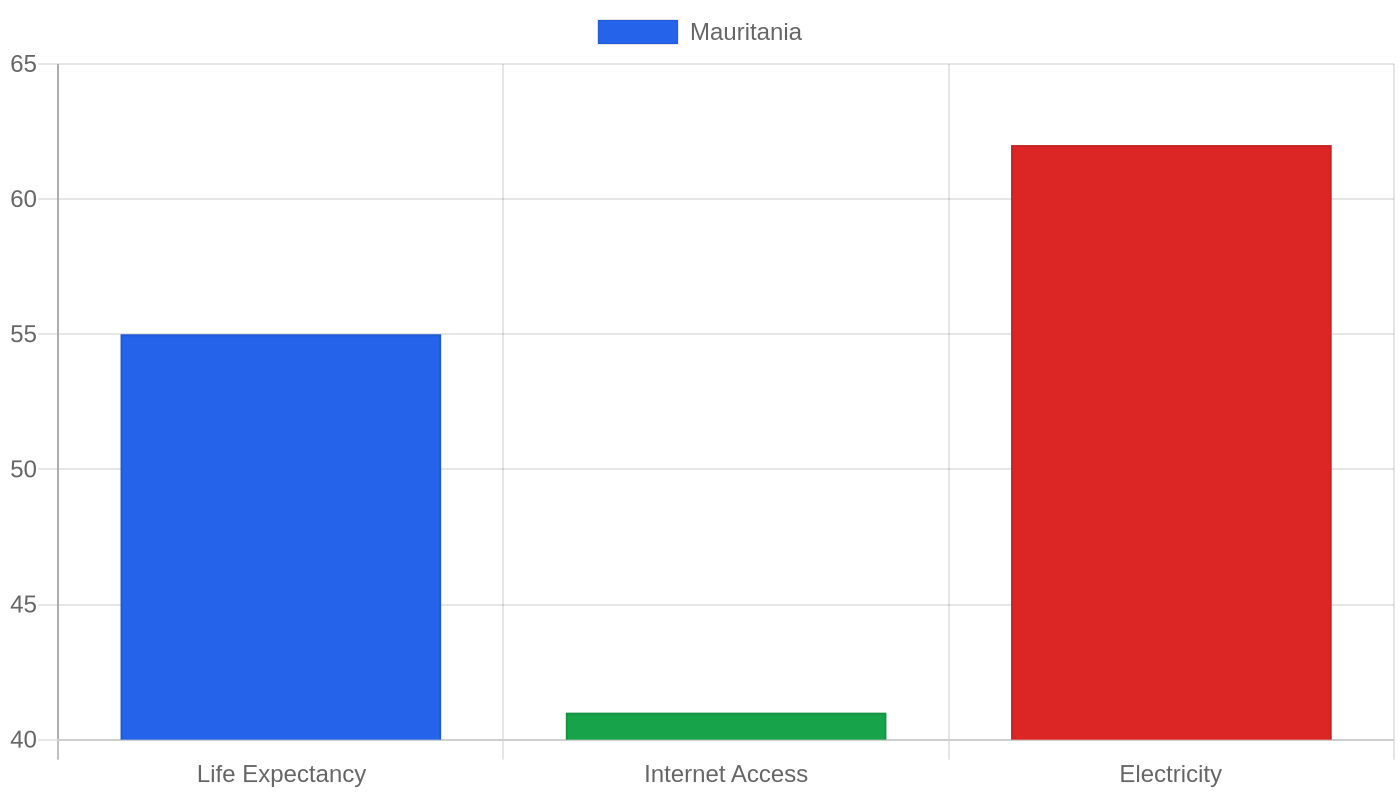
The economic narrative of Mauritania is currently defined more by what is missing than what is present. According to the latest data from the World Bank, critical metrics including GDP growth, inflation (CPI), and unemployment rates are listed as N/A, leaving economists and policymakers without a clear quantitative pulse on the nation’s health. This absence of standard macroeconomic data makes it difficult to gauge whether the economy is expanding or contracting in real-time terms.
Similarly, the total GDP in USD, GDP per capita adjusted for purchasing power parity (PPP), and Gross National Income (GNI) per capita are unavailable, preventing a direct comparison of living standards against regional peers. Even basic demographic anchors like total population size are not provided in this dataset, which complicates efforts to calculate per-capita productivity accurately. In such an environment, traditional economic analysis must pivot from numerical forecasting to structural observation.
Investors cannot rely on headline growth numbers to predict market trends; instead, they must look at sectoral dominance and institutional stability. The lack of these World Bank figures suggests either a delay in reporting standards or a unique data collection challenge within the country’s statistical infrastructure. Consequently, any assessment of Mauritania’s economic trajectory must be treated as preliminary, requiring reliance on qualitative indicators rather than hard statistical proofs.
Cost of Living: A Qualitative Assessment
Determining the precise cost of living in Mauritania is inherently difficult without specific CPI data or housing market statistics. With no reported inflation figures, it is impossible to calculate how rapidly daily expenses have risen over the last twelve months. Furthermore, the absence of general price level data means that comparisons between renting versus buying property cannot be made using standard affordability ratios.
Daily expenses for goods and services remain opaque, as there is no baseline index to measure the cost of food, energy, or transportation. While one might infer that costs align with broader West African averages, the lack of explicit data prevents any definitive statement on whether Mauritania is cheaper or more expensive than neighboring nations. For an expatriate or business traveler, budgeting becomes an exercise in estimation rather than calculation.
Without a transparent cost-of-living index, families relocating to the region face uncertainty regarding their disposable income after covering essential needs. The silence on housing costs further compounds this issue, as there is no data to indicate whether the rental market is saturated or constrained. Ultimately, the financial reality for residents is known only through direct experience, as aggregate data fails to capture the nuance of local market dynamics.
Investment & Business Climate: Sector Dominance
Despite the macroeconomic data void, the corporate landscape offers clear insights into where capital flows. The top companies operating in Mauritania are heavily concentrated in consumer services, telecommunications, and finance, indicating a mature service-oriented economy. Air Mauritanie, Mauritania Airlines, and Mauritania Airways dominate the aviation sector, suggesting that connectivity and tourism-related logistics are key economic drivers.
In the financial space, the Central Bank of Mauritania plays a pivotal role, likely stabilizing monetary policy in the absence of publicized inflation targets. Telecommunications is represented by Mauritel, highlighting the importance of digital infrastructure and communication services in modern business operations. Industrials are also present, with the Mauritanian Post Company facilitating logistical networks across the country.
These entities suggest that investment opportunities may lie less in raw resource extraction and more in the services that support them. For foreign investors, partnering with established local firms like Mauritel or the national airline may provide a safer entry point than attempting to build infrastructure from scratch. The concentration of major players in these specific sectors implies that regulatory frameworks and market access are already structured around these industries.
Therefore, business development strategies should focus on supporting the existing service ecosystem rather than introducing entirely new industrial paradigms.
Safety, Politics & Quality of Life: Institutional Stability
The political structure of Mauritania is clearly defined by its legislative framework, which consists of a single chamber known as the National Assembly. This body comprises 176 members who are elected for five-year terms in single-seat constituencies, pointing toward a representative democratic system with localized accountability. However, when it comes to personal security, the picture is less clear.
Both the Crime Index and the Safety Index are listed as N/A, meaning there is no standardized metric to assess the risk of theft, violence, or civil unrest. This lack of safety data creates ambiguity for tourists and long-term residents trying to gauge the security of urban versus rural areas. Without happiness data or quality-of-life scores, understanding the social well-being of the population remains speculative.
The political stability implied by regular five-year election cycles contrasts with the uncertainty surrounding public safety metrics. Potential expatriates must therefore rely on diplomatic advisories and local contacts rather than statistical safety ratings. The centralization of political power in a single assembly may streamline governance but could also mask regional disparities in security and service delivery.
Ultimately, while the political architecture appears stable and functional, the human security environment remains a black box due to missing indices.
What’s Happening Now: The Invisible Pulse
In the absence of recent news feeds or live indicators, the “current affairs” section of Mauritania’s story is written in silence. There are no reported reforms, elections, or policy shifts to analyze because no recent news sources were provided in the dataset. This void itself is a significant indicator; it suggests that the country may not be in the headlines for dramatic economic surprises or political upheavals.
Instead, the status quo appears to be maintained by the steady operation of its core institutions, such as the Central Bank and the National Assembly. Businesses continue to operate within the established framework of consumer services and telecommunications without immediate disruption. The lack of active news coverage might imply a period of quiet consolidation rather than volatile change.
For observers looking for breaking developments, the absence of information is the most prominent feature of the current moment. It forces analysts to look backward at historical trends rather than forward at emerging crises. The narrative here is one of continuity, driven by the enduring presence of major corporations and a stable legislative body. Until new data emerges, the country’s current affairs are defined by their quiet persistence rather than loud transformation.
The Bottom Line
Mauritania presents a unique case study for investors and researchers: a functioning state with a clear corporate hierarchy but obscured macroeconomic foundations. Those interested in the consumer services, aviation, and telecommunications sectors have tangible entities to engage with, such as Air Mauritanie and Mauritel. However, anyone seeking to make decisions based on GDP growth, inflation trends, or safety statistics will find themselves without the necessary tools for quantitative analysis.
This country requires a qualitative approach to investment, relying on institutional trust rather than numerical certainty. Watch Mauritania not for explosive growth, but for steady, service-led development in a data-sparse environment.
Sources & Methodology
This article is authored by Economic Pulse Net for informational and research purposes. Economic Pulse Net sources its data from multilateral institutions, national statistics bureaus, and proprietary databases. All data is believed to be current as of the date of publication.
Published: October 07, 2026 | Category: Research — Mauritania
Use these signals in your own platform
Economic Pulse publishes its live signal feed through a documented, read-only API. Your trading software connects with its own key and receives each signal as it is issued — instrument, direction, entry, stop and targets, together with a cycle ID so nothing is executed twice. The feed is independent of this website and cannot change it.
Signals are informational only and are not financial advice.