Economic Pulse Net | Sources: World Bank World Development Indicators, Government Sources | 2026
🇲🇱 Mali in Transition: Navigating Economic Fragility Amidst Political Upheaval
Key Takeaways
* Mali’s economic trajectory is currently obscured by a lack of recent official World Bank data, with key metrics such as GDP growth, inflation, and unemployment rates listed as unavailable in the latest reports.
The country’s business landscape is dominated by a mix of state-influenced telecommunications, financial services, and consumer goods sectors, with major players like Ikatel, Malitel, and Banque de l’Habitat du Mali.
Political control rests firmly with a military junta led by Transitional President Assimi Goïta, who has replaced the National Assembly with the National Transitional Council, creating a centralized power structure.
The absence of reliable crime and safety indices complicates the assessment of the daily quality of life for residents and potential investors alike.
The economy operates under a 1992 constitution that mandates a secular constitutional republic, yet in practice, the National Committee for the Salvation of the People exercises complete control over the political system.
The Data Void: An Economy in Limbo
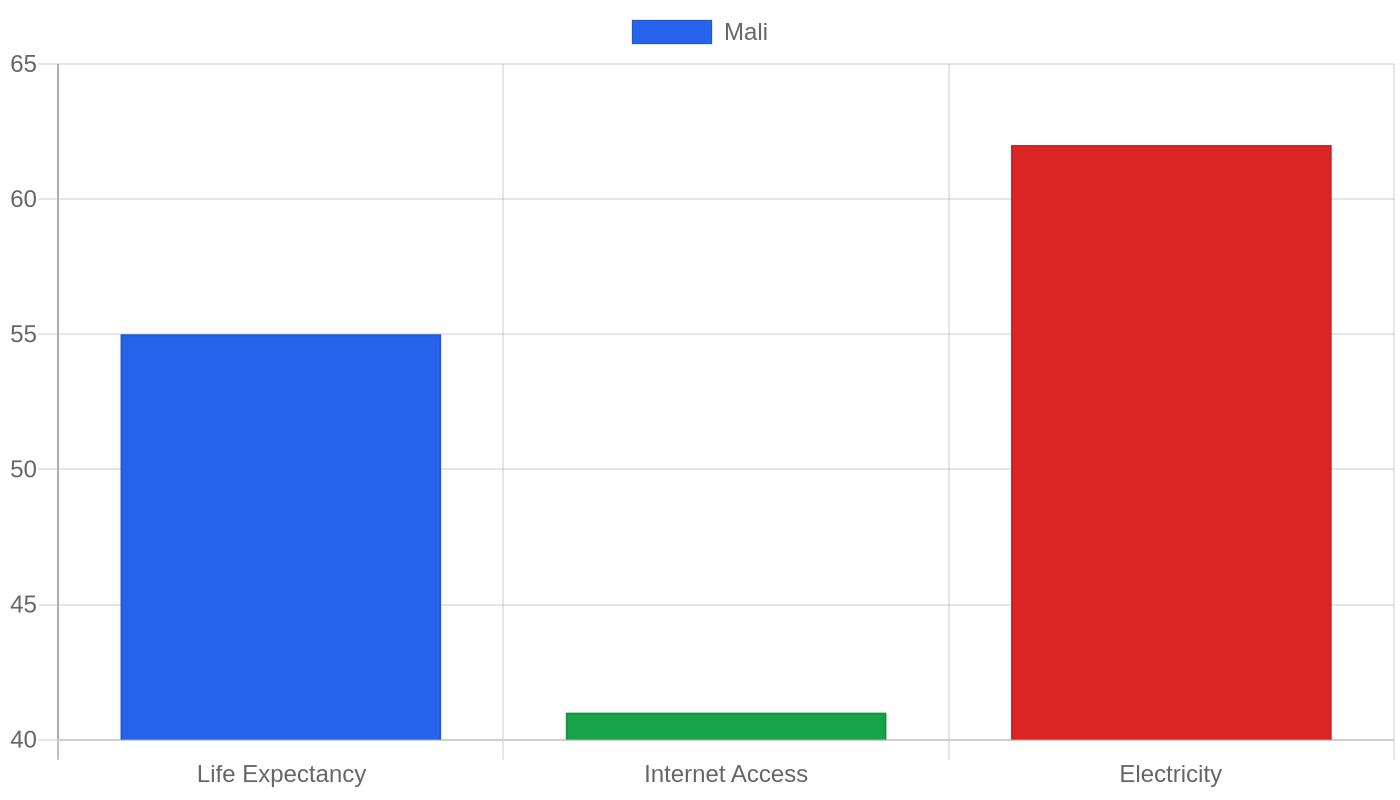
Understanding the current economic pulse of Mali is challenging, as the most recent World Bank data presents a significant gap in critical indicators. Key metrics such as GDP growth, Consumer Price Index (CPI) inflation, and unemployment rates are currently recorded as “N/A” in the available datasets, suggesting a disruption in data collection or reporting during this period of political transition.
Without these fundamental numbers, it is difficult to gauge the immediate health of the domestic economy or the purchasing power of the average citizen. The absence of specific figures for total GDP, GDP per capita, and Gross National Income (GNI) per capita further limits the ability to compare Mali’s economic standing against regional peers or historical baselines.
This data blackout is itself a significant signal, potentially reflecting the administrative challenges that often accompany a shift from civilian governance to military-led administration. For analysts and policymakers, the lack of transparent, up-to-date macroeconomic data creates a fog that obscures the true scale of economic contraction or stability.
It underscores the urgent need for the transitional government to restore credibility in national statistics, as reliable data is the bedrock of any effective economic policy.
Living Costs in an Uncertain Landscape
While specific figures for housing costs, rent, and daily expenses are not detailed in the provided data, the general economic ambiguity suggests that cost-of-living pressures remain a central concern for Malian households. In the absence of precise inflation data, it is reasonable to infer that price stability is a volatile variable, likely influenced by global commodity trends and local supply chain disruptions.
The cost of living in Mali typically varies significantly between the capital, Bamako, and rural areas, with urban centers commanding higher prices for goods and services. For residents, the primary economic activity remains tied to the sectors where local companies operate, such as telecommunications and consumer services, which provide essential daily utilities. Without clear data on regional averages or specific housing markets, the focus remains on the broader economic resilience of the population.
The lack of detailed cost-of-living breakdowns means that consumers and businesses alike must navigate a landscape where price predictability is low, requiring careful budgeting and resource management.
Corporate Giants in a State-Led Framework
The business environment in Mali is anchored by a set of prominent companies that span telecommunications, financial services, and consumer goods. Telecommunications is a particularly strong sector, with Ikatel and Malitel standing out as key players providing essential connectivity to the population.
In the financial sector, institutions such as Banque de l’Habitat du Mali and Malian Solidarity Bank play a crucial role in facilitating credit and savings, supporting both individual households and small businesses. The consumer services and goods sectors are represented by firms like Africable, Compagnie malienne pour le développement du textile, and Air Mali, which cater to everyday needs and travel.
These companies operate within a political framework where the state maintains significant influence, particularly under the current transitional government. The presence of multiple airlines, including Mali Air Express, Mali Air Transport, and Mali Airways, indicates a fragmented but active aviation sector, though its efficiency is likely tied to broader infrastructure and regulatory conditions.
For investors, these established firms represent the primary entry points into the Malian market, offering a glimpse into the sectors that drive local economic activity.
Security, Politics, and the Quality of Life
The political landscape of Mali is defined by the authority of Transitional President Assimi Goïta, who leads a military junta consisting of four other officers known as the National Committee for the Salvation of the People. This group has complete control over the political system, having replaced the National Assembly with the National Transitional Council following the 2020 coup.
Although the 1992 constitution establishes Mali as a secular constitutional republic with a separation of powers, the practical reality is one of centralized military authority. Data regarding crime and safety indices is currently unavailable, with both the Crime Index and Safety Index listed as “N/A,” leaving the precise state of public order to be inferred from broader political narratives.
This lack of specific safety data makes it difficult to assess the day-to-day risk for residents or visitors, highlighting a transparency gap in non-economic metrics. The quality of life in such a context is heavily influenced by political stability, which remains a work in progress under the transitional administration.
The shift from a parliamentary system to a council-led structure suggests that political discourse is currently dominated by military priorities, with limited space for opposition or independent legislative oversight.
The Current Reality: A State in Suspension
The current situation in Mali is characterized by a profound sense of suspension, where the transition from military rule to civilian governance has not yet materialized in any concrete economic or political milestones. With no recent news indicating specific reforms, elections, or policy shifts, the status quo of military control persists, leaving the economic and social fabric in a state of flux.
The lack of live economic indicators or recent policy announcements means that the primary dynamic is the consolidation of power by the National Committee for the Salvation of the People. This period of uncertainty impacts all aspects of national life, from business investment to daily consumer confidence.
The absence of data on inflation trends or business developments further suggests that the economy is operating in a reactive mode, responding to immediate security and administrative challenges rather than long-term growth strategies. For the international community, the key observation is the durability of the junta’s control, which has effectively halted the democratic transition process outlined in previous agreements.
The focus now remains on how the transitional government manages its mandate, as the lack of clear next steps for political normalization continues to define the national narrative.
The Bottom Line
Mali presents a complex case study in political and economic transition, where the absence of reliable data reflects the broader instability of the current regime. Investors and observers should monitor the restoration of statistical transparency and the potential for political normalization as the primary indicators of future stability. The country’s economic potential, anchored in its telecommunications and financial sectors, remains significant but is currently capped by the political environment.
Until the transitional government demonstrates a clear path toward democratic governance and economic data reliability, Mali will remain a high-risk, high-uncertainty environment for external stakeholders.
Sources & Methodology
This article is authored by Economic Pulse Net for informational and research purposes. Economic Pulse Net sources its data from multilateral institutions, national statistics bureaus, and proprietary databases. All data is believed to be current as of the date of publication.
Published: September 08, 2026 | Category: Research — Mali
Use these signals in your own platform
Economic Pulse publishes its live signal feed through a documented, read-only API. Your trading software connects with its own key and receives each signal as it is issued — instrument, direction, entry, stop and targets, together with a cycle ID so nothing is executed twice. The feed is independent of this website and cannot change it.
Signals are informational only and are not financial advice.