Economic Pulse Net | Sources: World Bank World Development Indicators, Government Sources | 2026
Key Takeaways
- The political landscape is dominated by the military junta, specifically the National Committee for the Salvation of the People, which holds de facto control over the state.
- The corporate sector is anchored by a mix of telecommunications giants like Ikatel and Malitel, alongside state-linked financial institutions and consumer service providers.
- Current macroeconomic indicators from the World Bank are currently unavailable, creating a significant opacity risk for international investors and analysts.
- The transition from the 1992 constitutional republic framework to a transitional governance model has fundamentally altered the separation of powers and political stability.
- With key metrics such as GDP growth, inflation, and unemployment rates currently unrecorded in available data, the economic baseline remains unclear.
The Data Void: Measuring an Economy in Flux
Economic analysis typically begins with the hard numbers provided by institutions like the World Bank, yet for Mali, the latest dataset presents a striking void.
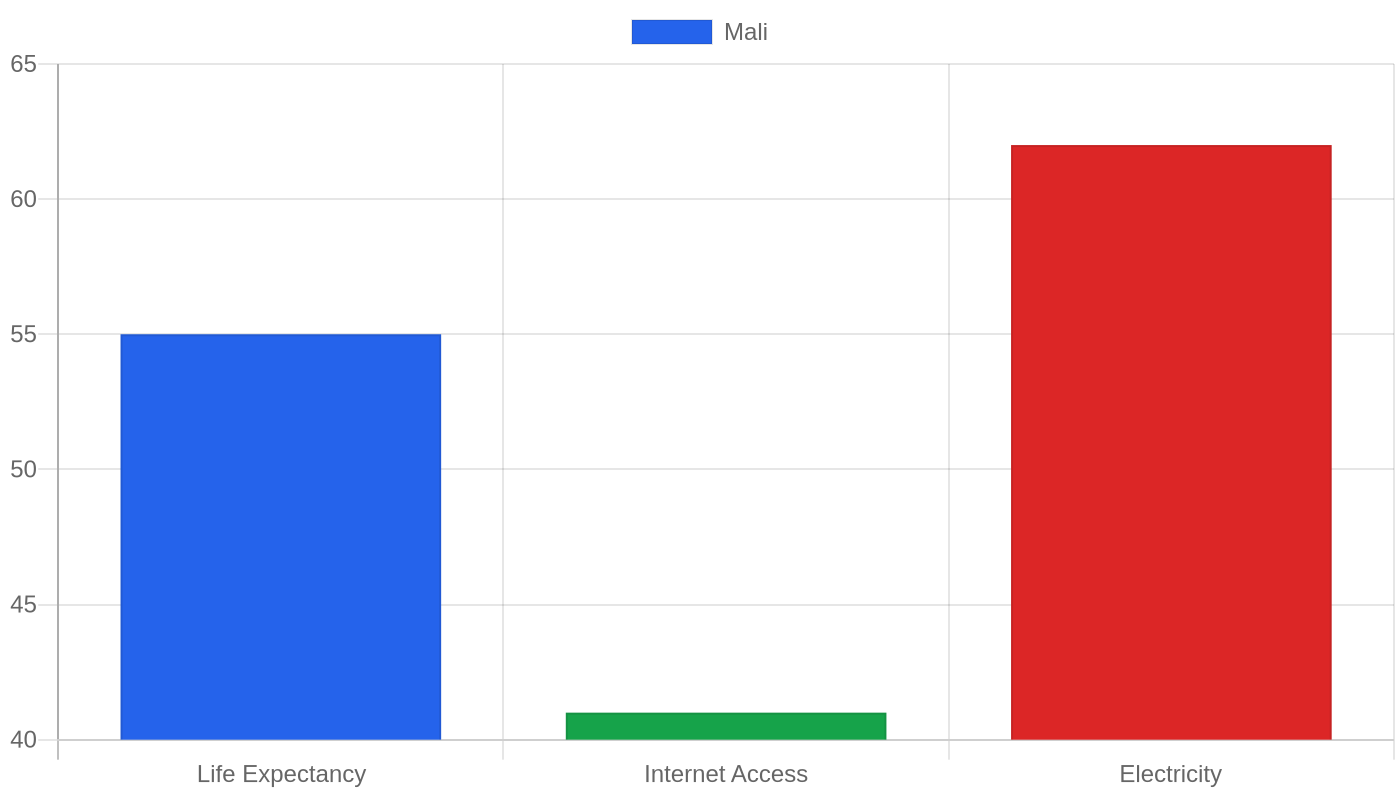
Key indicators including GDP growth, inflation (CPI), unemployment rates, and total GDP in USD are all currently listed as “N/A” in the provided World Bank data.
This absence is not merely a statistical gap but a reflection of the profound disruption caused by political instability and the breakdown of standard institutional reporting channels.
Without reliable figures for GDP per capita (PPP) or GNI per capita, it is impossible to accurately gauge the purchasing power of the average Malian citizen or the overall size of the economy relative to its population.
The lack of data on inflation and unemployment is particularly concerning because these are the primary barometers of daily economic health.
Inflation dictates the cost of essentials like food and fuel, while unemployment reflects the capacity of the labor market to absorb the workforce.
When these metrics are unavailable, it suggests that the statistical machinery of the state may be compromised or that the economic situation is too volatile to be captured by standard quarterly reports.
This opacity complicates any attempt to understand the trajectory of the country’s main industries, as the health of sectors like agriculture or mining cannot be assessed without knowing the broader economic context.
The World Bank’s inability to provide current figures for Mali underscores the challenges faced by international development agencies in regions experiencing political transitions.
It forces observers to rely on qualitative assessments rather than quantitative analysis, which inherently increases the margin of error in forecasting.
For policymakers and investors, this data vacuum represents a significant hurdle, as decisions made without a clear understanding of the current economic baseline are akin to navigating without a map.
The situation highlights the critical link between political stability and economic transparency; without a stable governance structure, the flow of reliable economic data often dries up.
Navigating Daily Life in an Opaque Economy
The cost of living in Mali remains difficult to quantify with precision due to the lack of specific data on housing costs, rent-to-buy ratios, and daily expense benchmarks.
Without concrete figures on regional averages or specific urban versus rural cost disparities, it is challenging to provide a detailed comparison of living standards.
However, the general economic environment suggests that the cost of living is likely to be driven by the availability of basic goods and the stability of the local currency, both of which are influenced by the broader political situation.
In the absence of specific data on housing markets, we can infer that the property sector may be experiencing volatility.
In many transitional states, the real estate market often slows down as uncertainty discourages long-term investments and home purchases.
Rent prices may fluctuate based on supply and demand dynamics in key cities, but without specific indices, these trends remain speculative.
The daily expenses for the average Malian citizen are likely tied to the prices of food and fuel, which are sensitive to global commodity markets and local supply chain disruptions.
The lack of detailed cost-of-living data also means that comparisons to regional averages are not possible within the scope of this report.
This limits our ability to assess whether Mali is becoming more or less affordable relative to its neighbors.
For expatriates or foreign workers, this uncertainty adds a layer of complexity to financial planning, as there is no reliable baseline for budgeting.
The situation underscores the need for improved data collection and reporting mechanisms to provide a clearer picture of the economic realities facing the Malian population.
Corporate Pillars in a Shifting Landscape
Despite the macroeconomic uncertainty, Mali’s corporate sector continues to operate with a distinct structure, anchored by a few key players in telecommunications, finance, and consumer services.
The top companies list includes Ikatel and Malitel, both of which are prominent in the telecommunications sector, indicating a continued reliance on digital infrastructure for economic activity.
These companies likely play a crucial role in connecting the population and facilitating business transactions, serving as vital arteries of the economy.
In the financial sector, Banque de l’Habitat du Mali and Malian Solidarity Bank stand out as key institutions.
These banks are likely to be central to housing finance and general banking services, respectively, providing the necessary credit for individuals and businesses.
The presence of these financial entities suggests that the banking system, while potentially under pressure, remains a functional part of the economic landscape.
The consumer services and goods sector is represented by Africable, Compagnie malienne pour le développement du textile, and several aviation-related companies such as Air Mali, Mali Air Express, Mali Air Transport, and Mali Airways.
The prominence of multiple aviation companies is notable, suggesting that air travel is a significant mode of transport and a key industry for both domestic and international connectivity.
These companies likely face challenges related to fuel costs and political stability, but they remain essential for the movement of people and goods.
Governance and Security: The Juncture of Power
The political landscape in Mali is defined by the transition from a constitutional republic to a system controlled by the military junta.
Transitional President Assimi Goïta, assisted by Prime Minister Abdoulaye Maïga and the National Transitional Council, is the nominal head of state.
However, in practice, the National Committee for the Salvation of the People, a group of military officers, holds complete control over the political system.
This dual structure of nominal civilian leadership and de facto military control creates a complex and potentially unstable governance environment.
The 1992 constitution, which established Mali as a secular constitutional republic with a separation of powers, has been effectively suspended or overridden by the actions of the military junta.
This shift has significant implications for the rule of law and the protection of civil liberties.
The National Transitional Council, which replaced the National Assembly, serves as a legislative body, but its independence and effectiveness are likely constrained by the military’s dominance.
The lack of data on crime and safety indices, with both the Crime Index and Safety Index listed as “N/A,” further complicates the assessment of the security situation.
While the political instability is evident, the specific level of crime and safety for residents and visitors remains unclear.
This opacity makes it difficult for individuals and businesses to make informed decisions about their safety and security.
The situation underscores the need for a return to democratic governance and the restoration of independent institutions to ensure the rule of law and protect the rights of citizens.
The Current Moment: A Nation at a Crossroads
The current affairs in Mali are dominated by the ongoing transition period and the efforts to stabilize the country after the 2020 coup.
The military junta, led by the National Committee for the Salvation of the People, is tasked with restoring order and paving the way for a return to civilian rule.
However, the exact timeline and conditions for this transition remain unclear, creating a sense of uncertainty and anticipation.
The lack of recent news and live indicators in the provided data limits our ability to discuss specific reforms, elections, or policy shifts that are currently unfolding.
However, the general trend in transitional states suggests that there may be efforts to reform the security sector, address economic challenges, and engage with international partners.
The international community is likely to be closely monitoring the situation, with potential implications for aid, trade, and diplomatic relations.
The business environment is likely to be shaped by these political developments, with companies adapting to the new governance structure and security challenges.
The telecommunications and financial sectors, in particular, may play a key role in maintaining economic activity and providing services to the population.
The aviation industry, with its multiple players, may face specific challenges related to safety and security, but it remains a vital part of the economic landscape.
The Bottom Line
Mali is at a critical juncture, with its future shaped by the success or failure of the military-led transition.
For investors and observers, the key takeaway is the need for caution and a clear understanding of the political and economic risks.
The lack of reliable data and the dominance of the military junta create a challenging environment, but the presence of key corporate players in telecommunications, finance, and aviation suggests that the economy is not entirely stagnant.
Those watching Mali should focus on the progress of the transition to civilian rule, the restoration of democratic institutions, and the improvement of economic indicators.
The country’s potential lies in its human capital and natural resources, but realizing this potential will require stability, transparency, and inclusive governance.
In the meantime, the situation remains fluid, with the possibility of both positive change and further instability.
Sources & Methodology
This article is authored by Economic Pulse Net for informational and research purposes.
Economic Pulse Net sources its data from multilateral institutions, national statistics bureaus, and proprietary databases.
All data is believed to be current as of the date of publication. Published: September 03, 2026 |
Category: Research — Mali
Use these signals in your own platform
Economic Pulse publishes its live signal feed through a documented, read-only API. Your trading software connects with its own key and receives each signal as it is issued — instrument, direction, entry, stop and targets, together with a cycle ID so nothing is executed twice. The feed is independent of this website and cannot change it.
Signals are informational only and are not financial advice.