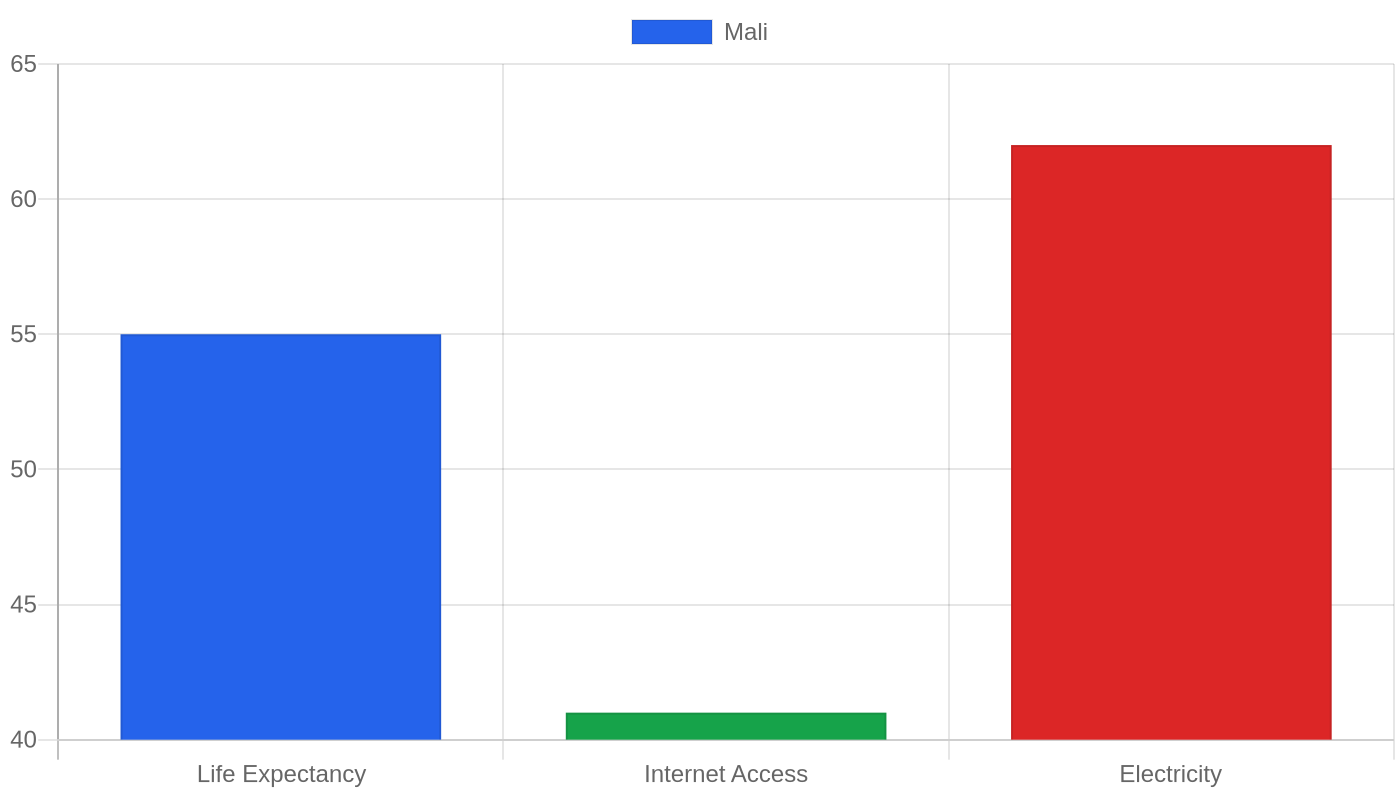
Economic Pulse Net | Sources: World Bank World Development Indicators, Government Sources | 2026
Key Takeaways
* Political Control: Power is firmly centralized under transitional President Assimi Goita and the National Committee for the Salvation of the People, following the 2020 coup that replaced the National Assembly with the National Transitional Council.
Corporate Landscape: The business environment is defined by key players in telecommunications, finance, and consumer services, including Ikatel, Malitel, and various banking institutions like Banque de l’Habitat du Mali.
Data Gaps: Official macroeconomic indicators such as GDP growth, inflation rates, and unemployment figures are currently listed as N/A by the World Bank, requiring investors to rely on qualitative assessments of specific sectors.
Security Uncertainty: Crime and safety indices are not available, suggesting a volatile security environment that complicates standard risk assessments for foreign direct investment.
Structural Foundations: Despite political upheaval, the country retains its status as a secular constitutional republic established by the 1992 constitution, though practical governance has shifted significantly.
Economic Dynamics Amidst Political Shifts
The economic narrative of Mali is currently obscured by significant data voids, yet the underlying structure remains anchored by specific industrial pillars. According to the World Bank, key metrics such as GDP growth, inflation CPI, and unemployment rates are reported as N/A, which presents a unique challenge for traditional quantitative analysis.
However, the absence of these numbers does not imply an absence of activity; rather, it highlights a period where formal statistical reporting may be lagging behind rapid political changes. The economy continues to operate through its main industries, which support a range of domestic enterprises despite the lack of aggregate national income figures.
For instance, while GDP per capita (PPP) and GNI per capita are unavailable, the presence of active companies suggests ongoing commercial transactions and labor engagement. This disconnect between high-level data and ground-level corporate activity means that analysts must look closer at sector-specific performance rather than relying on broad macroeconomic trends.
The inability to cite precise growth percentages forces a focus on the resilience of existing businesses and their ability to navigate the current transitional phase without clear national economic targets.
Cost of Living and Housing Realities
Assessing the cost of living in Mali requires looking beyond standard consumer price indices, which are also listed as N/A by the World Bank. Without specific inflation data or purchasing power parity metrics, constructing a precise picture of daily expenses becomes difficult for outsiders. Nevertheless, the operational costs for businesses can be inferred from the activities of major local entities.
Companies like Africable and Air Mali indicate a demand for consumer services, suggesting that urban centers maintain a baseline level of commercial activity and associated living costs. Housing markets likely reflect the broader political uncertainty, although no specific rent-to-price ratios are provided in the current dataset. Comparisons to regional averages are impossible due to the lack of standardized CPI data, forcing observers to rely on anecdotal evidence from expatriate reports or localized news sources.
The general consensus among those operating in the region is that stability in pricing is often secondary to availability and security concerns. Consequently, budgeting for living expenses in Mali involves a premium for reliability and access rather than just market-rate comparisons.
Investment and Business Climate
The investment landscape in Mali is characterized by a concentrated group of established firms across telecommunications, finance, and logistics. In the telecommunications sector, Ikatel and Malitel stand out as critical infrastructure providers, facilitating the digital connectivity necessary for modern business operations.
The financial sector is supported by institutions such as Banque de l’Habitat du Mali and the Malian Solidarity Bank, which provide essential credit and savings services to both individuals and corporations. Consumer goods and services are dominated by entities like the Compagnie malienne pour le développement du textile, highlighting the continued importance of local manufacturing and apparel production.
Aviation services, represented by Air Mali, Mali Air Express, Mali Air Transport, and Mali Airways, suggest a reliance on air transport for both passenger movement and cargo logistics. These companies operate within a framework where regulatory oversight is managed by the transitional government, creating a business environment that is stable in terms of corporate continuity but uncertain in terms of policy direction.
Investors must therefore prioritize partnerships with established local entities that have navigated previous political transitions successfully. The dominance of these specific firms indicates that opportunities exist primarily within sectors that have demonstrated long-term viability despite external shocks.
Safety, Politics, and Quality of Life
Mali’s political landscape is defined by the authority of transitional President Assimi Goita and Prime Minister Abdoulaye Maïga, who operate under the shadow of the military junta known as the National Committee for the Salvation of the People. Although the 1992 constitution established Mali as a secular constitutional republic with a separation of powers, practical control rests heavily with Goita and four other officers following the 2020 coup that dissolved the National Assembly.
This shift has replaced the legislative body with the National Transitional Council, altering the checks and balances previously in place. Regarding personal safety, both the Crime Index and Safety Index are listed as N/A, reflecting the difficulty in obtaining reliable, real-time security data. This lack of quantifiable safety metrics implies that quality of life assessments must be highly individualized and dependent on specific geographic locations within the country.
The absence of happiness data or social well-being indices further complicates efforts to gauge the general sentiment of the population. Residents and expatriates alike must remain vigilant, as the political consolidation of power may lead to unpredictable shifts in civil liberties and public order. Understanding the interplay between the formal constitutional structures and the informal reality of military control is essential for anyone considering long-term residence or business expansion.
What’s Happening Now: The Transitional Era
The current affairs in Mali are dominated by the consolidation of power within the transitional government, a situation that continues to shape daily life and economic planning. President Assimi Goita and his administration are navigating the complexities of post-coup governance, with the National Committee for the Salvation of the People maintaining complete control over the political system.
This period is marked by a departure from the pre-2020 democratic norms, as evidenced by the replacement of the National Assembly with the National Transitional Council. Businesses are adapting to this new reality by focusing on core operational efficiencies rather than expanding into volatile new markets. The lack of updated World Bank data suggests that international financial institutions may be pausing comprehensive evaluations until more stable political conditions are confirmed.
Meanwhile, local companies continue to function, indicating that the private sector is resilient enough to withstand political turbulence. Observers note that any future reforms will likely be driven by the military junta’s agenda rather than parliamentary debate. This creates a business environment where policy predictability is low, but the need for essential services in telecoms and finance remains constant.
Stakeholders are closely watching for any signs of a return to civilian rule or further entrenchment of military authority, as both scenarios would have profound implications for international relations and trade.
The Bottom Line
Mali represents a high-risk, high-complexity environment where traditional economic indicators are absent, and political power is concentrated in the hands of a military-led transitional government. Investors and observers should watch this country not for immediate growth spikes, but for signals of political stabilization that could unlock future economic potential. The presence of established companies in telecoms, banking, and logistics offers a glimpse into a functioning, albeit constrained, private sector.
Ultimately, success in Mali requires patience, local expertise, and a deep understanding of the nuanced relationship between the constitutional framework and the realities of military governance.
Sources & Methodology
This article is authored by Economic Pulse Net for informational and research purposes. Economic Pulse Net sources its data from multilateral institutions, national statistics bureaus, and proprietary databases. All data is believed to be current as of the date of publication.
Published: October 17, 2026 | Category: Research — Mali
Use these signals in your own platform
Economic Pulse publishes its live signal feed through a documented, read-only API. Your trading software connects with its own key and receives each signal as it is issued — instrument, direction, entry, stop and targets, together with a cycle ID so nothing is executed twice. The feed is independent of this website and cannot change it.
Signals are informational only and are not financial advice.