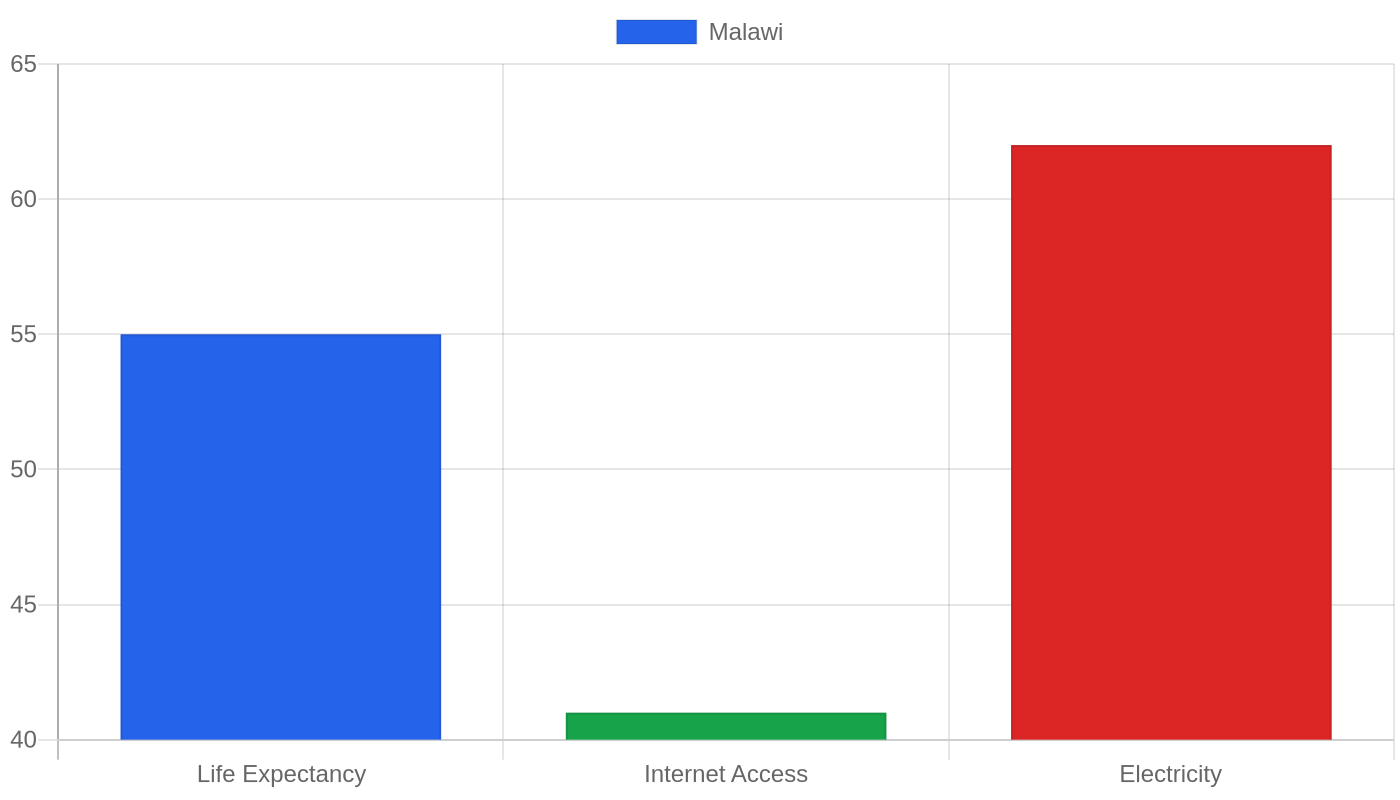
Economic Pulse Net | Sources: World Bank World Development Indicators, Government Sources | 2026
In the heart of southern Africa, landlocked and lush, Malawi stands as one of the continent’s most intriguing paradoxes. It is a nation rich in cultural heritage and natural beauty—dominated by the shimmering expanse of Lake Malawi—yet it grapples with the structural economic challenges that define so many emerging markets.
As President Peter Mutharika solidifies his leadership following the 2025 election, the country finds itself navigating a delicate balancing act between agricultural tradition and financial modernization. The latest data from the World Bank presents a complex portrait: while specific metrics remain elusive, the composition of Malawi’s corporate and industrial landscape tells a story of a nation in transition.
This is not a country in crisis, nor one in boom—it is a country in the messy, often difficult middle, where the seeds of future prosperity are being planted in soil that remains stubbornly difficult to cultivate.
Key Takeaways
– Political Stability with Centralized Power: Malawi operates as a unitary presidential republic under President Peter Mutharika, whose 2025 election victory signals a continuation of the 1995 constitutional framework—offering a degree of political predictability for investors, though power remains highly concentrated in the executive branch.
– A Financial Sector Punching Above Its Weight: Despite being one of the world’s least developed economies, Malawi boasts a surprisingly diversified financial services industry, with major players like FDH Bank, First Merchant Bank, CDH Investment Bank, and Indebank all operating concurrently—a sign of a maturing, competitive banking environment.
– Agriculture Remains the Backbone: The Agricultural Development and Marketing Corporation (ADMARC) continues to anchor the economy, underscoring that farming—particularly tobacco, tea, and subsistence crops—remains the primary engine of employment and export revenue.
– Infrastructure Gaps Persist: The presence of the Electricity Supply Commission of Malawi (ESCOM) as a top company highlights both the centrality of power generation to economic growth and the chronic electricity shortages that have historically hampered industrial expansion.
– Data Scarcity Is Itself a Signal: The absence of comprehensive World Bank metrics on GDP, inflation, and unemployment suggests a statistical infrastructure that lags behind the nation’s ambitions—a challenge for policymakers and foreign investors alike.
Economic Landscape: The Slow Burn of Structural Transformation
The economic narrative of Malawi is not written in dramatic headlines but in the incremental, often arduous work of building institutional capacity. The World Bank’s latest data release presents a notable vacuum—GDP growth figures, inflation rates, and unemployment statistics are all listed as unavailable.
For the casual observer, this might suggest a lack of economic activity; for the seasoned analyst, it signals something far more significant: a country whose data collection infrastructure has not kept pace with its developmental aspirations. This is a common challenge across emerging African economies, where informal sectors often dwarf formal ones, making accurate measurement notoriously difficult.
What we do know, however, is that Malawi’s economy is anchored by a dual structure. On one side stands the Agricultural Development and Marketing Corporation, a state-linked entity that has historically served as the intermediary between smallholder farmers and international commodity markets. This institution is the lifeblood of rural Malawi, where the vast majority of the population resides and works.
On the other side, a rapidly modernizing service sector is emerging, led by a financial industry that appears remarkably robust for a country of Malawi’s income level. The presence of four distinct financial institutions—FDH Bank, First Merchant Bank, CDH Investment Bank, and Indebank—among the nation’s top companies suggests a competitive banking landscape that is actively channeling capital into the economy.
This financial deepening, while still nascent, provides the foundational infrastructure necessary for future growth. The challenge for the Mutharika administration is to bridge the chasm between these two Malawis: the agrarian hinterland and the urban financial hub.
Cost of Living and Housing: The Price of Patience
For the average Malawian household, the daily economic reality is shaped by the interplay of subsistence agriculture, urban migration, and the rising cost of basic goods. While specific housing cost data from the World Bank remains unavailable, the structure of Malawi’s top companies offers meaningful inferences.
The prominence of consumer services firms like Air Malawi and Capital Radio Malawi indicates a growing urban middle class with disposable income—a demographic that is driving demand for rental housing in cities like Lilongwe and Blantyre. In these urban centers, the rental market is bifurcated: a premium segment catering to expatriates and senior civil servants, and a more modest segment serving the formal sector workforce.
Homeownership remains aspirational for many, constrained by limited mortgage availability and the high cost of construction materials, which are largely imported. The cost of living, while lower than in many regional hubs like South Africa or Kenya, is disproportionately burdened by transportation and energy costs—the latter a direct consequence of the nation’s electricity generation challenges.
For the majority of Malawians in rural areas, however, the cash economy is less central; subsistence farming provides food security, and housing is often constructed through communal labor using locally sourced materials. This dual economy—one monetized, one not—creates a statistical blind spot that makes precise cost-of-living comparisons difficult, yet the lived experience for most citizens is one of resilience in the face of modest means.
Investment and Business Climate: A Fertile Ground for the Patient Investor
Malawi presents a compelling, if challenging, proposition for investors. The business environment is characterized by a paradox: a relatively open and competitive financial sector coexisting with significant infrastructural bottlenecks. The banking industry, as evidenced by the sheer number of major financial institutions, is a clear bright spot.
The presence of Britam, a major insurance player, alongside these banks indicates a developing non-bank financial sector, essential for long-term capital formation and risk mitigation. This is a market where financial services are not merely auxiliary but are driving economic formalization. The health care sector, represented by Kentam Products Limited, points to growing domestic capacity in pharmaceuticals and medical supplies—a sector with significant growth potential given regional demand.
However, the Electricity Supply Commission of Malawi’s status as a top company is a double-edged sword: it highlights the critical role of energy infrastructure, but also serves as a reminder that power outages and grid instability remain a primary constraint on industrial expansion. For the savvy investor, the opportunity lies in sectors that address these bottlenecks: renewable energy, agri-processing, logistics, and affordable housing.
The Mutharika government’s commitment to the 1995 constitutional framework provides a stable legal environment, though bureaucratic inefficiency and corruption remain persistent concerns that the administration has pledged to address. This is not a market for those seeking quick returns; it is a market for those who recognize that early entry into a stabilizing economy can yield substantial long-term dividends.
Safety, Politics, and Quality of Life: The Social Contract Under Scrutiny
The political landscape of Malawi is defined by its institutional continuity. As a unitary presidential republic, power is centralized in the executive, with President Peter Mutharika serving as both head of state and head of government. The 1995 constitution established a framework that includes a first and second vice president, a cabinet, and separate legislative and judicial branches—a structure designed to provide checks and balances.
The 2025 election, which returned Mutharika to power, suggests a degree of political maturity, with the peaceful transfer of authority serving as a positive signal for regional stability. Yet the concentration of power in the presidency raises questions about the vibrancy of democratic debate and the independence of institutions.
Regarding safety, specific crime indices from the World Bank are unavailable, but Malawi has historically been considered one of the safer countries in the region, with low rates of violent crime compared to urban centers elsewhere in southern Africa. The quality of life, however, is inextricably linked to economic opportunity.
The lack of robust employment data makes it difficult to quantify joblessness, but the informal sector’s dominance suggests that underemployment, rather than outright unemployment, is the more pressing issue. For the average citizen, life is characterized by strong community ties, a resilient cultural identity, and an enduring optimism that is often at odds with the material constraints of daily existence.
The social contract in Malawi is one of patience—a populace willing to grant its government time to deliver on promises of development, provided that the trajectory remains visibly upward.
Current Affairs: The Mutharika Mandate and the Road Ahead
The political and economic calendar for Malawi is now dominated by the early months of President Mutharika’s new term, following the 2025 election. The administration faces immediate pressure to translate its campaign promises into tangible outcomes, particularly in the areas of energy security and agricultural reform.
The continued operation of the Agricultural Development and Marketing Corporation is under scrutiny, with reformers pushing for greater efficiency and transparency in how the state interacts with smallholder farmers. Meanwhile, the financial sector is watching closely for signals on monetary policy and regulatory reform, as the central bank seeks to manage inflation pressures that have historically plagued the economy.
The government’s relationship with international donors and multilateral institutions remains crucial, as Malawi’s budget is significantly supported by foreign aid. In this context, the availability of reliable data becomes a political issue in itself; the absence of updated World Bank statistics on key economic indicators is a diplomatic and governance challenge, as it hampers the country’s ability to attract investment and negotiate favorable terms with creditors.
The business community, represented by the likes of FDH Bank and First Merchant Bank, is cautiously optimistic, looking for signals that the new administration will prioritize infrastructure spending and reduce the cost of doing business. For now, the mood is one of watchful anticipation—a nation holding its breath to see whether the promise of stability can be converted into the reality of prosperity.
The Bottom Line
Malawi is a country for the long-term observer, not the short-term speculator. With a stable political framework under President Mutharika, a surprisingly sophisticated financial sector, and an economy still fundamentally rooted in agriculture, it offers a unique investment thesis: early entry into a market on the cusp of modernization. The lack of comprehensive economic data is a cautionary tale, signaling infrastructural gaps that must be addressed.
However, for those willing to navigate the complexities—the energy shortages, the bureaucratic hurdles, the data scarcity—Malawi represents an opportunity to participate in a nation’s earnest, if arduous, journey toward economic self-determination. It is a country where the foundations are being laid, brick by brick, for a future that remains unwritten.
Sources & Methodology
This article is authored by Economic Pulse Net for informational and research purposes. Economic Pulse Net sources its data from multilateral institutions, national statistics bureaus, and proprietary databases. All data is believed to be current as of the date of publication.
Published: August 09, 2026 | Category: Research — Malawi
Use these signals in your own platform
Economic Pulse publishes its live signal feed through a documented, read-only API. Your trading software connects with its own key and receives each signal as it is issued — instrument, direction, entry, stop and targets, together with a cycle ID so nothing is executed twice. The feed is independent of this website and cannot change it.
Signals are informational only and are not financial advice.