Economic Pulse Net | Sources: World Bank World Development Indicators, Government Sources | 2026
Key Takeaways
– Malawi operates as a unitary presidential republic under President Peter Mutharika, who has led the country since 2025, with elections held every five years for the executive branch.
– The nation’s economic foundations rest on agricultural production, with the Agricultural Development and Marketing Corporation serving as a cornerstone of the consumer goods sector.
– Financial services are experiencing notable diversification, with multiple banks including FDH Bank, First Merchant Bank, and CDH Investment Bank operating alongside insurance provider Britam.
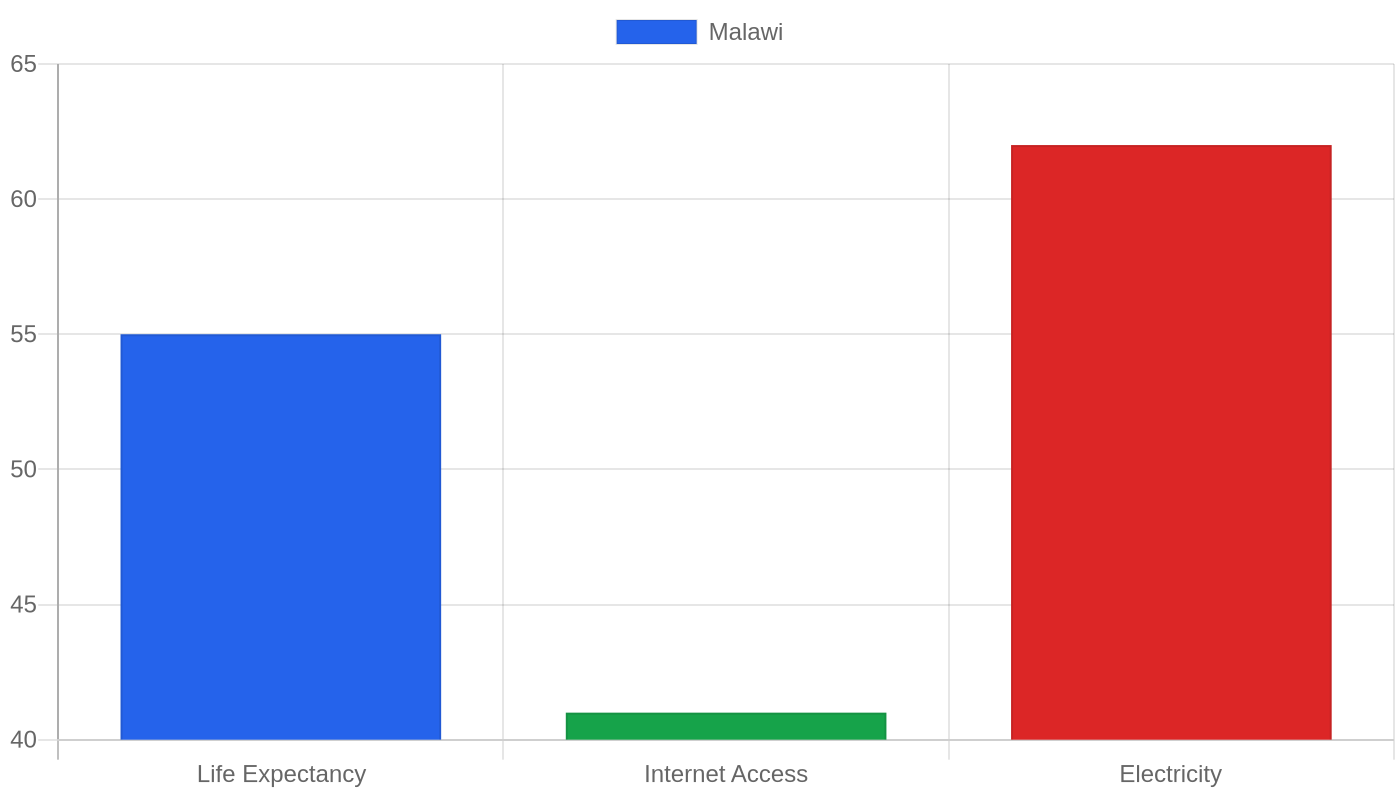
– Infrastructure and utilities remain central to the development agenda, with the Electricity Supply Commission of Malawi managing the nation’s power generation and distribution.
– The country maintains a functioning democratic framework established by its 1995 constitution, with executive, legislative, and judicial branches operating under a presidential system.
The Economic Engine: Agriculture, Finance, and the Search for Stability
Malawi’s economic narrative is fundamentally shaped by its agricultural heritage and its ongoing efforts to diversify into financial services and telecommunications. The World Bank’s economic indicators for Malawi currently show a complex picture, with GDP growth figures, inflation rates, and unemployment data all registering as unavailable in the latest reporting cycle.
This data gap itself tells a story — it reflects the challenges of economic data collection and reporting in a developing economy that has faced significant headwinds in recent years.
The agricultural sector, anchored by the Agricultural Development and Marketing Corporation, remains the backbone of the economy. This state-linked enterprise handles the marketing and distribution of key cash crops, connecting smallholder farmers to broader markets. The dominance of agriculture means that Malawi’s economic fortunes remain closely tied to weather patterns, global commodity prices, and the health of the smallholder farming sector that employs the majority of the workforce.
Yet beneath this agricultural surface, a more modern economic story is emerging. The financial services sector has grown considerably, with a competitive banking landscape that includes FDH Bank, First Merchant Bank, and Indebank, alongside the investment banking operations of CDH Investment Bank. The presence of Britam in the insurance sector further indicates a maturing financial ecosystem — one that is gradually expanding access to capital and risk management tools for businesses and individuals alike.
The utilities sector, represented by the Electricity Supply Commission of Malawi, plays a critical role in determining the country’s economic trajectory. Reliable power supply remains one of the most significant constraints on industrial development across sub-Saharan Africa, and Malawi is no exception. The commission’s ability to expand generation capacity and improve grid reliability will largely determine whether manufacturing and services can grow beyond their current footprints.
The Cost of Living: Navigating Daily Realities in a Developing Economy
For ordinary Malawians, the cost of living is shaped by the interplay between agricultural production, import dependence, and the purchasing power of local currency. While specific housing cost data and rental indices are not currently available through the World Bank’s reporting, the broader economic context provides meaningful insight into daily life in the country.
In Malawi, as in many agrarian economies, food costs typically consume a substantial portion of household budgets. The reliance on rain-fed agriculture means that food prices can fluctuate significantly based on harvest outcomes. When harvests are good, staple food prices tend to moderate; when drought or flooding disrupts production, food inflation can quickly erode household purchasing power.
Housing dynamics in Malawi reflect a dual market structure common in developing nations. Urban centers like Lilongwe and Blantyre have seen growing demand for formal housing, driven by the expansion of government services, financial institutions, and international organizations. Meanwhile, the majority of the population continues to live in rural areas, where traditional housing and land tenure systems prevail.
The gap between urban formal housing costs and rural traditional housing remains substantial, creating distinct cost-of-living experiences across different segments of the population.
The presence of multiple financial institutions suggests improving access to banking services, which can help households manage their finances more effectively. However, the affordability of formal financial services remains a consideration for lower-income households, who may still rely on informal savings mechanisms and community-based lending arrangements.
Investment and Business Climate: Opportunities in a Maturing Market
Malawi’s business environment presents a study in contrasts — a country with genuine opportunities for patient investors, yet one that continues to grapple with structural challenges. The corporate landscape includes a mix of state-linked enterprises, domestic private companies, and international players, particularly in the financial and consumer services sectors.
The banking sector stands out as particularly dynamic. With FDH Bank, First Merchant Bank, and Indebank competing alongside CDH Investment Bank, the financial services industry demonstrates a level of competition that can benefit consumers and businesses seeking credit. The presence of Britam in the insurance market adds another layer of financial infrastructure, providing risk management products that are essential for business planning and investment.
Consumer services companies, including Air Malawi and Capital Radio Malawi, represent the country’s growing services economy. Air Malawi, as the national carrier, plays a strategic role in connecting the country to regional and international markets, while Capital Radio’s presence indicates a functioning media and communications sector.
Kentam Products Limited in the healthcare sector highlights opportunities in health-related industries, a sector that is likely to see growing demand as the population expands and healthcare needs evolve. For investors, the healthcare sector offers potential in pharmaceutical distribution, medical supplies, and related services.
However, the business climate is not without its challenges. The reliance on agricultural exports makes the economy vulnerable to commodity price shocks and weather-related disruptions. Infrastructure constraints, particularly in power generation and transportation, can increase operational costs for businesses. The regulatory environment, while improved in recent years, still requires navigation by companies unfamiliar with local procedures and practices.
Safety, Politics, and Quality of Life: Democracy in Action
Malawi’s political system is defined by its 1995 constitution, which established a unitary presidential republic with a clear separation of powers among executive, legislative, and judicial branches. The current political landscape, under the leadership of President Peter Mutharika since 2025, reflects the country’s commitment to democratic governance and peaceful transitions of power.
The executive branch is structured around a president who serves as both head of state and head of government, supported by first and second vice presidents and the Cabinet of Malawi. Presidential and vice-presidential elections are held together every five years, providing regular opportunities for citizens to express their political preferences and hold their leaders accountable.
The constitution also allows for the appointment of a second vice president, adding a layer of political complexity to the executive structure.
This democratic framework has important implications for quality of life and political stability. Regular elections create mechanisms for addressing grievances through political means rather than through conflict, contributing to the country’s relative stability compared to some regional neighbors. The judicial branch provides a check on executive power, and the legislative branch offers a platform for diverse political voices.
Specific crime and safety indices for Malawi are not currently available, but the country’s democratic institutions and peaceful transitions of power suggest a political environment that is generally conducive to social stability. The presence of independent media, including Capital Radio Malawi, supports the free flow of information that is essential for democratic accountability and civic engagement.
As with many developing nations, quality of life in Malawi is closely tied to economic opportunities and access to basic services. The expansion of financial services, improvements in healthcare through companies like Kentam Products Limited, and the ongoing development of power infrastructure all contribute to gradual improvements in living standards. However, the pace of these improvements depends on sustained economic growth and effective implementation of development policies.
Current Affairs: A New Administration’s Agenda
The political landscape shifted significantly in 2025 with President Peter Mutharika assuming leadership of the country. This transition has brought renewed attention to the nation’s development priorities and economic management strategies. As the administration settles into its term, observers are watching closely to see how the government balances fiscal discipline with the need for investment in infrastructure and social services.
The Electricity Supply Commission of Malawi remains at the center of national attention, as power generation and distribution continue to be critical constraints on economic activity. The commission’s performance in expanding capacity and improving reliability will be a key indicator of whether the country can accelerate its industrial development and attract the kind of investment needed to diversify the economy beyond agriculture.
The financial sector’s continued growth suggests confidence in Malawi’s economic direction. The presence of multiple banks and an insurance company indicates a functioning financial system that can support business development and household financial management.
Whether this financial infrastructure translates into broader economic opportunities will depend on factors including agricultural performance, infrastructure development, and the government’s ability to maintain a stable macroeconomic environment.
The country’s democratic institutions are being tested as the new administration establishes its policy agenda and works with the legislative branch to advance its priorities. The five-year electoral cycle provides a clear timeline for the administration to demonstrate progress and make its case to voters in the next election.
The Bottom Line
Malawi represents a nation in transition — a democracy with established institutions, an economy with genuine growth potential, and a society navigating the challenges of development in a complex global environment. For investors and observers willing to look beyond the data gaps, the country offers a narrative of resilience and gradual progress.
The agricultural sector provides a foundation, the financial services industry offers diversification, and the political system demonstrates a commitment to democratic governance. Those watching Malawi should pay attention to the new administration’s economic policies, the performance of the power sector, and the continued development of the financial services industry — these factors will largely determine whether the country can translate its democratic stability into sustained economic progress.
Sources & Methodology
This article is authored by Economic Pulse Net for informational and research purposes. Economic Pulse Net sources its data from multilateral institutions, national statistics bureaus, and proprietary databases. All data is believed to be current as of the date of publication.
Published: August 16, 2026 | Category: Research — Malawi
Use these signals in your own platform
Economic Pulse publishes its live signal feed through a documented, read-only API. Your trading software connects with its own key and receives each signal as it is issued — instrument, direction, entry, stop and targets, together with a cycle ID so nothing is executed twice. The feed is independent of this website and cannot change it.
Signals are informational only and are not financial advice.