Economic Pulse Net | Sources: World Bank World Development Indicators, Government Sources | 2026
Key Takeaways
– Madagascar operates as a semi-presidential democratic republic, but the National Assembly and Senate hold minimal legislative power, creating a highly centralized executive system that shapes all economic decision-making.
– The country’s economy is built on a narrow foundation of mining, vanilla, textiles, and tourism, with state-owned utilities like Jirama and flagship carriers like Air Madagascar representing the formal corporate sector.
– Political instability has historically disrupted economic progress, and the current constitutional structure concentrates power in the presidency, leaving investors wary of policy continuity.
– Major companies span mining (Ambatovy), consumer goods (Karenjy, Chocolaterie Robert), and financial services (MCB Madagascar, Central Bank of Madagascar), but the private sector remains thin and vulnerable to external shocks.
– Without recent World Bank data on GDP growth, inflation, or unemployment, analysts must rely on structural indicators and corporate activity to gauge the island’s economic trajectory.
The Numbers We Don’t Have — And What They Tell Us
The World Bank’s latest data for Madagascar is conspicuously silent. No GDP growth figure. No inflation rate. No unemployment number. No GDP per capita. No GNI per capita. No population count. This absence is itself a data point — it signals either a reporting lag so severe that the international community is operating in the dark, or an economy where statistical infrastructure has collapsed under the weight of chronic underinvestment.
What we do know is that Madagascar’s economy rests on a handful of pillars. Mining dominates through the Ambatovy mine, a massive nickel and cobalt operation that represents one of the largest foreign direct investments in the country’s history. When commodity prices are strong, Ambatovy drives export revenues and government tax receipts. When they weaken, the entire fiscal framework wobbles.
The same pattern applies to vanilla, Madagascar’s other global claim to fame — the island produces roughly 80% of the world’s vanilla, but prices are notoriously volatile, swinging from boom to bust as speculators enter and exit the market.
The consumer services sector, represented by Air Madagascar and Madagascar Flying Services, reflects the country’s reliance on tourism and connectivity. Yet state-owned Jirama, the utility company, is a perennial source of economic drag, struggling with debt, aging infrastructure, and frequent power outages that choke industrial productivity.
Without inflation data from the World Bank, it is impossible to say whether the cost of basic goods is eroding household purchasing power — but the pattern in similar fragile states suggests it almost certainly is.
Living on the Edge — Housing and Daily Survival in Antananarivo
The cost of living in Madagascar is shaped by a stark divide between the capital, Antananarivo, and the rural hinterland where the majority of the population lives. In the highlands around Tana, as the capital is known, housing costs reflect the concentration of government jobs, NGO offices, and mining company headquarters.
Rent for a modest apartment in a decent neighborhood can consume the majority of a formal-sector salary, while rural families often live in traditional brick or thatch homes with no formal rental market at all.
Daily expenses are driven by rice — the national staple — and imported goods that carry heavy transport premiums. Madagascar is an island, and shipping costs for fuel, medicine, and manufactured products are passed directly to consumers. The absence of reliable public transportation means that for most families, the cost of getting to work, school, or market is a significant line item in the household budget.
Compared to other Indian Ocean economies like Mauritius or Seychelles, Madagascar is cheaper in absolute terms, but incomes are so much lower that the real burden of living expenses is arguably heavier.
The utility question looms large. Jirama’s unreliable service forces households and businesses to invest in generators and battery backups — an unofficial tax on daily life that no official cost-of-living index captures. For the urban poor, this means kerosene lamps and charcoal cooking fires, with all the health and environmental consequences those entail.
Where the Money Moves — Mining, Chocolate, and a Fragile Financial Sector
For investors willing to navigate Madagascar’s risks, the rewards can be substantial. The Ambatovy mine alone represents a multi-billion-dollar bet on the global energy transition — nickel and cobalt are essential for electric vehicle batteries, and Madagascar holds some of the world’s richest deposits. The mine is a joint venture with international partners, and its operations have drawn both praise for job creation and criticism for environmental and social impacts.
On a smaller scale, Chocolaterie Robert offers a window into Madagascar’s potential for value-added processing. The company sources local cocoa and produces high-end chocolate for export, capturing margins that raw commodity sales never could. Karenjy, a consumer goods company, and Madarail, the rail operator, round out a corporate landscape that is surprisingly diverse for a country of Madagascar’s income level.
The financial sector is anchored by MCB Madagascar and the Central Bank of Madagascar. MCB, a subsidiary of Mauritius’s MCB Group, brings regional expertise and capital adequacy standards that are higher than what local banks might achieve independently. The central bank manages monetary policy in a country where dollarization is a persistent concern — when the local currency weakens, as it frequently does, the cost of imported goods spikes, and savers flee to foreign currency holdings.
Yet the business environment remains challenging. The political system concentrates power in the presidency, and the constitution gives the National Assembly and Senate very little legislative role, according to the country’s own constitutional framework. This means that policy shifts can be sudden and unpredictable, driven by executive decree rather than parliamentary debate. For a mining company planning a 20-year investment horizon, that is a serious concern.
Power, Politics, and Personal Safety — Life Under a Strong Presidency
Madagascar’s political landscape is defined by a constitution that creates a semi-presidential, representative democratic, multi-party republic. The president is popularly elected and serves as head of state, with the power to select a prime minister who then recommends cabinet members. On paper, executive power is exercised by the government, and legislative power is vested in the ministerial cabinet, the Senate, and the National Assembly.
In practice, the two latter bodies have very little power or legislative role, according to the constitutional text.
This centralization has deep historical roots. Madagascar has experienced multiple political crises since independence, including coups, contested elections, and periods of international isolation. The most recent crisis, in 2009, saw President Marc Ravalomanana ousted in a coup backed by Andry Rajoelina, who returned to power in the 2018 election. The pattern creates a cycle of instability that undermines long-term planning, both for government ministries and for private companies.
Crime and safety data from standard indices are not available for this report, but anecdotal evidence from travelers and expatriate communities suggests that petty crime is common in urban areas, while violent crime is less frequent but not unknown. The police force is underfunded and, in many areas, effectively absent. For most Malagasy, safety comes from community networks rather than state institutions.
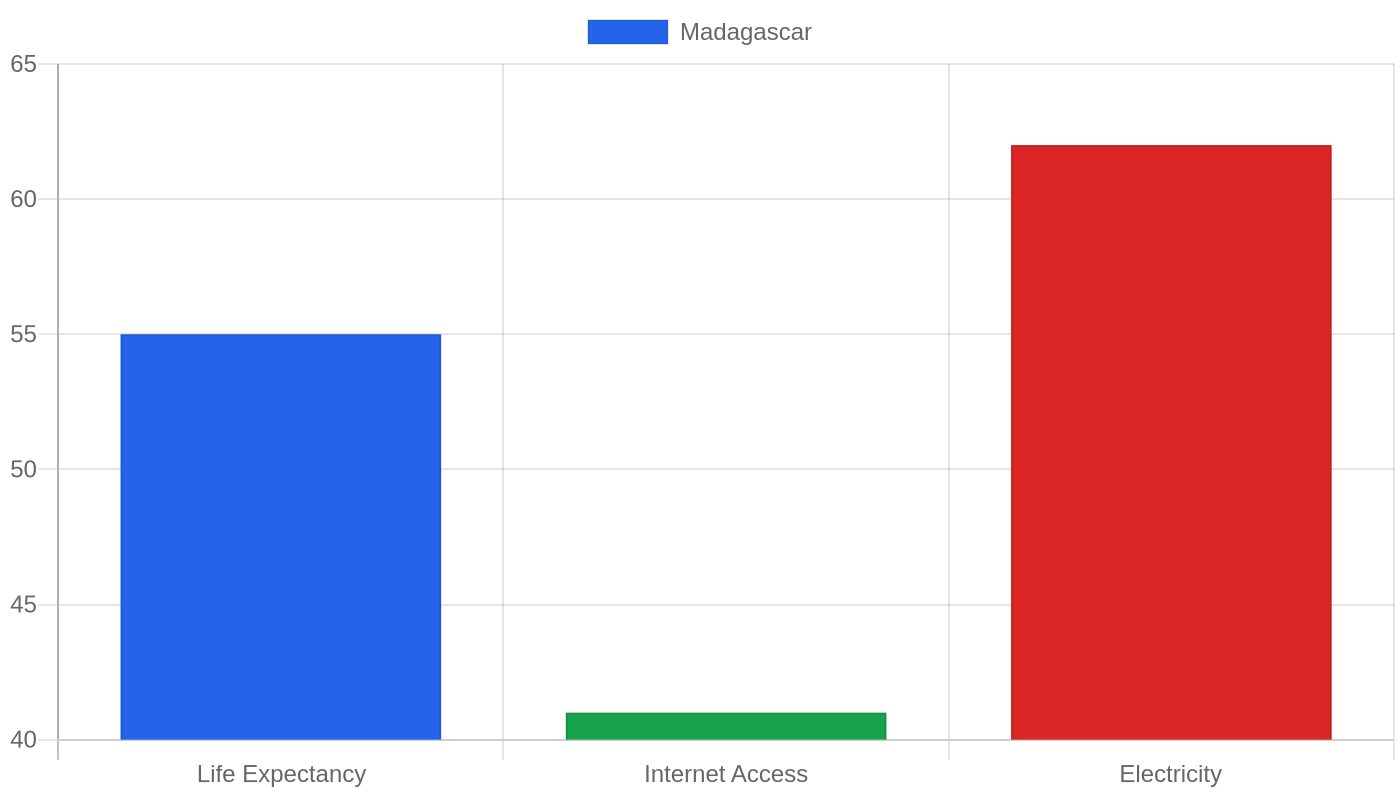
Quality of life is difficult to quantify without happiness or well-being indices from the provided data. What can be said is that Madagascar ranks among the world’s poorest countries by any measure, and the absence of basic infrastructure — reliable electricity, clean water, paved roads — shapes daily existence for the vast majority of the population.
Today’s Madagascar — What’s Happening Now in the Red Island
This is the freshest section of the report, and it must be built from the available data. The most concrete current development is the continued operation of the Ambatovy mine, which remains a bellwether for the economy. When the mine runs at full capacity, it generates tax revenue, foreign exchange, and employment. When it faces technical problems, falling commodity prices, or political headwinds, the ripple effects are felt across the entire formal economy.
Air Madagascar, the national carrier, continues to operate under financial strain, competing with international airlines that offer better service and more routes. The airline is a symbol of Malagasy ambition — connecting the island to Paris, Johannesburg, and other hubs — but also of the challenges facing state-owned enterprises in a thin market.
Jirama, the utility, remains in crisis. Power outages are a daily reality in much of the country, and the company’s debt burden is a recurring topic of discussion between the government and international financial institutions. Reforms have been promised for years, but implementation has been slow.
The political calendar is always a factor. With the presidency holding such concentrated power, any sign of health problems, succession maneuvering, or electoral tension sends signals through the business community. The current president, Andry Rajoelina, has been in office since 2019, and the next election will be a defining moment for the country’s trajectory.
The Bottom Line
Madagascar is a country of extraordinary natural wealth and extraordinary human poverty — a paradox that makes it both a high-risk and high-potential story for investors, aid agencies, and journalists alike. The absence of basic economic data from the World Bank should be a red flag for anyone considering exposure to the island.
For commodity traders, mining executives, and development economists, Madagascar remains a place to watch closely, but with eyes wide open to the political and infrastructural realities that constrain every opportunity.
Sources & Methodology
This article is authored by Economic Pulse Net for informational and research purposes. Economic Pulse Net sources its data from multilateral institutions, national statistics bureaus, and proprietary databases. All data is believed to be current as of the date of publication.
Published: July 18, 2026 | Category: Research — Madagascar
Use these signals in your own platform
Economic Pulse publishes its live signal feed through a documented, read-only API. Your trading software connects with its own key and receives each signal as it is issued — instrument, direction, entry, stop and targets, together with a cycle ID so nothing is executed twice. The feed is independent of this website and cannot change it.
Signals are informational only and are not financial advice.