Economic Pulse Net | Sources: World Bank World Development Indicators, Government Sources | 2026
Key Takeaways
– Libya’s economy remains fundamentally tethered to its hydrocarbon sector, with state-owned giants like the Arabian Gulf Oil Company and Brega Marketing Company dominating the landscape, yet comprehensive macroeconomic data from the World Bank remains unavailable, underscoring the profound institutional fragmentation that persists more than a decade after the 2011 uprising.
– The political landscape is defined by division: the collapse of the Libyan Arab Jamahiriya and the killing of Muammar Gaddafi in 2011 gave way to factional violence and a devastating Second Civil War beginning in 2014, leaving the country with competing centers of authority rather than a unified state.
– The business environment is a study in contrasts — a resilient private sector has emerged in consumer services and aviation, with carriers like Afriqiyah Airways and Buraq Air maintaining operations, while the financial sector, anchored by institutions like the Agricultural Bank of Libya, struggles to function as a coherent national system.
– For international observers and investors, Libya represents one of the world’s most complex frontier markets: significant resource wealth and strategic position are offset by profound security risks, political unpredictability, and the absence of reliable economic data.
The Great Data Void — Reading Libya’s Economic Silence
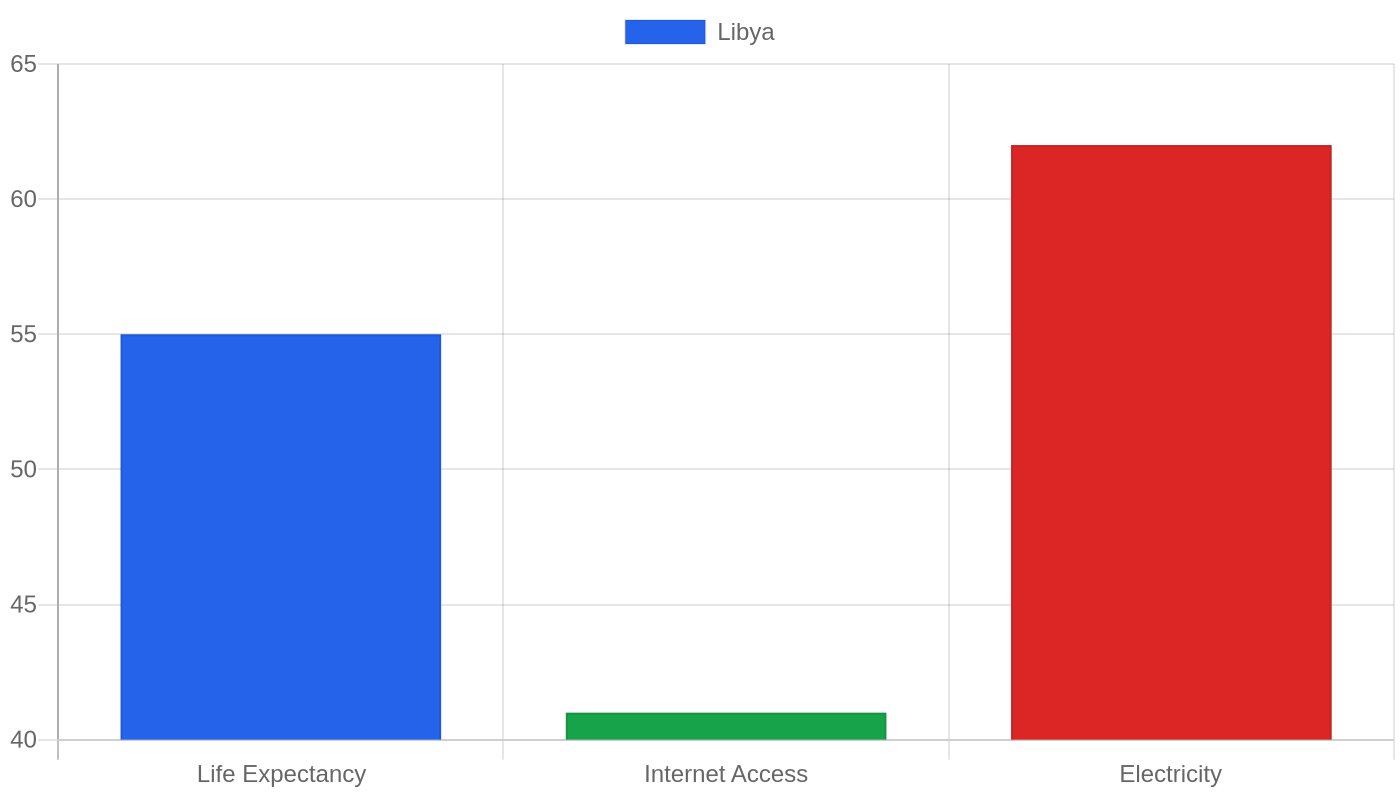
Any serious examination of Libya’s economy must begin with an uncomfortable admission: the numbers simply are not there. The World Bank’s latest figures for GDP growth, inflation, unemployment, and per-capita income are all unavailable — a statistical silence that speaks volumes about the country’s condition. When an economy cannot produce reliable data, it is not merely an administrative failure; it is a symptom of deeper institutional collapse.
For a country that sits atop Africa’s largest proven crude oil reserves, this absence of basic economic intelligence is both remarkable and telling.
The industries that do define Libya’s economic character are overwhelmingly concentrated in hydrocarbons and the services that orbit them. The Arabian Gulf Oil Company, a subsidiary of the National Oil Corporation, remains a cornerstone of production, while Brega Marketing Company handles the crucial domestic distribution of petroleum products.
These enterprises continue to function, but their operations are perpetually vulnerable to the security environment and the political struggles that have plagued the country since the fall of the Gaddafi regime.
The consumer services sector, particularly aviation, tells a more resilient story. Afriqiyah Airways, Buraq Air, Air Libya, and a host of smaller carriers like Alajnihah Airways and Air One Nine continue to operate in one of the world’s most challenging aviation environments. Their survival is a testament to the determination of Libyan businesses to function despite the odds, yet it also reflects a grim reality: when ground transport is insecure, air travel becomes a necessity rather than a luxury.
The industrial sector, represented by companies like Arabian Cement Co., suggests pockets of productive capacity, but these operate in a context where supply chains, financing, and security are perpetually precarious.
The financial sector embodies the paradox of Libyan enterprise. The Agricultural Bank of Libya and Banque Sahélo-Saharienne pour l’Investissement et le Commerce exist as institutions, but their capacity to provide the credit, savings, and payment services that a modern economy requires is severely constrained. Without reliable banking, businesses cannot invest, households cannot plan, and the informal economy expands to fill the void.
The result is an economy that functions, but in ways that are difficult to measure, tax, or regulate.
Housing and Daily Life — The Cost of Living in a Fragmented State
For ordinary Libyans, the cost of living is shaped less by market dynamics than by the fundamental uncertainties of state failure. Housing, in particular, presents acute challenges. The destruction wrought by years of civil conflict has reduced the available housing stock in cities like Benghazi and parts of Tripoli, while displacement has created intense pressure on the areas that remain habitable.
Reconstruction has been slow, hampered by political divisions and the difficulty of coordinating large-scale infrastructure projects across competing authorities.
The rental market in Libya’s major cities operates in a context of profound volatility. Prices are driven not only by supply and demand but by security considerations — safe neighborhoods command significant premiums, while areas near conflict zones see values collapse. For most Libyans, homeownership remains the preferred model, reflecting both cultural norms and the absence of reliable rental protections.
However, the ability to purchase property is constrained by the same banking system that struggles to provide mortgages and construction financing.
Daily expenses for food, fuel, and basic goods are heavily influenced by the country’s dependence on imports and the parallel exchange rate that has emerged due to the central bank’s difficulties. Subsidized fuel and food staples provide some relief, but these subsidies are themselves a source of fiscal strain and are frequently subject to disruption.
The comparison to regional averages is difficult to establish without reliable data, but anecdotal evidence suggests that Libyan households face significant purchasing power erosion, even as the country’s oil wealth theoretically positions it among the region’s more prosperous nations.
The Investment Puzzle — Opportunity Amid Chaos
For investors willing to accept extraordinary risk, Libya offers opportunities that few other markets can match. The oil and gas sector remains the crown jewel, with the Arabian Gulf Oil Company and Brega Marketing Company representing the established pillars of the industry. The reserves are vast, the extraction costs are relatively low, and the global demand for energy shows no sign of abating.
However, the path to realizing this potential is obstructed by the political fragmentation that has prevented the passage of a modern hydrocarbons law and the establishment of transparent contractual frameworks.
Beyond oil, the aviation sector presents an interesting case study in resilience. Afriqiyah Airways, Buraq Air, and their smaller counterparts have maintained operations that connect Libya’s cities and provide links to the outside world. For international investors, these companies represent potential partners or acquisition targets, particularly if the security situation stabilizes.
Similarly, the cement industry, exemplified by Arabian Cement Co., suggests that domestic manufacturing can survive and potentially thrive given the reconstruction needs that will eventually materialize.
The financial sector remains the critical bottleneck. The Agricultural Bank of Libya and Banque Sahélo-Saharienne pour l’Investissement et le Commerce are functional institutions, but they operate within a system that lacks clear regulatory oversight and is vulnerable to political interference. Foreign investors face formidable challenges in repatriating profits, securing financing, and navigating a legal system that is itself fragmented.
The business environment is thus characterized by high barriers to entry and significant operational risks, but also by limited competition and the potential for outsized returns for those who navigate the complexities successfully.
Security, Politics, and the Quality of Life
The political landscape in Libya is not merely unstable; it is fundamentally contested. The 2011 uprising, which began as part of the Arab Spring and was accompanied by NATO intervention, resulted in the collapse of the Libyan Arab Jamahiriya and the killing of Muammar Gaddafi. What followed was not a smooth transition to a new order but a deepening crisis, marked by factional violence and the outbreak of the Second Libyan Civil War in 2014.
The control over the country remains divided among rival authorities, militias, and political factions, each claiming legitimacy and controlling different territories and resources.
This political fragmentation has profound implications for the quality of life. Crime and safety indices are unavailable, but the lived experience of Libyans is shaped by the threat of violence, the presence of armed groups, and the absence of a unified police and judicial system. Kidnappings, extortion, and property seizures are recurring risks, particularly for business owners and political figures.
The psychological toll of living in a perpetual state of insecurity cannot be overstated, and it affects everything from mental health to economic decision-making.
The social fabric, once among the strongest in the region, has been severely strained. Displacement has uprooted communities, while the influx of foreign fighters and the regional dimensions of the conflict have added layers of complexity. Yet Libyan society has also demonstrated remarkable resilience. Family networks, tribal structures, and local communities have stepped in to provide services and security where the state has failed.
This informal governance is a double-edged sword: it provides a semblance of order but also reinforces the fragmentation that prevents the emergence of a unified national authority.
Current Affairs — A Nation Waiting for a Breakthrough
As of the latest reporting, Libya remains locked in a political stalemate that shows few signs of imminent resolution. The competition between the Government of National Unity in Tripoli and the rival administration in the east continues, with each side controlling key institutions and resources. Efforts to hold national elections have repeatedly stalled, and the international community’s attempts to broker a lasting settlement have yet to yield a breakthrough.
The result is a country that is technically at peace — the large-scale combat of the civil war has largely subsided — but remains far from a stable, unified state.
The energy sector reflects this precarious equilibrium. Production has recovered from the lows of the conflict, but it remains vulnerable to blockades, attacks, and political disputes over revenue distribution. The National Oil Corporation has managed to maintain operations and export flows, but its ability to invest in new capacity is severely constrained.
The World Bank’s lack of updated economic data is itself a reflection of this stasis — without a unified government, there is no institution capable of producing reliable national statistics.
For the Libyan people, the current moment is defined by a painful paradox. The country possesses the resources and the potential to provide a decent standard of living for its citizens, yet those resources are trapped within a political system that cannot agree on how to share them.
The aviation companies continue to fly, the cement plants continue to produce, and the banks continue to operate, but these are the actions of a society holding its breath, waiting for a political settlement that would allow the economy to breathe fully.
The Bottom Line
Libya is a country that should be watched by anyone with an interest in energy markets, Middle East geopolitics, or the dynamics of state failure and reconstruction. The absence of reliable data is itself a signal — it tells us that this is a nation still in the throes of a profound transition, one whose outcome remains deeply uncertain. For the intrepid investor, the potential rewards are enormous, but so too are the risks.
For the policy analyst, Libya offers a case study in the limits of military intervention and the difficulty of building institutions from the rubble of dictatorship. And for the Libyan people, the hope remains that the country’s vast wealth will one day be translated into the stability, security, and prosperity that have proven so elusive since 2011.
Sources & Methodology
This article is authored by Economic Pulse Net for informational and research purposes. Economic Pulse Net sources its data from multilateral institutions, national statistics bureaus, and proprietary databases. All data is believed to be current as of the date of publication.
Published: August 27, 2026 | Category: Research — Libya
Use these signals in your own platform
Economic Pulse publishes its live signal feed through a documented, read-only API. Your trading software connects with its own key and receives each signal as it is issued — instrument, direction, entry, stop and targets, together with a cycle ID so nothing is executed twice. The feed is independent of this website and cannot change it.
Signals are informational only and are not financial advice.