Economic Pulse Net | Sources: World Bank World Development Indicators, Government Sources | 2026
Key Takeaways
– Kenya’s political system remains a multi-party democracy, but historical concerns over executive overreach into the judiciary—particularly during Daniel arap Moi’s era—continue to shadow governance debates today.
– The country’s corporate sector is diverse, spanning financial services, cement manufacturing, aviation, and insurance, with major players like Bamburi Cement, Commercial Bank of Africa, and CIC Insurance Group anchoring the economy.
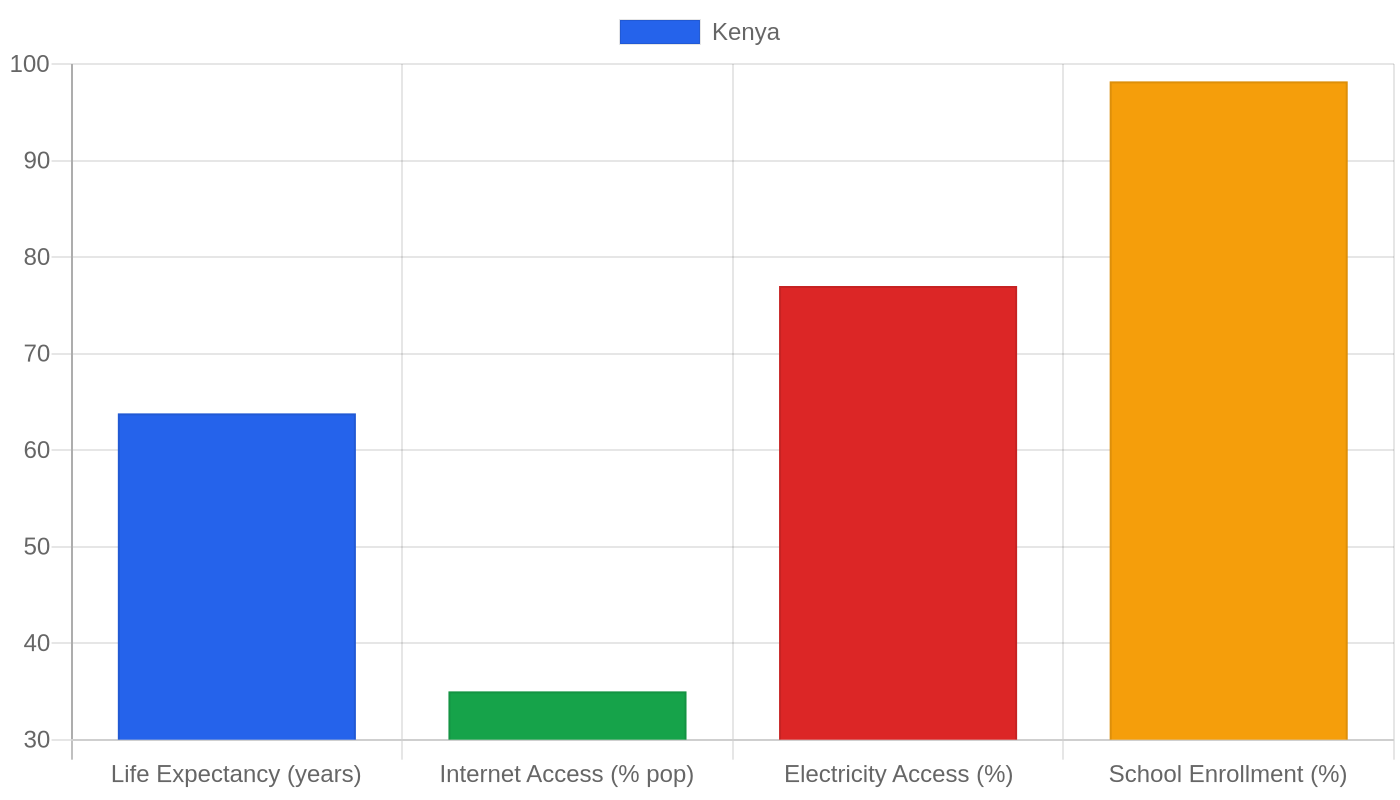
– Cost of living pressures are a central political and social issue, though specific CPI and GDP data are currently unavailable from the World Bank, making independent verification of trends difficult.
– Recent news from *Business Daily Africa* indicates active corporate, economic, and market developments, suggesting a dynamic but potentially volatile business environment.
– Kenya’s safety and crime indices are not currently reported, but the political landscape—with its checks and balances between the executive, legislature, and judiciary—remains a critical factor for investors and residents alike.
The Nairobi Equation — Growth, Gaps, and the Numbers We Don’t Have
Kenya’s economic story is one of ambition constrained by incomplete data. The World Bank’s latest figures do not provide GDP growth, inflation, unemployment, or GDP per capita for the country, leaving analysts to piece together a narrative from corporate activity, policy signals, and regional context. What is clear is that Kenya operates as a presidential representative democratic republic with a multi-party system, where the president serves as both head of state and head of government.
Executive power is exercised by the government, while legislative authority is shared between the National Assembly and the Senate. The judiciary is constitutionally independent—but that independence has been a point of contention, especially during the tenure of former president Daniel arap Moi, when the executive was accused of increasingly meddling with judicial affairs.
This structural tension matters for the economy. When institutions are perceived as compromised, investment confidence erodes. The absence of fresh macroeconomic data from the World Bank may itself be a signal—either of reporting lags or of deeper challenges in data collection and transparency.
Kenya’s main industries are not enumerated in the available data, but the top companies list reveals a strong presence in financial services (ABC Bank, Chase Bank Kenya, Commercial Bank of Africa, CIC Insurance Group), industrials (ARM Cement, Bamburi Cement), and consumer services (98.4 Capital FM, ALS – Aircraft Leasing Services, CMC Aviation). This mix suggests an economy that is both service-oriented and industrially anchored, with cement and aviation playing notable roles.
Without GDP figures, however, it is impossible to say whether these sectors are expanding or contracting, or how they compare to regional peers like Tanzania or Ethiopia.
The Price of Living in Kenya — Rent, Bread, and the Squeeze on Households
Housing and daily expenses in Kenya are shaped by a complex interplay of urban demand, infrastructure constraints, and income inequality. While specific cost-of-living indices are not provided in the available data, the presence of major cement companies—Bamburi Cement and ARM Cement—points to a construction sector that is active enough to support large industrial players. This suggests ongoing building activity, which in turn implies demand for housing, particularly in Nairobi and other urban centers. Rent vs.
buy decisions in Kenya are heavily influenced by access to mortgage financing, which is dominated by banks like Commercial Bank of Africa and ABC Bank. For most households, renting remains the default, especially in cities where property prices are high relative to incomes.
Daily expenses—food, transport, utilities—are a constant source of political pressure. Kenya has historically experienced periodic spikes in food and fuel prices, which ripple through the economy and affect everything from consumer confidence to electoral outcomes. Without current CPI data from the World Bank, it is not possible to quantify the latest inflation trend, but the fact that *Business Daily Africa* is actively covering economic news suggests that price movements are a live issue.
Compared to other East African nations, Kenya has traditionally had a higher cost of living, driven by its role as a regional hub for trade, finance, and transport. That status comes with a price tag—and for many Kenyans, that price is rising faster than wages.
Corporate Kenya — Banks, Cement, and the Battle for Market Share
Kenya’s top companies list reads like a who’s who of East African capitalism. On the financial side, Commercial Bank of Africa, Chase Bank Kenya, ABC Bank, and CIC Insurance Group dominate, reflecting the centrality of banking and insurance to the economy. These institutions serve not only Kenya’s domestic market but also regional clients across East Africa, making them sensitive to cross-border trade flows, currency stability, and regulatory shifts.
The industrial sector is anchored by Bamburi Cement and ARM Cement, both of which are tied to construction activity—a key barometer of economic health. When cement sales rise, it typically signals infrastructure spending and real estate development; when they fall, it suggests a slowdown.
The consumer services sector includes 98.4 Capital FM, a major radio station, and ALS – Aircraft Leasing Services and CMC Aviation, which point to Kenya’s role as an aviation hub. Nairobi’s Jomo Kenyatta International Airport is a gateway to the region, and aviation companies benefit from both passenger travel and cargo logistics. For investors, the key question is whether these companies are growing their revenues and profits in the current environment.
Without profit-and-loss data, one must look to news coverage—and *Business Daily Africa* is reporting on corporate developments, which implies that mergers, acquisitions, earnings announcements, or regulatory changes are underway. The business climate in Kenya is generally considered more developed than in many neighboring countries, with a deeper capital market and a more established legal framework. But political risk, corruption, and infrastructure gaps remain persistent challenges.
Politics, Safety, and the Rule of Law — The Unseen Risk Factor
Kenya’s political landscape is defined by its constitutional structure: a presidential republic with a multi-party system, where power is divided among the executive, legislature, and judiciary. In theory, this creates checks and balances. In practice, the system has been tested repeatedly—most notably during the Moi era, when the executive was accused of encroaching on judicial independence. That legacy has not fully dissipated.
Concerns about executive overreach, electoral violence, and ethnic mobilization continue to shape Kenya’s political risk profile. The country has held multiple elections since the 2007-2008 post-election crisis, each time with varying degrees of tension and violence.
Crime and safety indices are not available in the provided data, which is itself a notable gap. In many Kenyan cities, particularly Nairobi, crime—including theft, carjackings, and residential burglaries—is a concern for both residents and expatriates. Security is a major factor in housing choices, with many middle- and upper-income Kenyans opting for gated communities with private security.
The quality of life in Kenya is highly stratified: those with access to private healthcare, education, and security can live comfortably, while those dependent on public services face significant challenges. The absence of happiness or well-being data makes it difficult to generalize, but anecdotal evidence and previous surveys suggest that Kenyans are resilient but frustrated by corruption, inequality, and the high cost of living.
What’s Happening Now — Corporate Shifts, Economic Signals, and Policy Moves
The most current window into Kenya’s economy comes from *Business Daily Africa*, which is reporting on three key areas: corporate developments, the broader economy, and markets and finance. This suggests that the news cycle is active and that businesses are making strategic moves—whether through expansions, restructurings, or responses to regulatory changes. On the economic front, the newspaper’s coverage likely reflects ongoing debates about fiscal policy, debt sustainability, and the cost of living.
Kenya has been navigating a challenging period of high public debt, currency depreciation against the dollar, and pressure from international lenders to implement reforms.
In the markets and finance space, attention is likely focused on the Nairobi Securities Exchange, banking sector performance, and monetary policy. The Central Bank of Kenya has historically used interest rates to manage inflation and support the shilling, but the effectiveness of these tools depends on external factors like global commodity prices and investor sentiment.
For businesses and investors, the key watchpoints are whether the government can maintain fiscal discipline, whether the shilling stabilizes, and whether the political environment remains calm ahead of future elections. The fact that *Business Daily Africa* is actively reporting on all three fronts indicates that these are live, evolving stories—not static data points.
The Bottom Line
Kenya is a country of contradictions: a regional economic powerhouse with deep structural vulnerabilities, a multi-party democracy with a history of executive overreach, and a nation of ambitious corporations and struggling households. For investors, the opportunity lies in Kenya’s role as a gateway to East Africa, its developed financial sector, and its entrepreneurial culture. But the risks—political instability, data opacity, and cost-of-living pressures—are real and require careful monitoring.
This is a country to watch for those with a high risk tolerance and a long-term horizon, but not for the faint of heart or the impatient.
Sources & Methodology
This article is authored by Economic Pulse Net for informational and research purposes. Economic Pulse Net sources its data from multilateral institutions, national statistics bureaus, and proprietary databases. All data is believed to be current as of the date of publication.
Published: July 21, 2026 | Category: Research — Kenya
Use these signals in your own platform
Economic Pulse publishes its live signal feed through a documented, read-only API. Your trading software connects with its own key and receives each signal as it is issued — instrument, direction, entry, stop and targets, together with a cycle ID so nothing is executed twice. The feed is independent of this website and cannot change it.
Signals are informational only and are not financial advice.