Economic Pulse Net | Sources: World Bank World Development Indicators, Government Sources | 2026
Key Takeaways
* Steady Growth Trajectory: Kenya’s economy is projected to grow by approximately 4.63% in 2025, indicating a stable expansion despite global headwinds.
Inflation Under Control: Consumer price inflation is holding steady at roughly 4.07%, suggesting effective monetary management and predictable cost structures for businesses.
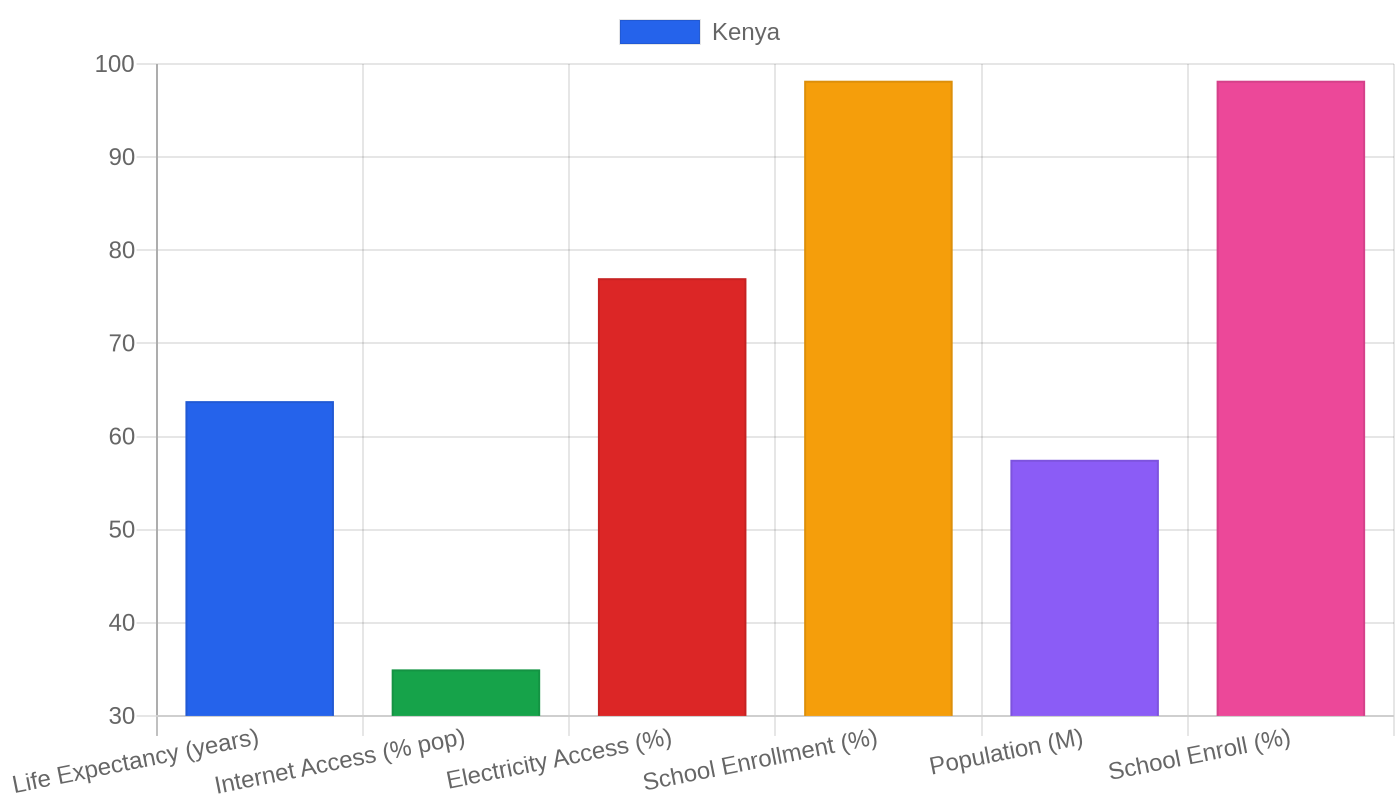
Labor Market Dynamics: With an unemployment rate of 5.45%, the country maintains a relatively tight labor market, though challenges remain in absorbing its rapidly growing population of over 57 million.
Corporate Landscape Dominance: The business environment is anchored by major players in financial services, cement manufacturing, and consumer media, signaling diversified economic pillars.
Economic Pulse: Growth and Stability
Kenya’s macroeconomic landscape in 2025 presents a picture of measured resilience, driven by a GDP growth rate of 4.63261093844984%. This expansion is particularly significant given the nation’s total economic output, which stands at $135,941,278,878.815 USD, reflecting a substantial aggregate value that underpins its status as a regional economic hub.
For the average citizen, this growth translates to a GDP per capita (PPP) of $7,015.93578839722, a figure that offers a more nuanced view of living standards than nominal income alone. However, the Gross National Income (GNI) per capita remains at $2,200.0, highlighting a disparity between broader national wealth and individual household earnings. This gap underscores the ongoing challenge of translating macro-level growth into tangible micro-economic benefits for all 57,532,493 residents.
Furthermore, the unemployment rate of 5.449% suggests that while job creation is occurring, it is not keeping pace with the sheer volume of new entrants into the workforce each year. These figures, sourced from the World Bank, indicate an economy that is growing but still grappling with the structural needs of a large, developing population.
Living Costs and Daily Realities
While specific cost-of-living metrics are not detailed in the current dataset, the inflation data provides a critical lens through which to view daily expenses. With CPI inflation at 4.0693076061457%, households can expect a moderate but noticeable increase in the cost of goods and services compared to previous years.
This level of inflation is generally considered manageable by central banks, implying that essential items such as food, housing, and utilities are rising at a pace that allows for some budgetary planning. For expatriates and investors, this stability is crucial; it means that salary adjustments and operational costs can be forecasted with reasonable accuracy.
In the absence of granular housing data, one must infer that rent and purchase prices are likely tracking this general inflationary trend, rather than experiencing volatile spikes. Consequently, the purchasing power of the average Kenyan, earning a GNI per capita of $2,200.0, is being tested by these steady price increases, requiring careful financial management to maintain quality of life.
Investment & Business Climate
The corporate sector in Kenya is robust, characterized by a mix of financial giants, industrial manufacturers, and service-oriented enterprises. Leading the charge are major financial institutions such as ABC Bank, Chase Bank Kenya Limited, CIC Insurance Group, and Commercial Bank of Africa, which form the backbone of the nation’s credit and insurance markets.
Beyond finance, the industrial sector is heavily represented by ARM Cement Limited and Bamburi Cement, alongside Carbacid Investments in basic materials, indicating strong domestic demand for infrastructure development. In the consumer services space, entities like 98.4 Capital FM, ALS – Aircraft Leasing Services, and CMC Aviation demonstrate a diversified economy that extends beyond traditional commodities.
These top companies suggest that investment opportunities exist across multiple verticals, from real estate and construction to media and aviation leasing. For foreign investors, the presence of these established local conglomerates offers both partnership potential and a competitive benchmark for entering the market. The concentration of power in these sectors highlights where regulatory focus and economic policy will likely have the most immediate impact.
Safety, Politics & Quality of Life
Navigating the socio-political terrain of Kenya requires an understanding of its complex democratic framework and security context. Politically, Kenya operates as a presidential representative democratic republic with a multi-party system, where executive power rests with the government and legislative authority is shared between the National Assembly and the Senate.
The judiciary is constitutionally independent, though historical tensions, particularly during the tenure of former president Daniel arap Moi, have raised concerns about executive interference in judicial affairs. This political structure creates a dynamic environment where policy shifts can occur rapidly following electoral cycles. On the safety front, specific crime and safety indices are currently listed as N/A, making it difficult to provide precise statistical assessments of personal security risks.
However, the absence of recent news regarding civil unrest or major security crises in the provided data suggests a baseline of stability. For residents and visitors alike, the interplay between a functioning democracy and historical institutional friction defines the quality of life and governance experience.
What’s Happening Now / Current Affairs
The current narrative in Kenya is being shaped by developments reported in the corporate, economy, and markets & finance sectors via Business Daily Africa. Recent coverage indicates active movement in the corporate sphere, with companies likely navigating post-pandemic recovery strategies and digital transformation initiatives. Simultaneously, economic reporting focuses on the interplay between the 4.63% growth rate and fiscal policies aimed at sustaining this momentum without exacerbating inflation.
In the markets and finance domain, attention is turning toward how major banks like ABC Bank and Commercial Bank of Africa are adapting to changing consumer behaviors and regulatory requirements. These reports suggest a period of consolidation and strategic adjustment rather than radical upheaval. Investors are closely watching how the government balances debt management with public spending, a key theme in recent economic discourse.
The timely nature of these updates reflects a market that is responsive to both domestic performance and global financial trends.
The Bottom Line
Kenya represents a compelling case study for investors seeking exposure to East Africa’s largest economy, offering a blend of steady growth and diversified industrial bases. While the data points to manageable inflation and respectable GDP expansion, stakeholders must remain vigilant regarding political dynamics and the gap between national wealth and individual income.
It is best suited for long-term investors interested in financial services, infrastructure, and consumer markets who can navigate a complex but structured regulatory environment.
Sources & Methodology
This article is authored by Economic Pulse Net for informational and research purposes. Economic Pulse Net sources its data from multilateral institutions, national statistics bureaus, and proprietary databases. All data is believed to be current as of the date of publication.
Published: October 24, 2026 | Category: Research — Kenya
Use these signals in your own platform
Economic Pulse publishes its live signal feed through a documented, read-only API. Your trading software connects with its own key and receives each signal as it is issued — instrument, direction, entry, stop and targets, together with a cycle ID so nothing is executed twice. The feed is independent of this website and cannot change it.
Signals are informational only and are not financial advice.