Economic Pulse Net | Sources: World Bank World Development Indicators, Government Sources | 2026
Key Takeaways
* Solid Growth Trajectory: Kenya’s economy is projected to expand by approximately 4.63% in 2025, signaling steady recovery and resilience despite global headwinds.
Price Stability: Inflation remains relatively contained at around 4.07%, providing a predictable environment for consumers and businesses alike.
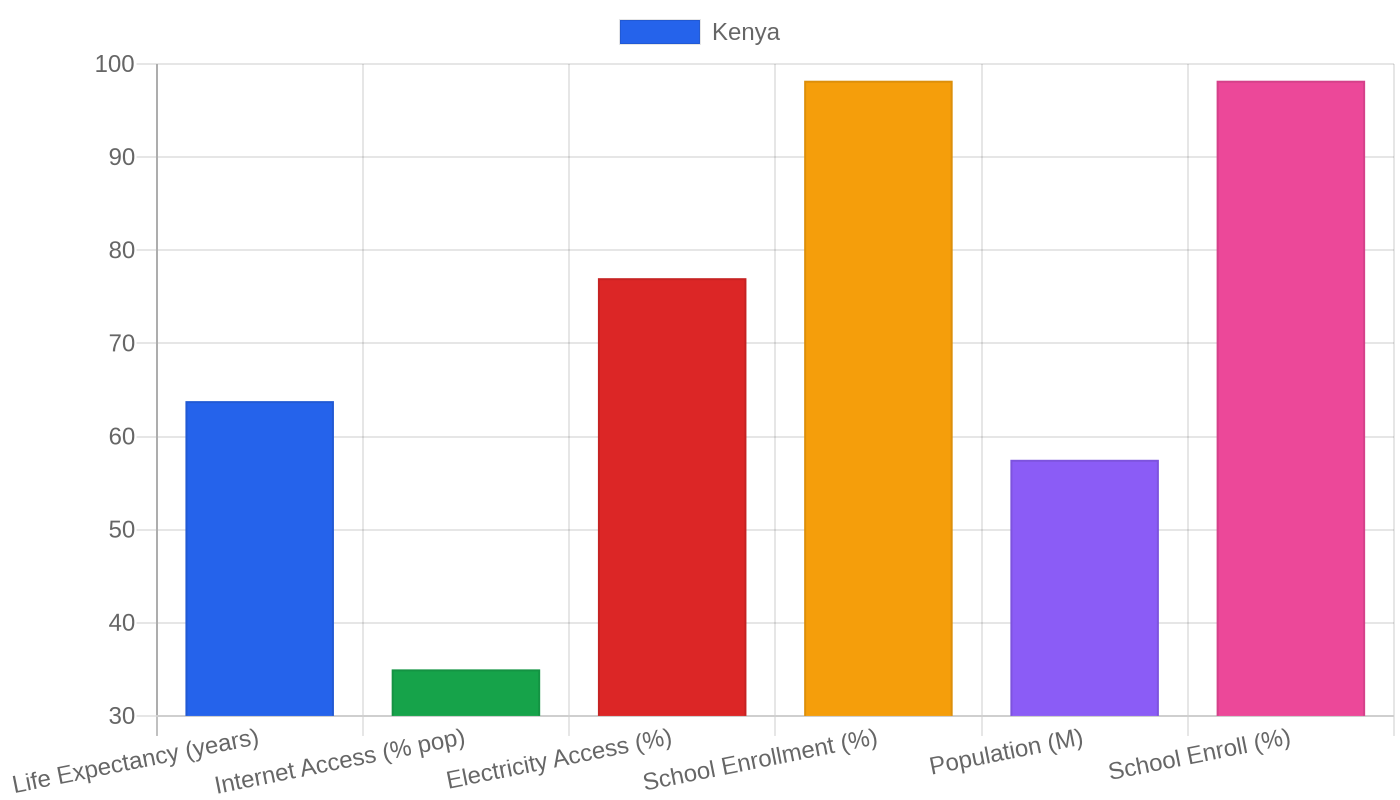
Labor Market Dynamics: With an unemployment rate of 5.45%, the country balances workforce participation against the challenges of job creation in a population exceeding 57 million.
Financial Sector Dominance: Major financial institutions like ABC Bank, Chase Bank, and CIC Insurance Group anchor a robust services sector that drives significant economic activity.
Economic Pulse: Measuring the Engine’s Output
Kenya’s economic engine is showing signs of robust performance, with GDP growth projected at 4.63% for 2025, according to data from the World Bank. This expansion is underpinned by a total GDP value of roughly $135.9 billion, reflecting the nation’s status as a key economic hub in East Africa. While the Gross National Income (GNI) per capita stands at $2,200, indicating ongoing development challenges, the overall macroeconomic picture suggests stability.
Inflation, tracked via the Consumer Price Index (CPI), has settled at 4.07%, a level that generally allows for sustainable consumer spending without eroding purchasing power too rapidly. The labor market presents a nuanced view; with an unemployment rate of 5.45%, the country is managing its large population of over 57.5 million people while striving to create sufficient employment opportunities.
These figures matter because they indicate that Kenya is not just growing, but doing so within a framework of manageable price volatility and fiscal discipline. For investors and policymakers, this combination of moderate growth and low inflation creates a favorable baseline for long-term planning and infrastructure investment.
Cost of Living: Daily Realities for Residents
For residents and expatriates alike, understanding the cost of living in Kenya requires looking beyond headline inflation numbers to the daily realities of housing and goods. While specific rental yields and housing price indices are not explicitly detailed in the current dataset, the broader economic context suggests a market where affordability varies significantly between urban centers like Nairobi and rural regions.
The CPI of 4.07% implies that essential goods and services are experiencing modest price increases, which helps maintain a degree of predictability for household budgeting. However, with a GNI per capita of $2,200, the disparity between income levels and the cost of premium services or imported goods can be stark. Consumers must navigate a landscape where basic necessities are relatively stable, yet discretionary spending may be constrained by wage stagnation in certain sectors.
This environment necessitates careful financial planning, particularly for those relying on fixed incomes or working in industries not directly tied to the booming financial and service sectors. Ultimately, the cost structure reflects a developing economy where efficiency and local sourcing often dictate the true expense of living.
Investment & Business Climate: Corporate Powerhouses
The business landscape in Kenya is heavily influenced by a strong financial and industrial core, dominated by several major corporate entities. Financial services play a pivotal role, with institutions such as ABC Bank, Chase Bank Kenya Limited, Commercial Bank of Africa, and CIC Insurance Group forming the backbone of the country’s credit and insurance markets.
Beyond finance, the industrial sector is anchored by manufacturing giants like ARM Cement Limited and Bamburi Cement, which are critical for infrastructure development. Consumer services also feature prominently, with companies like 98.4 Capital FM and ALS – Aircraft Leasing Services highlighting the diversification into media and specialized aviation services. Carbacid Investments further underscores the importance of basic materials in supporting both industrial and consumer needs.
These top companies demonstrate that investment opportunities exist across multiple verticals, from traditional banking to emerging aviation logistics. For foreign and domestic investors, these entities represent stable anchors in a market that is increasingly integrating with global supply chains. The presence of such diverse and established players suggests a mature business ecosystem capable of absorbing new capital and driving innovation.
Safety, Politics & Quality of Life: Navigating the Landscape
Political stability and social safety are foundational to Kenya’s long-term economic health, though the landscape has faced scrutiny in the past. Kenya operates as a presidential representative democratic republic with a multi-party system, where executive power is vested in the government and legislative authority is shared between the National Assembly and the Senate.
The judiciary is constitutionally independent, although historical concerns, particularly during the tenure of former President Daniel arap Moi, highlighted tensions between the executive branch and judicial affairs. Today, maintaining this separation of powers is crucial for investor confidence and rule of law. Regarding personal security, specific crime and safety indices are currently listed as N/A, meaning precise quantitative assessments of safety are unavailable in the current dataset.
However, the political framework suggests a structured approach to governance that aims to mitigate civil unrest and promote civic order. Quality of life indicators are implicitly linked to economic access, with the challenge being how effectively the government translates macroeconomic growth into tangible improvements in public safety and judicial integrity.
What’s Happening Now: Current Affairs and Trends
The most recent developments in Kenya are being driven by dynamic shifts in corporate strategy, economic policy, and market performance, as reported by Business Daily Africa. Recent news cycles highlight intense activity in the corporate sector, where companies are adapting to new regulatory environments and consumer demands. Simultaneously, the economy section reveals ongoing debates about fiscal management and growth strategies, reflecting the government’s focus on sustaining the 4.63% GDP growth trajectory.
Markets and finance updates provide real-time insights into stock performance and banking sector health, underscoring the vitality of institutions like CIC Insurance and Commercial Bank of Africa. These reports suggest a period of active consolidation and strategic positioning among major firms, likely in response to both regional competition and global economic pressures.
The emphasis on these three pillars—corporate, economy, and markets—indicates that stakeholders are closely monitoring policy implementations and their immediate impact on profitability. As Kenya navigates 2025, the interplay between government policy and private sector agility will continue to define the pace of change.
The Bottom Line
Kenya presents a compelling case for investors seeking exposure to a stable, growing African market with a diversified industrial base. The combination of solid GDP growth, controlled inflation, and a dominant financial sector offers a resilient platform for long-term engagement. However, stakeholders must remain vigilant regarding political dynamics and the nuances of the local cost of living.
For those willing to navigate the complexities, Kenya’s corporate giants and economic fundamentals provide a strong foundation for opportunity.
Sources & Methodology
This article is authored by Economic Pulse Net for informational and research purposes. Economic Pulse Net sources its data from multilateral institutions, national statistics bureaus, and proprietary databases. All data is believed to be current as of the date of publication.
Published: September 29, 2026 | Category: Research — Kenya
Use these signals in your own platform
Economic Pulse publishes its live signal feed through a documented, read-only API. Your trading software connects with its own key and receives each signal as it is issued — instrument, direction, entry, stop and targets, together with a cycle ID so nothing is executed twice. The feed is independent of this website and cannot change it.
Signals are informational only and are not financial advice.