Economic Pulse Net | Sources: World Bank World Development Indicators, Government Sources | 2026
Key Takeaways
– Guinea remains a *de facto* military autocracy following the 2021 coup, with its National Assembly dissolved and political transition timelines uncertain.
– The economy is overwhelmingly built around bauxite mining, with major players like Compagnie des Bauxites de Guinée and Alumina Company of Guinea dominating the corporate landscape.
– Despite being one of the world’s top bauxite producers, Guinea’s economic data gaps—no recent GDP growth, inflation, or unemployment figures—underscore a profound transparency deficit.
– The country’s industrial base is narrow: top companies are split between mining giants and a struggling aviation sector, with Air Guinée and its affiliates representing consumer services.
– For investors, Guinea offers resource wealth but demands patience with political risk; for the Guinean people, the promise of resource-driven prosperity remains largely unfulfilled.
The Bauxite Paradox — Growth Without Development
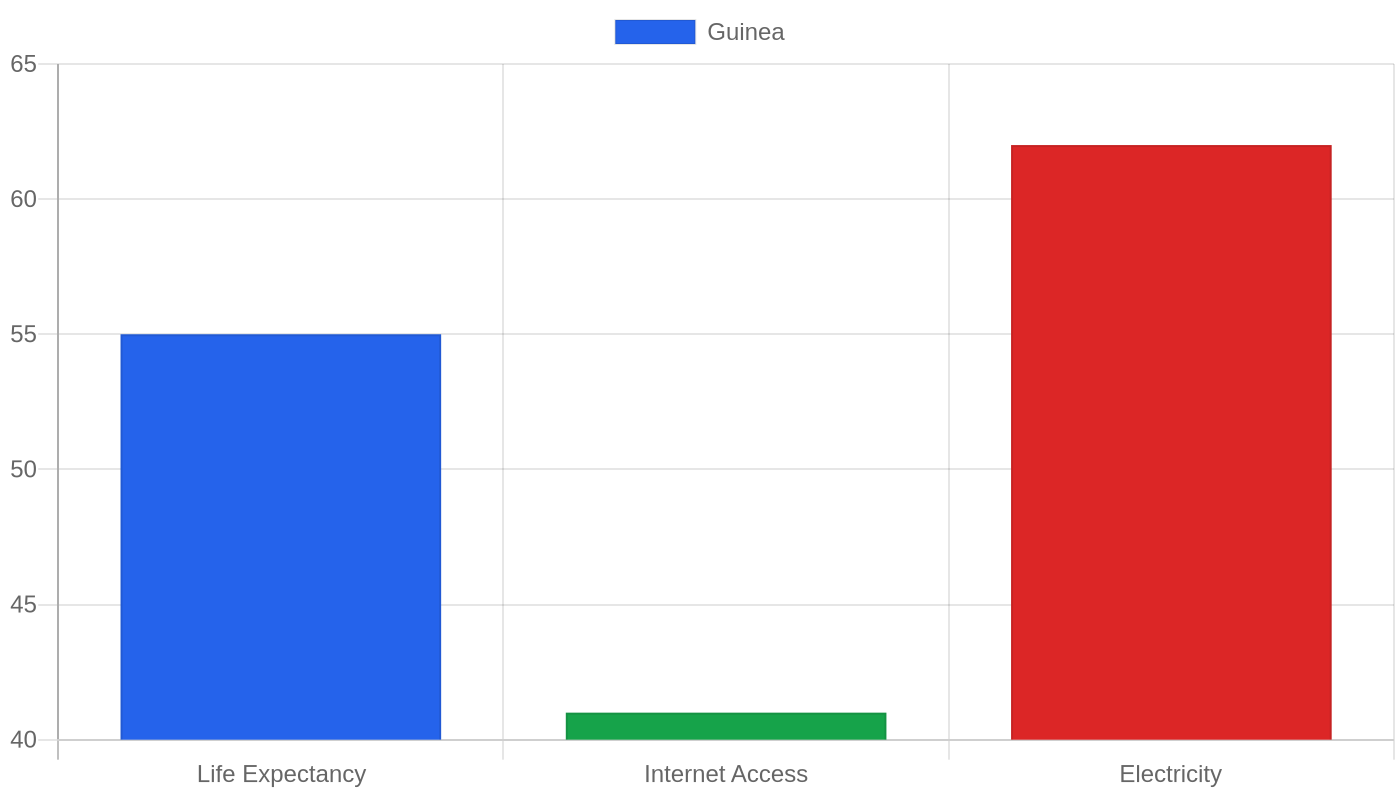
Guinea sits on the world’s largest reserves of bauxite, the raw material for aluminium, yet the World Bank provides no current GDP growth figure, no inflation rate, no unemployment statistic. This absence of data is itself a story. It speaks to a state that, eight years after the 2021 coup, has not restored the basic machinery of economic reporting. The last reliable numbers belong to a pre-coup era that now feels distant.
What we do know is that Guinea’s economy is not diversified. The top companies list reads like a mining directory: Compagnie des Bauxites de Guinée, Compagnie des bauxites de Kindia, Alumina Company of Guinea, and Halco Mining form the backbone of the formal economy. These are not small operations—Guinea’s bauxite feeds global aluminium supply chains from China to Europe. But the wealth generated has historically flowed outward, with limited reinvestment in domestic infrastructure, education, or health.
The industrial list also reveals a curious aviation cluster: Air Guinee Express, Air Guinee International, Air Guinée, Eagle Air, and Guinee Air Service. This suggests either a fragmented attempt at connectivity or a sector in flux. For a country with limited road infrastructure and a challenging geography, air transport is critical. Yet the proliferation of airlines with similar names hints at instability rather than competition.
Without GDP per capita or GNI per capita figures, we cannot benchmark living standards. But the absence itself is telling. In 2026, a country that cannot produce basic national accounts is a country whose citizens likely cannot trust that their government knows—or cares—how they are faring.
The Price of Everything — Cost of Living in a Data Void
The World Bank provides no cost of living data for Guinea. This is not a minor omission. For a country where the majority of the population works in subsistence agriculture or the informal economy, the cost of basic goods—rice, cooking oil, fuel, rent—determines daily survival. Without official indices, families rely on market gossip and memory.
What can be inferred is that Guinea’s economy is highly dollarised in its formal sectors, particularly mining, while the majority of Guineans transact in Guinean francs. This dual-currency reality creates constant volatility. When bauxite prices fall globally, the franc weakens; when they rise, inflation can still spike if the central bank lacks credibility. The lack of CPI data from the World Bank suggests either a breakdown in statistical collection or a reluctance to publish uncomfortable numbers.
Rental costs in Conakry, the capital, are known anecdotally to be high relative to incomes, driven by urban migration and limited housing stock. But without data, any regional comparison to West African peers like Senegal or Côte d’Ivoire would be speculation. What is certain is that Guineans face the same global inflationary pressures as their neighbours, without the same institutional safety nets.
Digging for Dollars — Investment Climate in a Military State
For investors, Guinea is a paradox of opportunity and obstruction. The top companies list confirms that the mining sector is both mature and concentrated. Compagnie des Bauxites de Guinée, a joint venture that includes the Guinean state and international partners, has operated for decades. Alumina Company of Guinea represents the downstream aspiration—processing bauxite into alumina rather than exporting raw ore.
But the business environment is shaped by the political landscape. Since the 2021 coup, Guinea has been governed as a *de facto* military autocracy. The National Assembly, the country’s legislative body, has been dissolved. This means there is no functioning parliament to pass mining codes, tax reforms, or investment guarantees. Contracts signed with the junta carry the risk of being repudiated by a future civilian government—or, conversely, being rewritten.
The presence of Office de la poste guinéenne among the top industrials is a reminder of how underdeveloped the non-mining economy remains. A postal service is a basic state function, not a driver of growth. For investors outside the mining sector—agribusiness, logistics, telecommunications—the challenge is navigating a state that has little capacity or incentive to support diversification.
Power, Politics, and the Price of Stability
The political landscape is the defining feature of modern Guinea. A republic *de jure*, the country has been a military autocracy *de facto* since the 2021 coup. The president, who is both head of state and head of government, is meant to be directly elected. But no credible election has been held since the coup. The judicial branch, headed by the Supreme Court of Guinea, exists on paper but operates under executive pressure.
The World Bank provides no Crime Index or Safety Index for Guinea. This is notable for a country that has experienced political violence, ethnic tensions, and periodic unrest in mining regions. The absence of safety data may reflect the difficulty of collecting it in a state where security forces are often the source of insecurity.
Quality of life in Guinea is shaped by this political uncertainty. Without functioning democratic institutions, citizens cannot hold leaders accountable. Without reliable economic data, they cannot plan for the future. The mining wealth that should fund schools, hospitals, and roads instead finances a security apparatus and a narrow elite. For the average Guinean, the coup did not bring stability—it merely changed the uniforms of those in power.
The Long Wait — Guinea’s Unfinished Transition
The most pressing question in Guinea today is not about GDP growth or inflation—it is about political transition. Since the 2021 coup, the military junta has promised a return to civilian rule, but no concrete timeline has been honoured. The National Assembly remains dissolved. Elections have been postponed. The international community, including the Economic Community of West African States (ECOWAS), has imposed sanctions and demanded a transition calendar, but the junta has shown little urgency.
This political paralysis has direct economic consequences. Without a legitimate government, the World Bank and International Monetary Fund are reluctant to disburse budget support. Foreign investors hesitate to commit capital. The mining sector continues to operate because it is too valuable to stop, but new exploration and processing projects are stalled.
For the people of Guinea, the cost of this delay is measured in lost opportunities. Every month without a civilian government is a month without a budget that could fund teachers, nurses, and roads. Every year without elections is a year in which the country’s vast mineral wealth continues to enrich a few while the many wait.
The Bottom Line
Guinea is a country of extraordinary natural wealth trapped in a cycle of political dysfunction. For commodity traders and mining executives, it remains an essential supplier of bauxite to global markets. For development economists and human rights observers, it is a case study in how resource riches can coexist with state failure. For the average reader, Guinea is a reminder that economic data is not just numbers—it is a measure of a government’s willingness to be held accountable.
Until the junta releases credible statistics and restores democratic institutions, Guinea will remain a country with everything to offer and nothing to show for it.
Sources & Methodology
This article is authored by Economic Pulse Net for informational and research purposes. Economic Pulse Net sources its data from multilateral institutions, national statistics bureaus, and proprietary databases. All data is believed to be current as of the date of publication.
Published: July 30, 2026 | Category: Research — Guinea
Use these signals in your own platform
Economic Pulse publishes its live signal feed through a documented, read-only API. Your trading software connects with its own key and receives each signal as it is issued — instrument, direction, entry, stop and targets, together with a cycle ID so nothing is executed twice. The feed is independent of this website and cannot change it.
Signals are informational only and are not financial advice.