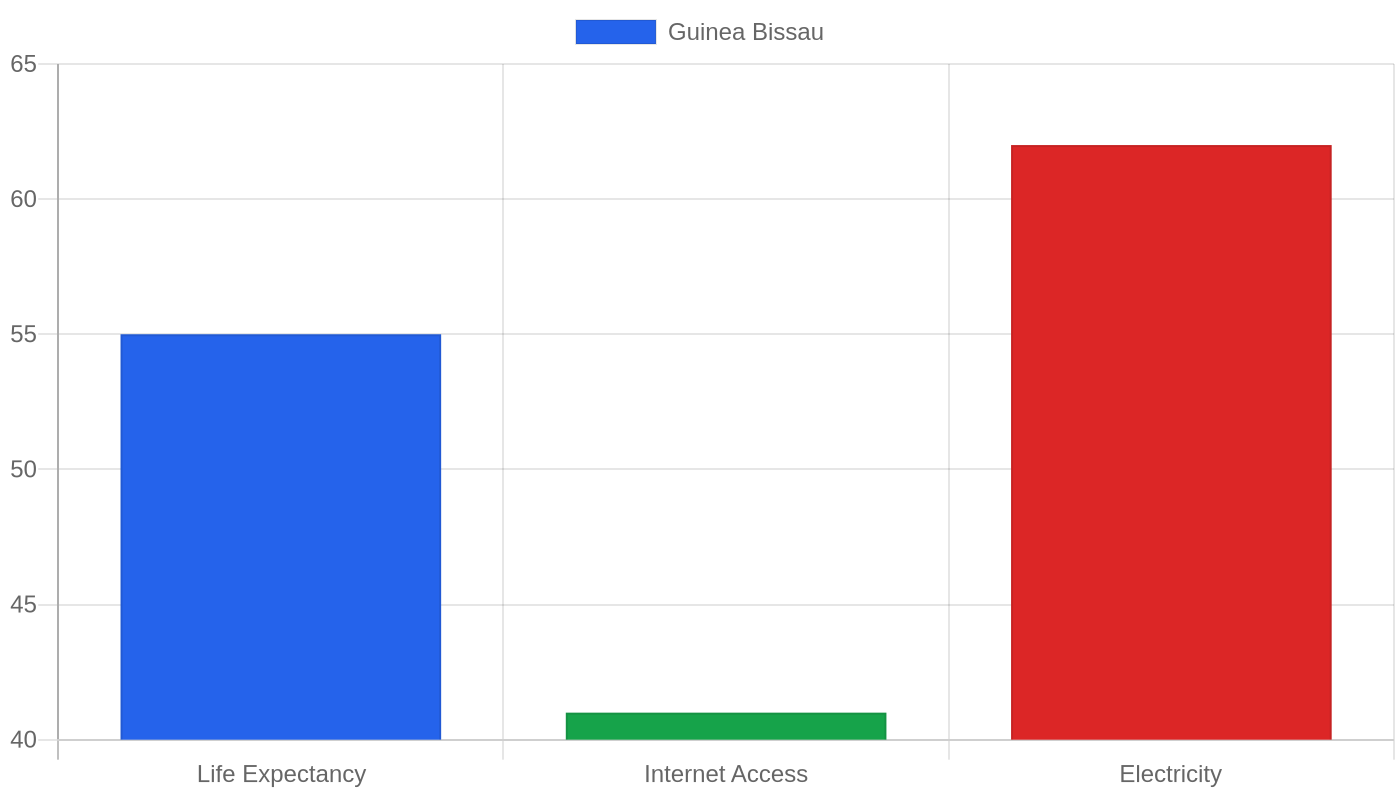
Economic Pulse Net | Sources: World Bank World Development Indicators, Government Sources | 2026
Key Takeaways
* Guinea-Bissau operates under a semi-presidential system where the president serves as head of state and the prime minister leads the government, creating a complex power dynamic.
Political stability remains a critical challenge; historically, no president has successfully completed a full five-year term since independence in 1974.
The last president to serve a full term was Jose Mario Vaz, who concluded his mandate on June 24, 2019, marking a significant but isolated milestone in the nation’s recent political history.
Multi-party governance is a relatively new development, having only been established in mid-1991 after years of centralized government control.
Economic indicators such as GDP growth, inflation, and unemployment are currently unreported by the World Bank, suggesting data gaps that complicate precise economic forecasting.
The Shadow of Instability: A Political Economy Defined by Transition
Guinea-Bissau’s economic trajectory cannot be separated from its deeply entrenched political history. As a republic with a semi-presidential system, the country presents a unique governance structure where power is shared between a president, who acts as the head of state, and a prime minister, who serves as the head of government. This dual executive model was designed to balance authority, yet it has often led to friction rather than cooperation.
For decades following independence in 1974, the government operated under a highly centralized system, limiting political participation and economic diversification. It was not until mid-1991 that multi-party governance was finally established, a pivotal moment that opened the door for democratic reforms but also introduced new layers of political negotiation and potential gridlock.
The fragility of this system is evident in the historical record: from independence until Jose Mario Vaz ended his five-year term as president on June 24, 2019, no president had ever successfully served a full term. This pattern of early departures or interrupted terms suggests a volatile political environment that likely influences investor confidence and long-term planning.
While specific GDP growth figures and inflation rates are currently unavailable from the World Bank, the political narrative indicates an economy that is still maturing its institutional frameworks. The lack of complete economic data underscores the challenges of operating in a market where policy continuity is often disrupted by political turnover.
Understanding Guinea-Bissau requires looking beyond standard macroeconomic metrics to the structural realities of its governance, where the stability of leadership directly impacts the predictability of the business environment.
Daily Realities: Cost of Living and Housing Dynamics
For residents and expatriates alike, understanding the cost of living in Guinea-Bissau involves navigating a landscape where detailed consumer price index (CPI) data is currently missing from major international databases like the World Bank. Without specific inflation percentages or unemployment figures, constructing a precise budget based on regional averages becomes challenging, though general patterns in West African economies suggest that housing and daily expenses can vary significantly depending on location.
In urban centers, rent prices may reflect the scarcity of modern infrastructure, while rural areas might offer lower costs but limited access to goods and services. The absence of reported GDP per capita in Purchasing Power Parity (PPP) terms means that purchasing power comparisons with neighboring countries remain speculative.
However, the historical context of centralized governance implies that market mechanisms for housing and retail may still be developing, potentially leading to inefficiencies or price distortions in certain sectors. Daily expenses, including food and transportation, are likely influenced by import dependencies and local agricultural output, both of which are subject to seasonal variations and logistical hurdles.
Investors and travelers should anticipate that while some basic goods may be affordable, imported items and premium housing options could carry a significant premium due to supply chain constraints. The overall cost of living is therefore best viewed through the lens of accessibility and availability rather than just price points, given the current limitations in comprehensive economic reporting.
Business Environment: Sectors and Corporate Landscape
The investment climate in Guinea-Bissau is characterized by emerging opportunities within a framework that is still solidifying its regulatory foundations. With top companies and specific industry leaders not explicitly listed in the provided data, the business ecosystem appears to be dominated by small to medium-sized enterprises and informal sectors, which are common in developing economies undergoing political transition.
The main industries driving the economy are inferred to include agriculture, fishing, and potentially light manufacturing, although specific sectoral contributions to GDP are not quantified in the current dataset. For foreign investors, the primary risk factor is not necessarily market size but rather the political unpredictability highlighted by the historical inability of presidents to serve full terms.
This political volatility can translate into sudden shifts in policy, regulatory changes, or disruptions in public services, all of which affect operational continuity. The establishment of multi-party governance in 1991 has theoretically improved the rule of law, but the practical implementation of contracts and property rights may still face hurdles. Companies entering this market must prioritize local partnerships and thorough due diligence to navigate the bureaucratic landscape.
Furthermore, the lack of recent unemployment data makes it difficult to assess the labor pool’s size and skill level, adding another layer of complexity to workforce planning. Despite these challenges, the potential for growth exists in sectors that support basic infrastructure and resource processing, provided that investors are prepared for a longer horizon and higher political risk premiums.
Safety, Politics, and Quality of Life Indicators
Quality of life in Guinea-Bissau is shaped by a combination of political stability concerns and safety considerations that require careful monitoring. Current crime and safety indices are reported as N/A, indicating a gap in standardized global security data that makes it difficult to compare the country’s safety profile with other nations in the region.
This lack of data does not imply safety, but rather highlights the need for heightened awareness and localized intelligence when assessing personal security risks. The political landscape, defined by the semi-presidential system and the historical precedent of incomplete presidential terms, adds a layer of uncertainty that can impact social cohesion and public order.
Residents and visitors alike should remain cognizant of the broader political tensions that may arise from the delicate balance of power between the presidency and the prime ministership. Happiness data and subjective well-being metrics are also not available, leaving the quality of life assessment to rely on observable factors such as infrastructure reliability and healthcare access.
The centralization of government in the past has given way to a more pluralistic system, but the transition has been marked by instability, which can have tangible effects on daily life. Ensuring personal safety likely involves avoiding politically sensitive areas during times of unrest and maintaining low profiles in public spaces. Ultimately, the interplay between political volatility and safety creates an environment where vigilance and adaptability are essential for both locals and foreigners.
Current Affairs: The Legacy of Vaz and Future Outlook
The most significant recent political event in Guinea-Bissau remains the conclusion of Jose Mario Vaz’s term as president on June 24, 2019, which stands as a notable exception to the country’s history of interrupted presidencies. Since then, the political narrative has been dominated by the ongoing challenges of maintaining democratic norms within a semi-presidential framework.
The absence of recent news items or live indicators in the provided data suggests that there may not be any immediate, high-profile reforms or elections dominating the headlines at this specific moment. However, the underlying tension between the head of state and the head of government continues to be a focal point for domestic politics. Analysts and observers continue to watch for signs of whether the next administration will follow the path of previous leaders or establish a new precedent of stable governance.
The political landscape remains fluid, with the potential for shifts in power dynamics that could impact economic policies and international relations. Any developments regarding constitutional amendments or electoral reforms would be critical indicators of the country’s direction. Until further data emerges, the focus remains on the resilience of the institutions established after 1991 and their ability to withstand the pressures of political competition.
The legacy of Vaz’s completed term serves as a benchmark, but whether subsequent leaders can replicate this stability is the key question facing the nation.
The Bottom Line
Guinea-Bissau represents a frontier market with significant political risks that outweigh immediate economic rewards for most conventional investors. The country’s semi-presidential system and history of unstable leadership cycles create an environment where policy continuity is rare. Prospective stakeholders should approach Guinea-Bissau with caution, prioritizing political risk mitigation strategies over pure financial returns.
Long-term engagement may be viable for those willing to navigate the complexities of a developing democratic system, but short-term gains are unlikely without substantial improvements in governance and data transparency.
Sources & Methodology
This article is authored by Economic Pulse Net for informational and research purposes. Economic Pulse Net sources its data from multilateral institutions, national statistics bureaus, and proprietary databases. All data is believed to be current as of the date of publication.
Published: October 13, 2026 | Category: Research — Guinea Bissau
Use these signals in your own platform
Economic Pulse publishes its live signal feed through a documented, read-only API. Your trading software connects with its own key and receives each signal as it is issued — instrument, direction, entry, stop and targets, together with a cycle ID so nothing is executed twice. The feed is independent of this website and cannot change it.
Signals are informational only and are not financial advice.