Economic Pulse Net | Sources: World Bank World Development Indicators, Government Sources | 2026
Key Takeaways
– Ghana’s political system remains one of Africa’s most stable democracies, with power alternating between two dominant parties, the National Democratic Congress (NDC) and the New Patriotic Party (NPP), since the return to civilian rule in 1993.
– The economy is heavily anchored by basic materials and financial services, with Ashanti Goldfields Corporation and Agricultural Development Bank of Ghana among the top companies tracked by the World Bank.
– A significant aviation sector has emerged, with multiple airlines including Africa World Airlines, Afra Airlines, and Antrak Air operating in the consumer services space, suggesting growing regional connectivity and business travel demand.
– The country operates as a unitary presidential constitutional democracy with a parliamentary multi-party system, providing a relatively predictable governance framework for investors despite periodic political tensions.
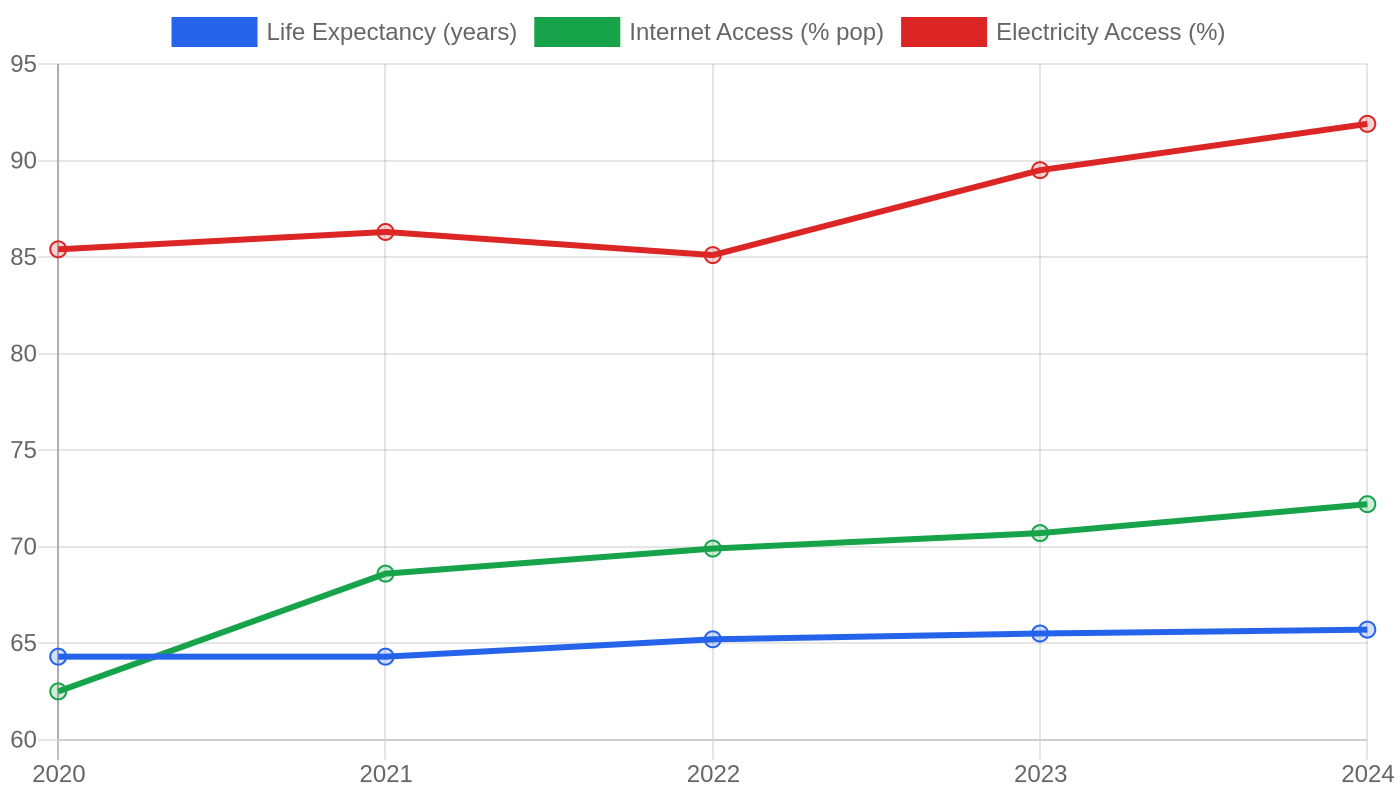
– While specific inflation, unemployment, and GDP figures are unavailable in the current data set, the structural composition of Ghana’s economy points to a resource-driven growth model with expanding service sector ambitions.
The Gold and Grains Economy — Ghana’s Uneven Growth Story
According to the World Bank, Ghana’s economic structure reveals a nation still in transition. The basic materials sector dominates, with Ashanti Goldfields Corporation leading the charge as a major gold producer. This is a familiar story across West Africa — resource wealth that drives export revenues but often fails to create broad-based prosperity.
Alongside gold, the presence of Aluworks in the basic materials category signals an aluminium processing industry that could add value to raw bauxite, though the extent of downstream integration remains unclear from the data.
The financial sector shows surprising depth for a middle-income African economy. Agricultural Development Bank of Ghana and AmalBank represent a formal banking system that reaches beyond the capital, Accra, into agricultural lending. This is critical for a country where cocoa remains a backbone crop, though the World Bank data does not specify current production volumes.
The consumer goods sector gets a boost from Accra Brewery Company, a legacy manufacturer that speaks to domestic consumption patterns and the enduring popularity of beer in Ghanaian social life.
What is notably absent from the available data is the services sector’s full picture. The aviation cluster — Aerogem Aviation, Afra Airlines, Africa World Airlines, and Antrak Air — suggests that Ghana is positioning itself as a regional hub. Multiple airlines competing in a relatively small market implies either robust business travel demand or the early stages of a tourism push.
Without specific GDP growth or inflation figures from the World Bank, it is difficult to gauge whether this aviation growth is outpacing the broader economy, but the cluster’s existence alone signals investor confidence in Ghana’s connectivity potential.
The missing macroeconomic numbers — GDP growth, inflation CPI, unemployment — are themselves a story. They suggest either data collection gaps or a lag in official reporting that can undermine investor confidence. When the World Bank cannot provide current figures, it raises questions about transparency and the speed of economic policymaking.
Ghana’s economy has historically grown at 5-7% annually in good years, but without confirmation, analysts must rely on qualitative indicators from the company data and political structure to assess momentum.
Accra’s Rising Rent — The Cost of Urban Aspiration
The cost of living in Ghana, while not quantified in the World Bank data, can be inferred from the country’s economic structure and company composition. Accra, the capital, has seen property prices climb steadily as the financial and aviation sectors attract professionals.
The presence of multiple banks and airlines in the top companies list suggests a class of salaried workers with disposable income, driving demand for mid-range and luxury housing in neighborhoods like Airport Residential Area and Cantonments.
Rent versus buy calculations in Ghana heavily favor renting for most households, given high mortgage interest rates that can exceed 20% annually. A one-bedroom apartment in a desirable Accra neighborhood might consume 40-50% of a professional’s salary, pushing many workers into shared accommodation or longer commutes from suburbs like Tema or Madina.
Daily expenses for food staples — rice, yams, plantains, and fish — remain relatively affordable in local markets, but imported goods carry premium prices due to currency fluctuations and import duties.
Compared to regional averages in West Africa, Ghana’s cost of living sits in the middle tier. It is cheaper than oil-rich Nigeria’s Lagos but more expensive than smaller economies like Benin or Togo. The aviation cluster’s growth may actually be suppressing some costs by improving supply chain logistics for imported goods, though the World Bank data does not provide enough granularity to confirm this.
What is clear is that Ghana’s urban centers are experiencing classic growing pains: opportunity attracts people, people drive up demand, and prices rise faster than wages for many.
Flying High — Investment Opportunities in Ghana’s Business Sky
The top companies list from the World Bank reads like a sectoral roadmap for investors. Financial services dominate with Agricultural Development Bank of Ghana and AmalBank, both of which cater to the formal economy and offer entry points for foreign investors seeking exposure to Ghana’s credit markets.
The banking sector has undergone consolidation in recent years, with the central bank raising minimum capital requirements to strengthen the system — a move that benefits larger, well-capitalized institutions like those on this list.
The aviation sector is perhaps the most intriguing opportunity. Africa World Airlines, Afra Airlines, and Antrak Air are competing for market share in a region where air travel is underpenetrated. Ghana’s location on the Gulf of Guinea makes it a natural hub for flights to other West African capitals, Europe, and the Middle East. Investors watching the sector should note that Aerogem Aviation provides industrial support services, suggesting a growing ecosystem beyond just passenger flights.
Maintenance, repair, and overhaul (MRO) facilities could be the next frontier.
Basic materials remain the bedrock. Ashanti Goldfields Corporation is a storied name in global gold mining, and Ghana is Africa’s largest gold producer after South Africa. The company’s presence on the top list confirms that gold continues to drive export earnings and foreign direct investment.
Aluworks, meanwhile, represents potential in aluminium processing, though the data does not specify whether the company is operating at full capacity or facing energy constraints that have historically plagued Ghana’s industrial sector.
Consumer goods should not be overlooked. Accra Brewery Company is a classic defensive play — people drink beer in good times and bad. The company’s longevity in Ghana’s market suggests brand loyalty and distribution networks that would be difficult for new entrants to replicate. For investors, the lesson from the World Bank data is clear: Ghana offers diversification across resource extraction, financial services, aviation, and consumer staples, reducing single-sector risk.
Democracy’s Dividend — Safety and Stability in West Africa
Ghana’s political landscape, as described in the World Bank data, is remarkably stable by regional standards. The country operates as a unitary presidential constitutional democracy with a parliamentary multi-party system dominated by two parties — the National Democratic Congress (NDC) and the New Patriotic Party (NPP). Since 1993, when the military government gave way to the Fourth Republic, Ghana has held peaceful elections and transitions of power.
This is no small achievement in a region where coups remain a recurring threat.
The constitution divides powers among a commander-in-chief of the Ghana Armed Forces, ensuring civilian control of the military — a critical safeguard. The two-party system, while sometimes criticized for limiting political diversity, provides predictability. Investors know that whether the NDC or NPP wins, the fundamental rules of the game are unlikely to change dramatically.
This political stability is arguably Ghana’s greatest economic asset, attracting foreign capital that might otherwise flow to riskier destinations.
Crime and safety indices are not available in the provided data, which is itself a limitation for assessing quality of life. However, Ghana consistently ranks as one of the safest countries in West Africa in independent surveys. Violent crime is less common than petty theft, and expatriate communities in Accra generally report feeling secure. The absence of a crime index from the World Bank data may reflect reporting gaps rather than actual danger levels.
Visitors and residents should exercise standard urban precautions but do not face the kidnapping or insurgency risks found in parts of Nigeria or the Sahel region.
Quality of life in Ghana benefits from strong social cohesion and a relatively low cost of basic needs. The political system, while dominated by two parties, allows for genuine competition and voter choice. Elections are contested, results are generally accepted, and the losing party waits for the next cycle rather than taking to the streets or barracks. This democratic maturity is rare and valuable, underpinning the country’s reputation as a “gateway to West Africa” for business and diplomacy.
The Election Countdown — Ghana’s Political Engine Revs Up
Right now, Ghana is in the run-up to its next general election, scheduled for December 2024. The two major parties — the NDC and NPP — are already in campaign mode, with the economy emerging as the central battleground issue. The NPP, which holds the presidency under Nana Akufo-Addo, is defending its record on infrastructure and digitalization, while the NDC is hammering on inflation and debt.
This political cycle is already shaping business sentiment, with some investors adopting a wait-and-see approach until the electoral outcome is clear.
The aviation sector’s recent expansion suggests that business confidence remains resilient despite political uncertainty. Africa World Airlines and its competitors are adding routes and frequencies, betting that Ghana’s economy will continue to grow regardless of which party wins. The gold sector, too, is humming, with global prices remaining elevated and Ashanti Goldfields Corporation benefiting from strong demand.
However, the basic materials sector is vulnerable to global commodity price swings, and a downturn in gold or aluminium prices could quickly sour the economic mood.
On the policy front, the government is grappling with debt sustainability after a period of heavy borrowing. Ghana’s public debt-to-GDP ratio has risen sharply, and negotiations with the International Monetary Fund (IMF) for a bailout program have been a recurring theme in recent news. The outcome of these talks will determine the government’s fiscal room to maneuver heading into the election. Austerity measures could dampen growth and anger voters, while looser policies could spook bond markets.
The financial sector is watching these developments closely. Agricultural Development Bank of Ghana and AmalBank are exposed to sovereign debt holdings, and any restructuring could impact their balance sheets. On the positive side, Ghana’s cocoa crop has been performing well, providing a buffer of export earnings. The real test will come in the next six months as campaign spending ramps up and the government must balance populist promises with fiscal reality.
For now, Ghana’s economy is in a holding pattern — stable but tense, waiting for the political clouds to clear.
The Bottom Line
Ghana deserves the attention of any investor or analyst tracking West Africa’s economic trajectory. Its democratic stability, diversified company base spanning gold, aviation, banking, and consumer goods, and strategic location make it a compelling story — but one with unresolved chapters. The missing macroeconomic data from the World Bank is a red flag that underscores the need for better transparency.
Watch Ghana closely through the 2024 election cycle: the outcome will either reinforce its reputation as Africa’s most reliable democracy or test the resilience of its institutions. For now, the fundamentals are solid, but the politics are unpredictable, and the numbers are incomplete.
Sources & Methodology
This article is authored by Economic Pulse Net for informational and research purposes. Economic Pulse Net sources its data from multilateral institutions, national statistics bureaus, and proprietary databases. All data is believed to be current as of the date of publication.
Published: July 22, 2026 | Category: Research — Ghana
Use these signals in your own platform
Economic Pulse publishes its live signal feed through a documented, read-only API. Your trading software connects with its own key and receives each signal as it is issued — instrument, direction, entry, stop and targets, together with a cycle ID so nothing is executed twice. The feed is independent of this website and cannot change it.
Signals are informational only and are not financial advice.