Economic Pulse Net | Sources: World Bank World Development Indicators, Government Sources | 2026
Key Takeaways
– The Gambia’s post-independence political trajectory has been defined by a single-party dominance followed by military rule, with democratic institutions still in their infancy.
– Despite being one of Africa’s smallest nations, The Gambia’s political stability is critical for West African regional security and economic integration.
– The country’s economic data remains largely opaque, with key indicators from the World Bank unavailable, raising questions about transparency and data collection capacity.
– The 1994 military coup fundamentally reshaped The Gambia’s governance structures, and the legacy of that intervention continues to influence political dynamics today.
– For investors and observers, The Gambia represents a high-risk, high-uncertainty environment where political evolution will determine economic potential.
The Economic Void — When Data Speaks Through Silence
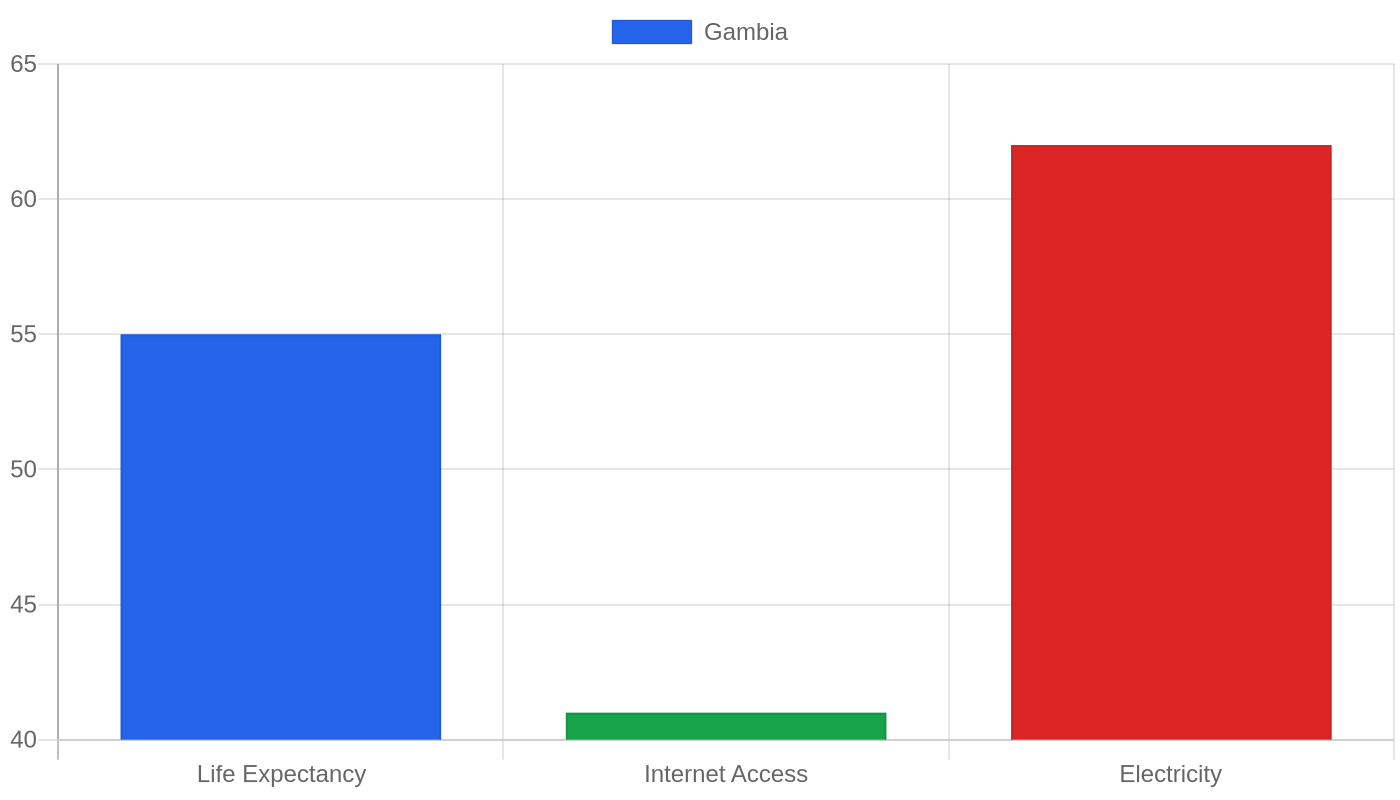
The most striking feature of The Gambia’s economic landscape is what remains unknown. According to the World Bank, fundamental indicators that economists and investors rely upon—GDP growth, inflation rates, unemployment figures, total GDP, GDP per capita, and GNI per capita—are all listed as unavailable. This data vacuum is itself a powerful signal.
It suggests either limited statistical capacity within government institutions or a deliberate lack of transparency that should concern anyone evaluating the country’s economic health.
Without concrete figures, analysts must rely on qualitative assessments. The Gambia’s economy has historically been dominated by agriculture, particularly groundnut production, tourism along its Atlantic coastline, and re-export trade through its port in Banjul. The absence of World Bank data makes it impossible to track whether these sectors are growing, stagnating, or contracting.
For a country that ranks among the world’s least developed nations, this information gap is not merely an academic inconvenience—it hampers effective policymaking, international aid allocation, and private sector investment decisions.
What can be inferred is that The Gambia faces structural challenges common to small, open economies in West Africa: vulnerability to commodity price shocks, dependence on remittances from the diaspora, and exposure to climate change impacts on agriculture. Without reliable data, however, even these assumptions remain speculative.
The World Bank’s inability to provide basic economic metrics should prompt urgent questions for both the Gambian government and international partners about improving statistical infrastructure and governance transparency.
Housing and Daily Life — The Unseen Cost of Living
The cost of living in The Gambia remains largely undocumented by official sources, yet anecdotal evidence and regional comparisons offer some insights. For a nation where the majority of the population works in subsistence agriculture or informal trade, housing costs in urban centers like Banjul and the tourism hub of Serrekunda present significant challenges.
Rent for a modest apartment in these areas likely consumes a substantial portion of household income, while rural housing is often constructed from local materials with minimal formal market transactions.
Daily expenses for basic necessities—food, transportation, healthcare, and education—are shaped by The Gambia’s heavy reliance on imports. The country imports most of its rice, the staple food, as well as fuel, manufactured goods, and construction materials. This import dependency makes Gambian households acutely vulnerable to global price fluctuations and currency movements. The dalasi, The Gambia’s currency, has historically experienced volatility, further squeezing household purchasing power.
Compared to regional averages in West Africa, The Gambia’s small population and limited industrial base likely mean higher prices for imported goods relative to larger economies with more developed port infrastructure. The tourism sector, which brings in foreign currency and seasonal employment, creates a dual economy where prices in tourist areas can be significantly higher than in the interior.
For the average Gambian family, the cost of living represents a daily negotiation between limited cash income and rising expenses, with little formal safety net.
Investment Climate — Promise Amidst Political Uncertainty
The Gambia’s business environment is shaped by its small market size, limited infrastructure, and the political turbulence that has marked its post-independence history. The top companies operating in the country remain unnamed in available data, but the private sector is dominated by small and medium enterprises in trade, agriculture, and tourism.
Foreign investment has historically been concentrated in tourism-related real estate, telecommunications, and banking, with European and regional West African investors playing significant roles.
Sectors with potential include agribusiness, particularly horticulture and fisheries, where The Gambia has natural advantages. The country’s location along the Gambia River offers irrigation possibilities that remain underdeveloped. Renewable energy presents another opportunity, as The Gambia has abundant solar resources and struggles with unreliable electricity supply that hampers industrial development. However, the political landscape creates significant risk.
The 1994 military coup and subsequent decades of authoritarian rule under Yahya Jammeh damaged investor confidence, and the transition to democracy under President Adama Barrow since 2016 has been uneven.
For investors considering The Gambia, the key questions center on political stability, rule of law, and contract enforcement. The country’s legal framework, inherited from British colonial administration, provides a theoretical basis for property rights and commercial dispute resolution. In practice, however, the capacity of the judicial system and the independence of regulatory bodies remain concerns.
The small size of the economy means that even modest investment can have outsized impact, but it also means limited diversification and higher vulnerability to political shocks.
Safety, Politics, and the Shadow of 1994
The Gambia’s political landscape is defined by a single transformative event: the military coup of 1994. According to historical records, from independence in 1965 until 1994, the country operated as a multi-party liberal democracy under Sir Dawda Jawara and his People’s Progressive Party. Yet this democracy was never tested by genuine political turnover.
The 1994 coup, executed by the Armed Forces Provisional Ruling Council, shattered the veneer of democratic stability and installed a military regime that would rule for over two decades.
The legacy of this coup continues to shape Gambian politics. The country has since transitioned to civilian rule, but democratic institutions remain fragile. The crime and safety indices are listed as unavailable, which itself speaks to the challenges of governance and public security monitoring.
For a small country with limited police resources and a history of state security forces being used for political purposes rather than public protection, safety is likely uneven—relatively secure in tourist areas and urban centers, but vulnerable to petty crime and occasional political violence.
Quality of life in The Gambia is inextricably linked to political stability. The country has avoided the civil wars that have devastated neighbors like Sierra Leone and Liberia, but it has not been immune to political repression, human rights abuses, and economic mismanagement under military rule. The current political transition, while hopeful, remains incomplete.
The Gambia’s small size means that political developments in Banjul reverberate quickly throughout the country, and the absence of strong independent institutions leaves citizens vulnerable to shifts in executive power.
Current Affairs — Democracy’s Unfinished Business
The Gambia today stands at a critical juncture in its political evolution. The military coup of 1994 remains the defining event of modern Gambian history, and the country is still grappling with its consequences. The transition from military rule to elected government has not been smooth, and the institutions necessary for democratic consolidation—independent judiciary, free press, professional civil service, and robust political parties—remain works in progress.
President Adama Barrow’s government faces the challenge of reconciling a nation still divided by the legacy of Yahya Jammeh’s authoritarian rule. Truth and reconciliation processes have been initiated, but their impact on national healing and institutional reform is uncertain. The economy, lacking reliable data from the World Bank, operates in a fog of uncertainty that hampers both domestic policymaking and international engagement.
For the international community, The Gambia represents both an opportunity and a cautionary tale. Its small size and strategic location make it a potential success story for democratic transition in West Africa. Yet the absence of basic economic data, the unresolved legacies of military rule, and the fragility of democratic institutions suggest that the path forward will be long and uncertain.
The Gambia’s ability to complete its democratic transition, establish transparent governance, and generate reliable economic data will determine whether it can attract the investment and development assistance needed to improve living standards for its people.
The Bottom Line
The Gambia is a country for patient observers and long-term investors who understand that political transformation is a generational project. The data gaps from the World Bank should be seen not as an inconvenience but as a symptom of deeper governance challenges that must be addressed before meaningful economic development can occur.
For those interested in West African political evolution, democratization, and post-conflict reconstruction, The Gambia offers a compact case study of the difficulties small nations face in building stable, transparent institutions. The potential exists—in agriculture, tourism, and renewable energy—but realizing it requires political stability, institutional reform, and a commitment to data transparency that has yet to be fully demonstrated.
Sources & Methodology
This article is authored by Economic Pulse Net for informational and research purposes. Economic Pulse Net sources its data from multilateral institutions, national statistics bureaus, and proprietary databases. All data is believed to be current as of the date of publication.
Published: July 20, 2026 | Category: Research — Gambia
Use these signals in your own platform
Economic Pulse publishes its live signal feed through a documented, read-only API. Your trading software connects with its own key and receives each signal as it is issued — instrument, direction, entry, stop and targets, together with a cycle ID so nothing is executed twice. The feed is independent of this website and cannot change it.
Signals are informational only and are not financial advice.