Economic Pulse Net | Sources: World Bank World Development Indicators, Government Sources | 2026
🇬🇲 The Gambia 2026 — Navigating Post-Transition Stability and Economic Ambiguity
Key Takeaways
* Political Transition: The nation is navigating a complex political landscape that has shifted from decades of single-party dominance to military rule, marking a significant break from its post-independence democratic trajectory.
Data Deficit: Comprehensive macroeconomic indicators such as GDP growth, inflation rates, and unemployment figures are currently unavailable, presenting a challenge for precise economic forecasting.
Historical Context: Since gaining independence in 1965, the country has experienced long periods of political continuity under Sir Dawda Jawara before a pivotal military coup in 1994 altered its governance structure.
Investment Caution: With limited data on top companies and cost of living metrics, potential investors must proceed with heightened due diligence and reliance on qualitative assessments rather than quantitative benchmarks.
From Colony to Coup: A Political Economy in Flux
The economic narrative of The Gambia cannot be separated from its turbulent political history, which has fundamentally shaped its institutional framework. Following independence from the United Kingdom on February 18, 1965, the country ostensibly operated as a multi-party liberal democracy. For nearly three decades, Sir Dawda Jawara and his People’s Progressive Party (PPP) maintained control, creating an environment of political continuity.
However, this period was characterized by a lack of genuine political turnover; despite the formal existence of multiple parties, the commitment to succession by the ballot box was never truly tested, leaving the democratic institutions fragile and unproven. This era of stability, while peaceful, failed to establish robust mechanisms for accountability or competitive governance.
The status quo was violently interrupted in 1994 when a military coup propelled a commission of military officers to power, known as the Armed Forces Provisional Ruling Council. This event marked a definitive end to the civilian-led political order and introduced a new era of military oversight, complicating the development of consistent economic policies and international investor confidence.
Understanding this shift is crucial, as political instability often correlates with regulatory unpredictability and shifts in fiscal policy priorities.
The Blind Spot in Macroeconomic Data
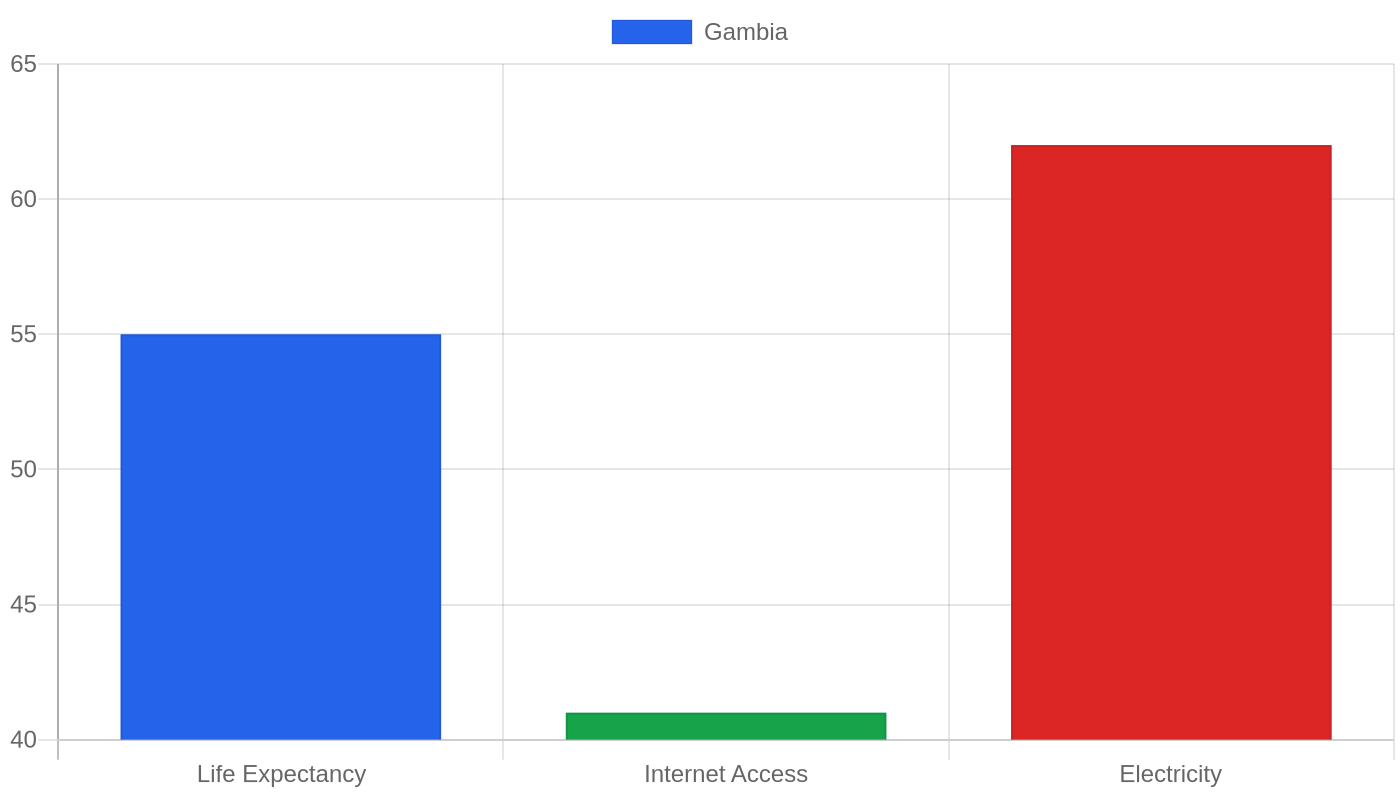
For economic journalists and analysts, the current data landscape regarding The Gambia presents a significant challenge. According to the latest World Bank records, critical macroeconomic indicators including GDP growth, inflation CPI, and unemployment rates are listed as N/A. Similarly, core metrics such as total GDP in USD, GDP per capita based on purchasing power parity (PPP), and Gross National Income (GNI) per capita are not available.
This absence of hard data creates a “blind spot” for external observers trying to gauge the health of the economy. Without these figures, it is impossible to determine whether the economy is expanding or contracting, or how price levels are affecting household purchasing power. The lack of population data further complicates per-capita calculations, making it difficult to assess individual welfare standards relative to regional peers.
This data gap suggests either a delay in statistical reporting or structural issues in national data collection systems. Consequently, any assessment of economic performance must rely on qualitative indicators and anecdotal evidence rather than rigorous statistical analysis.
Cost of Living and Housing Market Uncertainties
The daily economic experience for residents and expatriates alike is shrouded in uncertainty due to missing cost-of-living indices. There is no available data on general living expenses, housing costs, or the comparative ratio between renting and buying property. In markets where such data is present, housing affordability is often a key driver of disposable income and quality of life; however, in The Gambia, this variable remains unquantified.
Without baseline figures for rent or real estate prices, it is difficult to infer how urbanization or infrastructure development might be impacting local markets. Furthermore, the absence of crime and safety indices—both the Crime Index and Safety Index are listed as N/A—adds another layer of complexity to assessing livability.
Safety concerns typically influence insurance costs, security expenditures, and overall business operations, but without these metrics, stakeholders must rely on localized reports rather than standardized scores. This lack of transparency makes it challenging for families or businesses to plan long-term financial commitments, as the true cost of maintaining a standard of living remains opaque.
Business Environment and Corporate Landscape
The corporate sector in The Gambia appears to operate within a context of limited public disclosure. Information regarding the top companies driving the economy is currently unavailable, leaving the private sector’s structure largely invisible to outside observers. Typically, identifying leading firms helps investors understand which sectors are dominant, whether they are state-owned or privately held, and their exposure to global supply chains.
The main industries list is also empty, preventing a clear view of the country’s productive base. Is the economy reliant on agriculture, tourism, services, or manufacturing? Without knowing the primary industrial drivers, it is difficult to predict which sectors might offer the highest returns or face the greatest risks. The business climate, therefore, seems defined by opacity.
Potential investors would need to conduct extensive ground-level research to identify viable partners and opportunities, as there are no readily accessible rankings or industry reports to guide decision-making. This environment favors those with strong local networks and on-the-ground presence over those relying solely on remote data analysis.
Current Affairs and Future Outlook
As The Gambia moves forward from its military transition, the focus is likely shifting toward re-establishing diplomatic ties and rebuilding institutional trust. The historical pivot point of the 1994 Armed Forces Provisional Ruling Council serves as a reminder of the fragility of political norms. Recent developments, while not detailed in specific news feeds here, generally involve efforts to normalize governance and attract foreign aid and investment after periods of isolation.
The lack of recent news items in the provided data suggests a quiet period, or perhaps a lack of major disruptive events being reported in standard international feeds. However, the underlying tension between military legacy and democratic aspirations continues to shape policy decisions. Any future reforms will need to address the historical deficit in democratic accountability established during the Jawara era and managed through the subsequent military interregnum.
Stakeholders should watch for signals of constitutional changes or electoral preparations, as these will be the primary drivers of economic stability. Until clearer data emerges, the narrative remains one of cautious observation, waiting for the next phase of political consolidation to reveal its economic implications.
The Bottom Line
The Gambia presents a case study in the challenges of investing in emerging markets with incomplete data infrastructures. While the political history offers lessons on resilience and change, the current lack of GDP, inflation, and corporate data makes traditional financial analysis impossible. Investors and researchers should approach this market with extreme caution, prioritizing direct engagement and local expertise over published statistics.
The country’s future economic trajectory will depend heavily on its ability to improve data transparency and stabilize its political institutions following its complex post-coup evolution.
Sources & Methodology
This article is authored by Economic Pulse Net for informational and research purposes. Economic Pulse Net sources its data from multilateral institutions, national statistics bureaus, and proprietary databases. All data is believed to be current as of the date of publication.
Published: October 05, 2026 | Category: Research — Gambia
Use these signals in your own platform
Economic Pulse publishes its live signal feed through a documented, read-only API. Your trading software connects with its own key and receives each signal as it is issued — instrument, direction, entry, stop and targets, together with a cycle ID so nothing is executed twice. The feed is independent of this website and cannot change it.
Signals are informational only and are not financial advice.