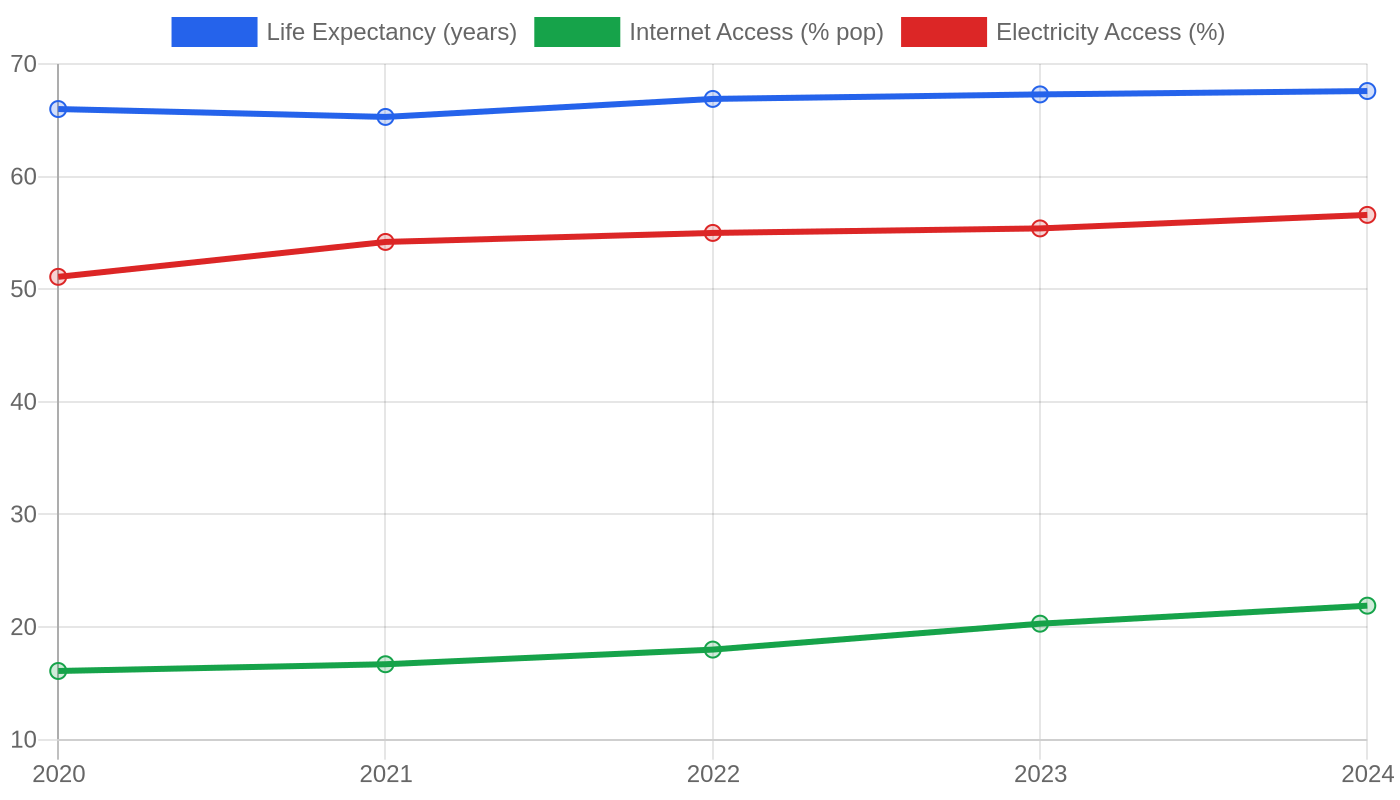
Economic Pulse Net | Sources: World Bank World Development Indicators, Government Sources | 2026
Key Takeaways
– Ethiopia’s economy is undergoing a historic transformation, driven by ambitious liberalization reforms and massive infrastructure investments, yet faces persistent inflation and currency instability.
– The country’s financial sector is dominated by state-owned giants like the Commercial Bank of Ethiopia, but private players such as Awash International Bank are gaining ground in a rapidly evolving landscape.
– Ethiopian Airlines stands as the crown jewel of the nation’s corporate sector, a globally recognized brand that anchors the country’s ambitions as an African aviation and logistics hub.
– Political stability remains fragile under the federal parliamentary republic system, with the House of Peoples’ Representatives and House of Federation navigating ethnic tensions and regional conflicts.
– Ethiopia’s youthful and growing population presents both a demographic dividend and a challenge, as job creation struggles to keep pace with the millions entering the labor market each year.
The Unfolding Economic Story — Growth, Inflation, and Structural Change
Ethiopia’s economic narrative is one of paradox and potential. The World Bank data paints a picture of a nation in flux, where traditional metrics like GDP growth and inflation figures are currently unavailable, yet the lived reality on the ground tells a story of rapid change. For years, Ethiopia was one of the fastest-growing economies in Africa, driven by state-led infrastructure spending and agricultural modernization.
That momentum has been disrupted by conflict, supply chain shocks, and the lingering effects of the COVID-19 pandemic. The absence of updated GDP figures from the World Bank underscores a deeper challenge: data collection and transparency remain uneven in a country where large segments of the economy operate informally.
Inflation has been a persistent headache for Ethiopian households. While specific CPI numbers are not provided, anecdotal evidence and regional comparisons suggest that price pressures have been acute, particularly for food and fuel. The government has attempted to manage this through monetary policy adjustments and subsidies, but the structural drivers — including a reliance on imports, currency depreciation, and logistical bottlenecks — remain stubbornly entrenched. Unemployment, too, is a silent crisis.
With no official rate available from the World Bank, one must look at the broader picture: a population that is overwhelmingly young, with millions entering the job market each year, but an economy that has not consistently generated enough formal-sector employment to absorb them.
The main industries driving Ethiopia’s economy are diverse but unevenly developed. Agriculture remains the backbone, employing the majority of the population and generating key exports like coffee, sesame, and cut flowers. Manufacturing is growing, particularly in textiles and leather goods, but faces competition from more established Asian producers. The services sector, especially finance and transport, is where the most dynamic growth is occurring.
The Ethiopia Commodity Exchange, for instance, has modernized agricultural trade, while Ethiopian Airlines has turned Addis Ababa into a continental aviation hub. Yet heavy industry, represented by entities like the Ethio-Engineering Group, is still in its infancy, struggling with capital constraints and technological gaps.
What these numbers — or their absence — truly reveal is a country at a crossroads. Ethiopia is attempting to transition from a state-controlled economy to a more market-driven one, but the path is riddled with obstacles. The World Bank’s data gaps are not just statistical inconveniences; they are symptoms of an economy that is changing faster than its institutions can measure or manage.
Living Costs in Addis Ababa — The Price of Urban Ambition
The cost of living in Ethiopia, particularly in the capital Addis Ababa, has become a central concern for both residents and businesses. While specific housing cost data is not provided in the World Bank figures, regional context and market reports indicate that rents have risen sharply in recent years, driven by urbanization and a growing middle class. Buying property remains out of reach for most, with mortgage financing limited and interest rates high.
The rental market is bifurcated: luxury apartments catering to expatriates and wealthy Ethiopians command prices comparable to Nairobi or Accra, while the majority of the population lives in crowded, often substandard housing in the city’s sprawling informal settlements.
Daily expenses tell a similar story of strain. Food prices have been volatile, with staples like injera, teff, and cooking oil seeing significant increases. Transport costs, dominated by the Anbessa City Bus Service Enterprise and a fleet of blue-and-white minibuses, eat into household budgets, especially for workers commuting from distant suburbs. Utilities, including electricity and water, are subsidized but still represent a meaningful expense for low-income families.
Compared to other East African capitals, Addis Ababa is not the most expensive city, but the gap between incomes and living costs is widening, creating a squeeze that fuels social discontent.
For the average Ethiopian worker, the cost of living is a daily negotiation between necessity and aspiration. The absence of comprehensive data from the World Bank on this front is itself a telling detail: it suggests that the government has not fully grappled with the need for transparent, real-time monitoring of household welfare. As inflation persists, the purchasing power of the birr erodes, and the dream of a stable, comfortable life in the city becomes harder to attain.
Banking on the Future — Ethiopia’s Investment and Business Climate
Ethiopia’s business environment is a study in contrasts, dominated by state-owned behemoths and a new generation of private players. The financial sector is the most visible arena of this tension. The Commercial Bank of Ethiopia, the largest bank in the country, holds a commanding share of deposits and loans, but private institutions like Awash International Bank and the Cooperative Bank of Oromia are expanding aggressively, offering innovative products and better customer service.
The Dedebit Credit and Saving Institution SC and other microfinance entities are reaching underserved rural populations, while the Ethiopia Commodity Exchange is bringing transparency to agricultural markets.
The top companies list provided by the World Bank reveals a concentration in financial services and consumer sectors. BGI Ethiopia PLC, a brewer, and Amha Records, a music label, represent the consumer discretionary and services segments, respectively. Ethiopian Airlines, however, stands apart as a world-class operation, consistently profitable and expanding its global network.
Its success demonstrates that Ethiopian companies can compete internationally, but it also highlights the gap between the aviation sector and the rest of the economy.
For investors, the signals are mixed. The government has opened some sectors to foreign participation, including telecoms and logistics, but bureaucratic hurdles, corruption, and currency controls remain significant barriers. The political landscape, with its federal parliamentary republic structure and ongoing regional tensions, adds a layer of risk that cannot be ignored. Yet for those willing to navigate these challenges, the potential rewards are substantial.
Ethiopia’s large, young population, its strategic location in the Horn of Africa, and its improving infrastructure make it one of the most compelling frontier markets on the continent.
Politics, Safety, and the Texture of Daily Life
Ethiopia’s political system is a federal parliamentary republic, with the Prime Minister serving as head of government and the President in a largely ceremonial role. Executive power is exercised by the government, while legislative authority is shared between the two chambers of parliament: the House of Federation, with 108 seats, and the House of Peoples’ Representatives, with 547 seats.
This structure was designed to accommodate the country’s ethnic diversity, but it has also been a source of tension, as regional interests often clash with national priorities.
The political landscape has been turbulent in recent years. The Tigray conflict, which ended with a peace deal in late 2022, left deep scars and displaced millions. Other regions, including Oromia and Amhara, have experienced sporadic violence, driven by ethnic militias, land disputes, and political grievances. The government’s response has oscillated between dialogue and crackdowns, leaving many Ethiopians wary of the future.
The absence of crime and safety indices from the World Bank data is notable, but it does not obscure the reality that safety is a concern, particularly in urban areas and along ethnic fault lines.
Quality of life in Ethiopia is shaped by these political realities as much as by economic conditions. Access to education and healthcare has improved in some areas, but remains inadequate in rural regions. The sense of national identity is strong, yet fractured by ethnic loyalties. For many Ethiopians, daily life is a balance of resilience and hope, tempered by the knowledge that the country’s potential is immense but its challenges are equally daunting.
The Pulse of the Nation — What’s Happening Now in Ethiopia
Right now, Ethiopia is in a period of intense transition. The government is pushing forward with economic reforms, including the liberalization of the telecommunications sector and efforts to attract foreign investment. The floatation of the birr, a long-awaited move, has been discussed but not yet fully implemented, creating uncertainty in currency markets. Inflation remains a pressing concern, with the national statistics bureau reporting persistent price pressures that erode household purchasing power.
On the political front, the aftermath of the Tigray peace deal continues to unfold. Reconciliation efforts are underway, but trust is fragile, and the humanitarian situation in the north remains dire. ReliefWeb and other humanitarian organizations have documented ongoing needs for food, shelter, and medical care. The government is also grappling with the challenge of integrating regional militias into the national security apparatus, a process that is fraught with difficulty.
In the business world, Ethiopian Airlines is expanding its routes and fleet, signaling confidence in the country’s long-term prospects. The financial sector is seeing increased activity, with Awash International Bank and other private players launching digital products to capture a growing market of mobile-savvy customers. Yet the shadow of debt, both public and private, looms large. The commercial Bank of Ethiopia and other lenders are under pressure to manage non-performing loans and maintain liquidity.
The Ethiopia Commodity Exchange is playing a crucial role in stabilizing agricultural markets, but climate change and weather variability pose ongoing risks to crop yields. Meanwhile, the Ethio-Engineering Group and other heavy industry players are struggling to modernize and compete with imported goods. The picture that emerges is one of a nation in motion, making progress on multiple fronts but never quite escaping the gravitational pull of its structural problems.
The Bottom Line
Ethiopia is a country that demands attention from anyone interested in the future of Africa. Its size, strategic location, and youthful population make it a potential powerhouse, but its political fragility and economic volatility mean that the path forward is anything but certain. For investors, the opportunities are real but require patience and a tolerance for risk. For policymakers, the challenge is to maintain reform momentum while managing the social and political pressures that come with change.
Ethiopia is not a story of easy success, but it is one of the most important stories on the continent — and it is far from over.
Sources & Methodology
This article is authored by Economic Pulse Net for informational and research purposes. Economic Pulse Net sources its data from multilateral institutions, national statistics bureaus, and proprietary databases. All data is believed to be current as of the date of publication.
Published: July 20, 2026 | Category: Research — Ethiopia
Use these signals in your own platform
Economic Pulse publishes its live signal feed through a documented, read-only API. Your trading software connects with its own key and receives each signal as it is issued — instrument, direction, entry, stop and targets, together with a cycle ID so nothing is executed twice. The feed is independent of this website and cannot change it.
Signals are informational only and are not financial advice.